Moreau Violaine, Fleury Cécile, Piquer Dominique, Nguyen Christophe, Novali Nicolas, Villard Sylvie, Laune Daniel, Granier Claude, Molina Franck
CNRS FRE 3009, SysDiag, CAP DELTA, 1682 Rue de la Valsière, CS 61003, 34184 Montpellier Cedex 4, France.
BMC Bioinformatics. 2008 Jan 30;9:71. doi: 10.1186/1471-2105-9-71.
Most methods available to predict protein epitopes are sequence based. There is a need for methods using 3D information for prediction of discontinuous epitopes and derived immunogenic peptides.
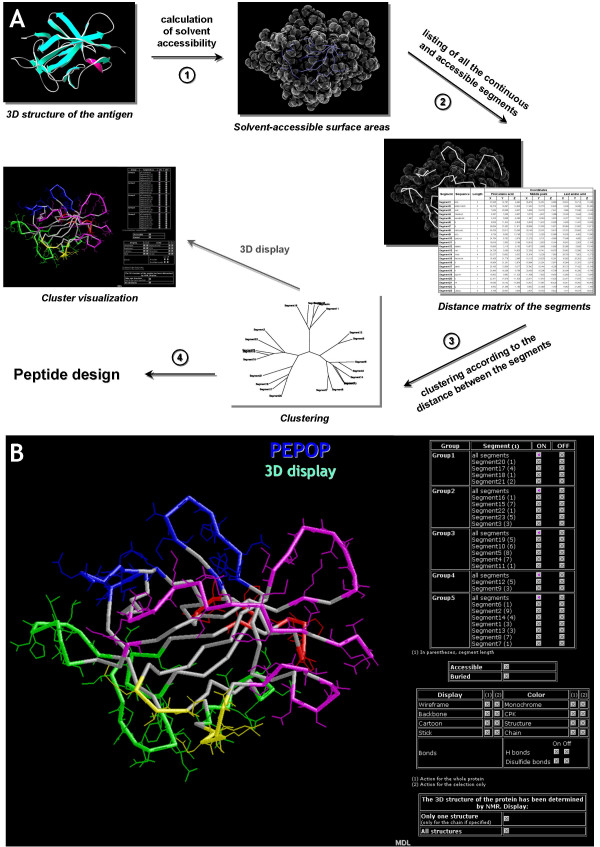
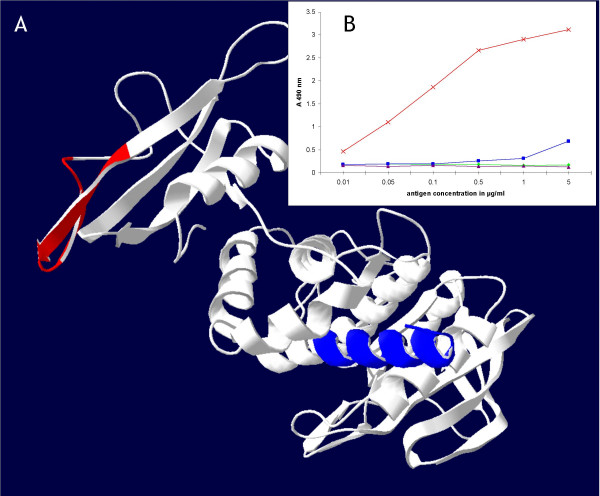
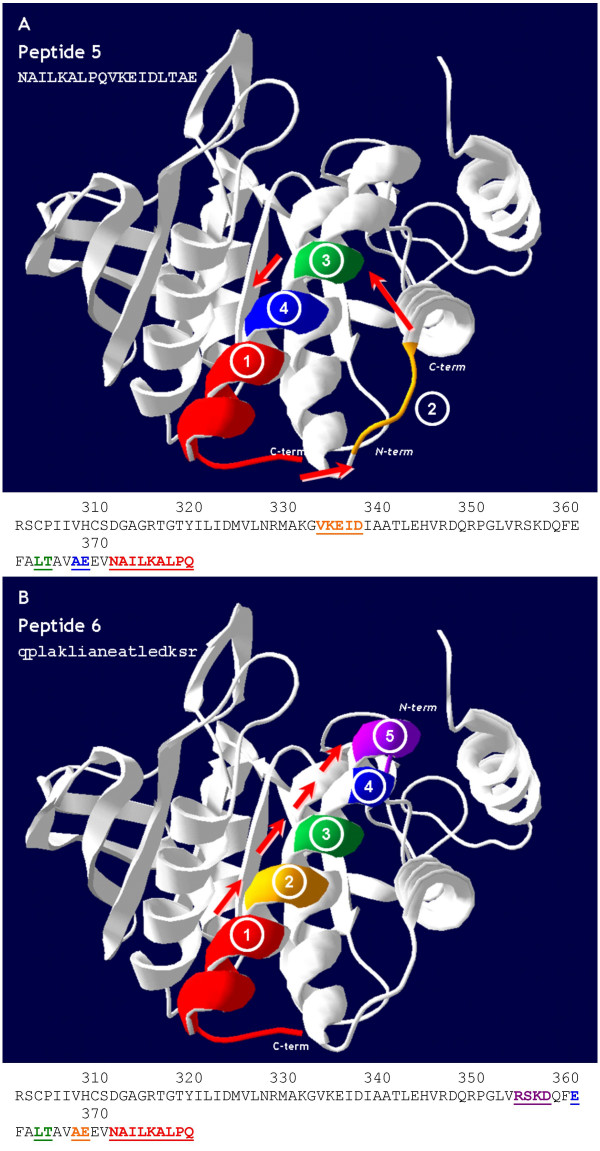
PEPOP uses the 3D coordinates of a protein both to predict clusters of surface accessible segments that might correspond to epitopes and to design peptides to be used to raise antibodies that target the cognate antigen at specific sites. To verify the ability of PEPOP to identify epitopes, 13 crystallographically defined epitopes were compared with PEPOP clusters: specificity ranged from 0.75 to 1.00, sensitivity from 0.33 to 1.00, and the positive predictive value from 0.19 to 0.89. Comparison of these results with those obtained with two other prediction algorithms showed comparable specificity and slightly better sensitivity and PPV. To prove the capacity of PEPOP to predict immunogenic peptides that induce protein cross-reactive antibodies, several peptides were designed from the 3D structure of model antigens (IA-2, TPO, and IL8) and chemically synthesized. The reactivity of the resulting anti-peptides antibodies with the cognate antigens was measured. In 80% of the cases (four out of five peptides), the flanking protein sequence process (sequence-based) of PEPOP successfully proposed peptides that elicited antibodies cross-reacting with the parent proteins. Polyclonal antibodies raised against peptides designed from amino acids which are spatially close in the protein, but separated in the sequence, could also be obtained, although they were much less reactive. The capacity of PEPOP to design immunogenic peptides that induce antibodies suitable for a sandwich capture assay was also demonstrated.
PEPOP has the potential to guide experimentalists that want to localize an epitope or design immunogenic peptides for raising antibodies which target proteins at specific sites. More successful predictions of immunogenic peptides were obtained when a peptide was continuous as compared with peptides corresponding to discontinuous epitopes. PEPOP is available for use at http://diagtools.sysdiag.cnrs.fr/PEPOP/.
大多数现有的预测蛋白质表位的方法都是基于序列的。需要利用三维信息来预测不连续表位和衍生免疫原性肽的方法。
PEPOP利用蛋白质的三维坐标来预测可能对应表位的表面可及片段簇,并设计用于产生靶向同源抗原特定位点抗体的肽。为了验证PEPOP识别表位的能力,将13个晶体学定义的表位与PEPOP簇进行了比较:特异性范围为0.75至1.00,敏感性范围为0.33至1.00,阳性预测值范围为0.19至0.89。将这些结果与另外两种预测算法的结果进行比较,显示出相当的特异性以及略高的敏感性和阳性预测值。为了证明PEPOP预测诱导蛋白质交叉反应抗体的免疫原性肽的能力,从模型抗原(IA-2、TPO和IL8)的三维结构设计了几种肽并进行化学合成。测量了所得抗肽抗体与同源抗原的反应性。在80%的情况下(五个肽中的四个),PEPOP的侧翼蛋白质序列处理(基于序列)成功地提出了能引发与亲本蛋白质交叉反应抗体的肽。针对由在蛋白质中空间上接近但在序列中分开的氨基酸设计的肽产生的多克隆抗体也能够获得,尽管其反应性要低得多。还证明了PEPOP设计适合夹心捕获测定的诱导抗体的免疫原性肽的能力。
PEPOP有潜力指导想要定位表位或设计用于产生靶向蛋白质特定位点抗体的免疫原性肽的实验人员。与对应于不连续表位的肽相比,当肽是连续的时候,能获得更成功的免疫原性肽预测。可通过http://diagtools.sysdiag.cnrs.fr/PEPOP/使用PEPOP。