Wee Christina C, Davis Roger B, Hamel Mary Beth
Division of General Medicine and Primary Care, Department of Medicine, Beth Israel Deaconess Medical Center, Harvard Medical School, Boston, Massachusetts, USA.
Health Qual Life Outcomes. 2008 Jan 30;6:11. doi: 10.1186/1477-7525-6-11.
To assess how well the SF-36, a well-validated generic quality of life (QOL) instrument, compares with its shorter adaptation, the SF-12, in capturing differences in QOL among patients with and without obesity.
We compared the correlation between the physical (PCS) and mental (MCS) component summary measures of the SF-12 and SF-36 among 356 primary care patients using Pearson coefficients (r) and conducted linear regression models to see how these summary measures captures the variation across BMI. We used model R2 to assess qualitatively how well each measure explained the variation across BMI.
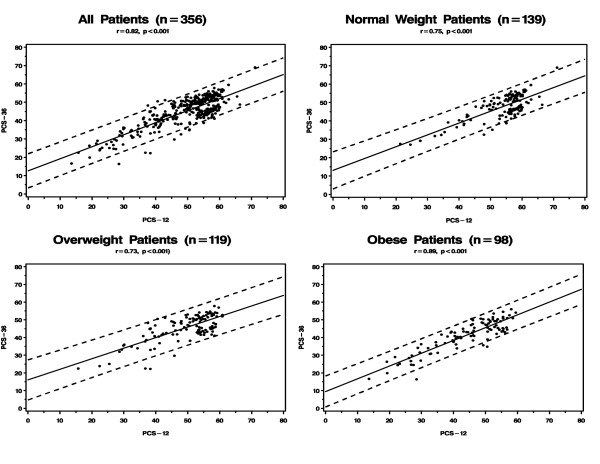
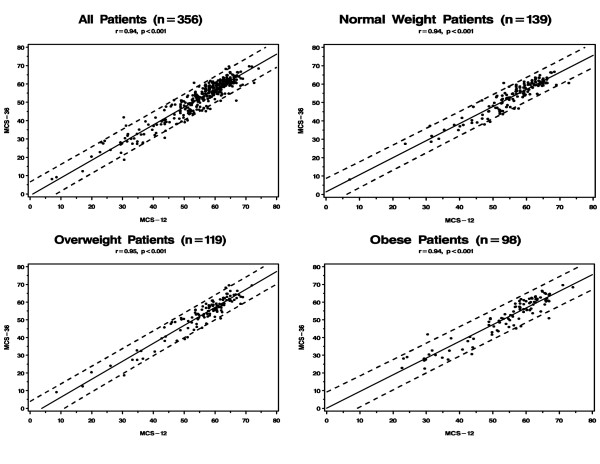
Correlations between SF-12 and SF-36 were higher for the PCS in obese (r = 0.89) compared to overweight (r = 0.73) and normal weight patients (r = 0.75), p < 0.001, but were similar for the MCS across BMI. Compared to normal weight patients, obese patients scored 8.8 points lower on the PCS-12 and 5.7 points lower on the PCS-36 after adjustment for age, sex, and race; the model R2 was higher with PCS-12 (R2 = 0.22) than with PCS-36 (R2 = 0.16). BMI was not significantly associated with either the MCS-12 or MCS-36.
The SF-12 correlated highly with SF-36 in obese and non-obese patients and appeared to be a better measure of differences in QOL associated with BMI.
评估经过充分验证的通用生活质量(QOL)工具SF-36与其较短版本SF-12在捕捉肥胖患者与非肥胖患者生活质量差异方面的比较情况。
我们使用Pearson系数(r)比较了356名初级保健患者中SF-12和SF-36的身体(PCS)和心理(MCS)成分总结测量之间的相关性,并进行线性回归模型以观察这些总结测量如何捕捉BMI的变化。我们使用模型R2定性评估每个测量在解释BMI变化方面的效果。
与超重患者(r = 0.73)和正常体重患者(r = 0.75)相比,肥胖患者中SF-12与SF-36在PCS方面的相关性更高(r = 0.89),p < 0.001,但MCS在不同BMI患者中相似。在调整年龄、性别和种族后,与正常体重患者相比,肥胖患者在PCS-12上得分低8.8分,在PCS-36上得分低5.7分;PCS-12的模型R2(R2 = 0.22)高于PCS-36(R2 = 0.16)。BMI与MCS-12或MCS-36均无显著关联。
SF-12在肥胖和非肥胖患者中与SF-36高度相关,并且似乎是衡量与BMI相关的生活质量差异的更好指标。