Cardone Maria Francesca, Jiang Zhaoshi, D'Addabbo Pietro, Archidiacono Nicoletta, Rocchi Mariano, Eichler Evan E, Ventura Mario
Department of Genetics and Microbiology, University of Bari, Via Amendola, Bari, 70126, Italy.
Genome Biol. 2008;9(2):R28. doi: 10.1186/gb-2008-9-2-r28. Epub 2008 Feb 7.
Chromosomal rearrangements, such as translocations and inversions, are recurrent phenomena during evolution, and both of them are involved in reproductive isolation and speciation. To better understand the molecular basis of chromosome rearrangements and their part in karyotype evolution, we have investigated the history of human chromosome 17 by comparative fluorescence in situ hybridization (FISH) and sequence analysis.
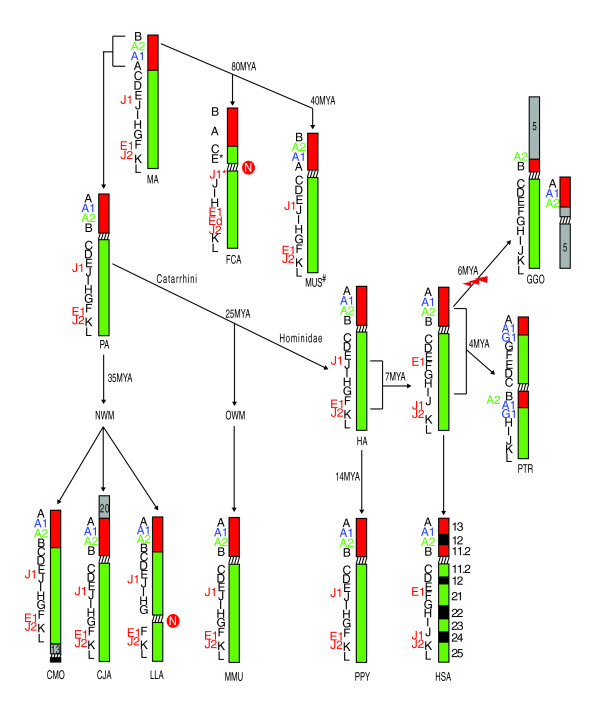
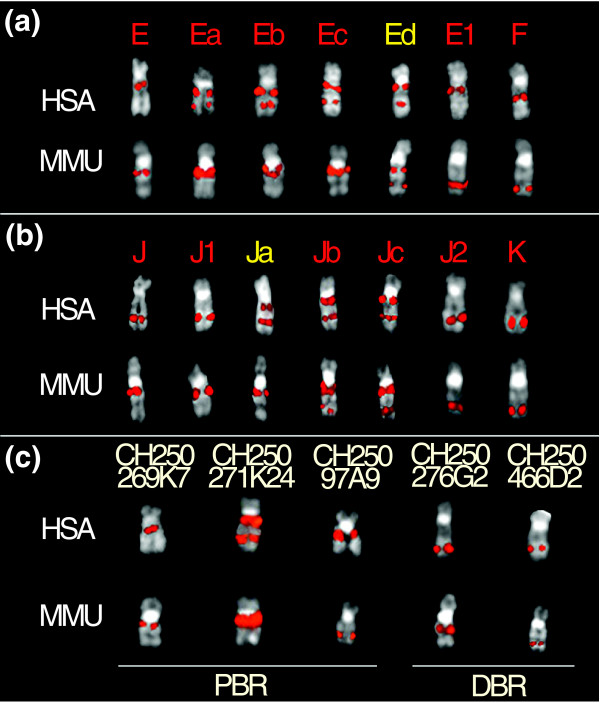
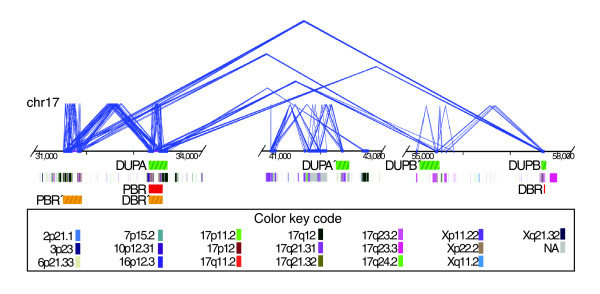
Human bacterial artificial chromosome/p1 artificial chromosome probes spanning the length of chromosome 17 were used in FISH experiments on great apes, Old World monkeys and New World monkeys to study the evolutionary history of this chromosome. We observed that the macaque marker order represents the ancestral organization. Human, chimpanzee and gorilla homologous chromosomes differ by a paracentric inversion that occurred specifically in the Homo sapiens/Pan troglodytes/Gorilla gorilla ancestor. Detailed analyses of the paracentric inversion revealed that the breakpoints mapped to two regions syntenic to human 17q12/21 and 17q23, both rich in segmental duplications.
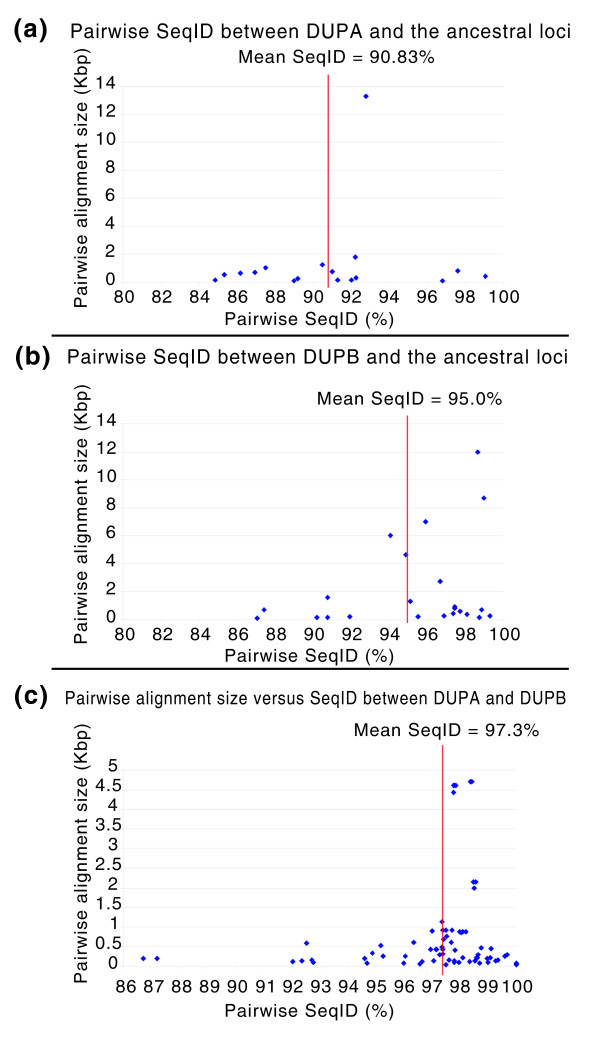
Sequence analyses of the human and macaque organization suggest that the duplication events occurred in the catarrhine ancestor with the duplication blocks continuing to duplicate or undergo gene conversion during evolution of the hominoid lineage. We propose that the presence of these duplicons has mediated the inversion in the H. sapiens/P. troglodytes/G. gorilla ancestor. Recently, the same duplication blocks have been shown to be polymorphic in the human population and to be involved in triggering microdeletion and duplication in human. These results further support a model where genomic architecture has a direct role in both rearrangement involved in karyotype evolution and genomic instability in human.
染色体重排,如易位和倒位,是进化过程中反复出现的现象,二者均与生殖隔离和物种形成有关。为了更好地理解染色体重排的分子基础及其在核型进化中的作用,我们通过比较荧光原位杂交(FISH)和序列分析研究了人类17号染色体的历史。
使用跨越17号染色体全长的人类细菌人工染色体/p1人工染色体探针,对大猩猩、旧世界猴和新世界猴进行FISH实验,以研究该染色体的进化历史。我们观察到猕猴的标记顺序代表了祖先的组织形式。人类、黑猩猩和大猩猩的同源染色体因一个臂内倒位而不同,该倒位发生在智人/黑猩猩/大猩猩的共同祖先中。对该臂内倒位的详细分析表明,断点定位于与人类17q12/21和17q23同线的两个区域,这两个区域都富含片段重复。
对人类和猕猴组织的序列分析表明,重复事件发生在狭鼻猿祖先中,在类人猿谱系进化过程中,重复块继续重复或经历基因转换。我们认为这些重复子的存在介导了智人/黑猩猩/大猩猩祖先中的倒位。最近,相同的重复块已被证明在人类群体中具有多态性,并参与引发人类的微缺失和重复。这些结果进一步支持了一个模型,即基因组结构在核型进化中的重排和人类基因组不稳定性中都具有直接作用。