Pavelka Margit, Neumüller Josef, Ellinger Adolf
Department of Cell Biology and Ultrastructure Research, Center for Anatomy and Cell Biology, Medical University of Vienna, Schwarzspanierstrasse 17, Vienna, Austria.
Histochem Cell Biol. 2008 Mar;129(3):277-88. doi: 10.1007/s00418-008-0383-1. Epub 2008 Feb 13.
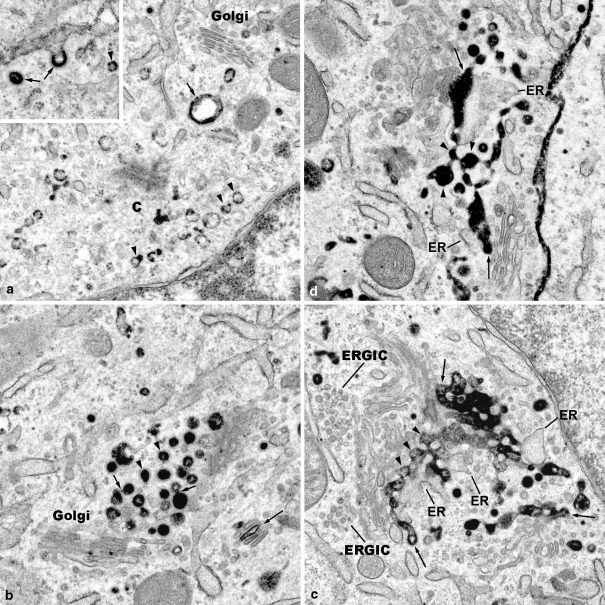
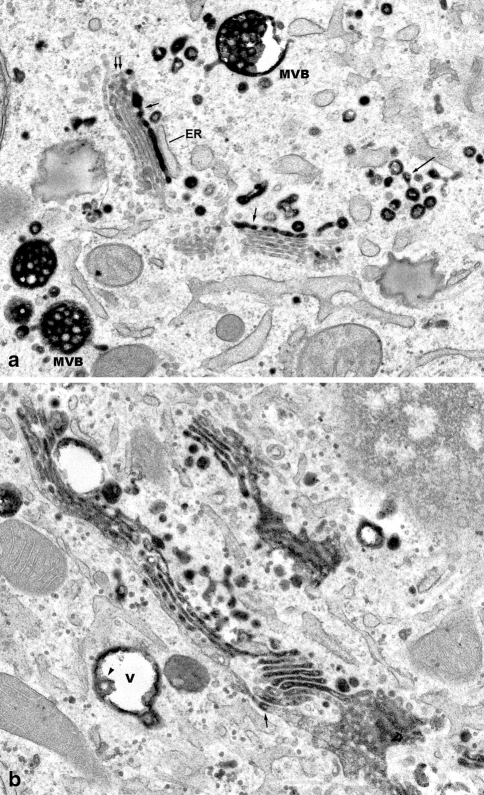
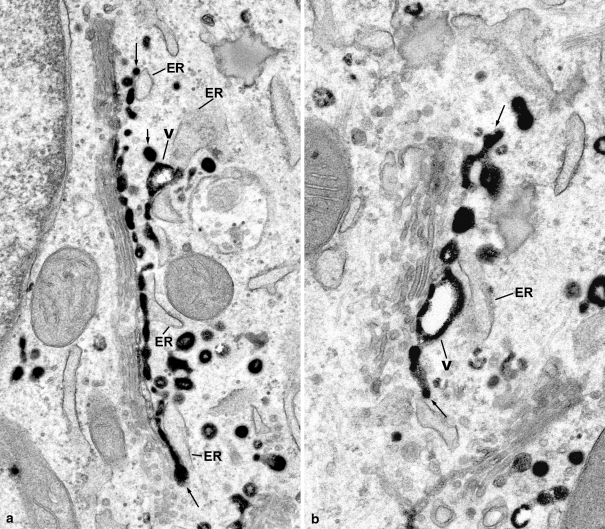
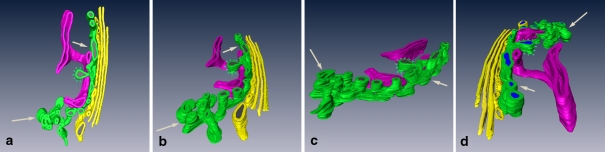
In the biosynthetic-secretory route from the rough endoplasmic reticulum, across the pre-Golgi intermediate compartments, the Golgi apparatus stacks, trans Golgi network, and post-Golgi organelles, anterograde transport is accompanied and counterbalanced by retrograde traffic of both membranes and contents. In the physiologic dynamics of cells, retrograde flow is necessary for retrieval of molecules that escaped from their compartments of function, for keeping the compartments' balances, and maintenance of the functional integrities of organelles and compartments along the secretory route, for repeated use of molecules, and molecule repair. Internalized molecules may be transported in retrograde direction along certain sections of the secretory route, and compartments and machineries of the secretory pathway may be misused by toxins. An important example is the toxin of Shigella dysenteriae, which has been shown to travel from the cell surface across endosomes, and the Golgi apparatus en route to the endoplasmic reticulum, and the cytosol, where it exerts its deleterious effects. Most importantly in medical research, knowledge about the retrograde cellular pathways is increasingly being utilized for the development of strategies for targeted delivery of drugs to the interior of cells. Multiple details about the molecular transport machineries involved in retrograde traffic are known; a high number of the molecular constituents have been characterized, and the complicated fine structural architectures of the compartments involved become more and more visible. However, multiple contradictions exist, and already established traffic models again are in question by contradictory results obtained with diverse cell systems, and/or different techniques. Additional problems arise by the fact that the conditions used in the experimental protocols frequently do not reflect the physiologic situations of the cells. Regular and pathologic situations often are intermingled, and experimental treatments by themselves change cell organizations. This review addresses physiologic and pathologic situations, tries to correlate results obtained by different cell biologic techniques, and asks questions, which may be the basis and starting point for further investigations.
在从糙面内质网开始,穿过高尔基前中间区室、高尔基体堆叠、反式高尔基体网络和高尔基体后细胞器的生物合成-分泌途径中,顺行运输伴随着膜和内含物的逆行运输,并与之相互平衡。在细胞的生理动态过程中,逆行流动对于回收从其功能区室逃逸的分子、维持区室平衡以及维持分泌途径中细胞器和区室的功能完整性、分子的重复利用和分子修复是必要的。内化的分子可能会沿着分泌途径的某些部分逆行运输,并且分泌途径的区室和机制可能会被毒素滥用。一个重要的例子是痢疾志贺菌的毒素,它已被证明能从细胞表面穿过内体,经过高尔基体,最终到达内质网和细胞质,在那里发挥其有害作用。在医学研究中最重要的是,关于细胞逆行途径的知识越来越多地被用于开发将药物靶向递送至细胞内部的策略。已知参与逆行运输的分子运输机制的多个细节;大量的分子成分已被表征,并且所涉及区室的复杂精细结构也越来越清晰可见。然而,存在多个矛盾之处,并且已经建立的运输模型再次受到不同细胞系统和/或不同技术所获得的矛盾结果的质疑。由于实验方案中使用的条件常常不能反映细胞的生理状况,还出现了其他问题。正常和病理状况常常相互交织,而且实验处理本身会改变细胞组织。本综述探讨了生理和病理状况,试图关联不同细胞生物学技术所获得的结果,并提出一些问题,这些问题可能是进一步研究的基础和起点。