Tian Xianbin, Swift Brandon, Zamek-Gliszczynski Maciej J, Belinsky Martin G, Kruh Gary D, Brouwer Kim L R
School of Pharmacy, University of North Carolina at Chapel Hill, Chapel Hill, NC 27599-7360, USA.
Drug Metab Dispos. 2008 May;36(5):911-5. doi: 10.1124/dmd.107.019273. Epub 2008 Feb 14.
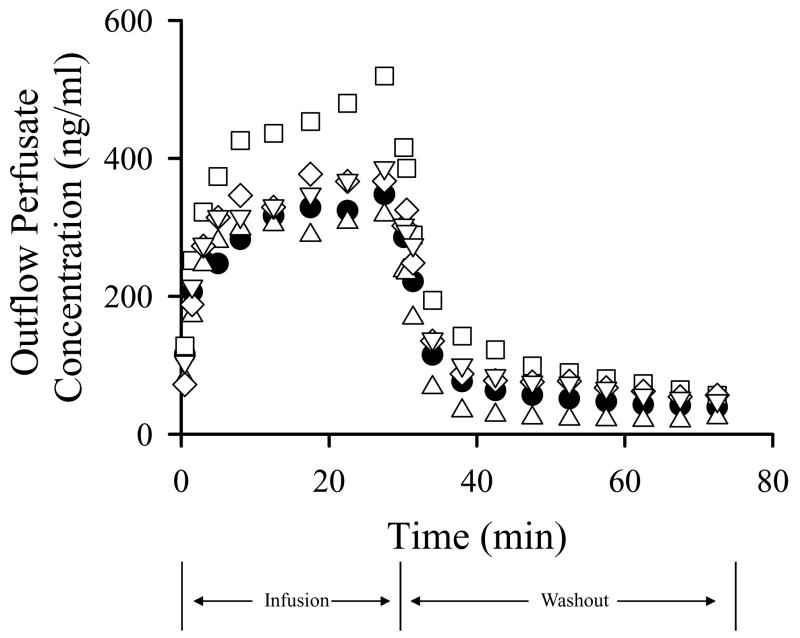
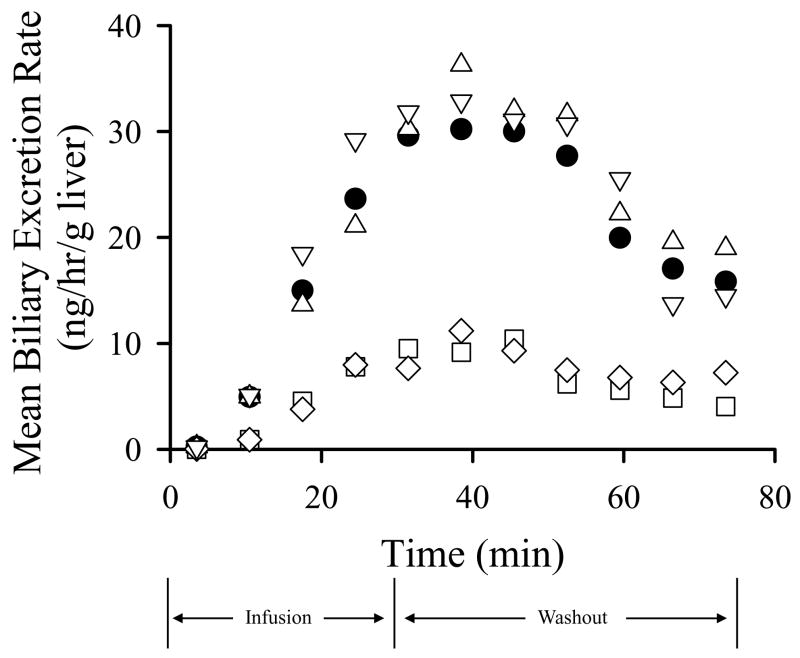
The disposition of fexofenadine, a commonly used antihistamine drug, is governed primarily by active transport. Biliary excretion of the parent compound is the major route of systemic clearance. Previous studies demonstrated that fexofenadine hepatic uptake is mediated by organic anion transporting polypeptides. Recently, we showed that in mice fexofenadine is excreted into bile primarily by multidrug resistance-associated protein (Mrp) 2 (Abcc2). In the present study, the roles of Mrp3 (Abcc3) and Mrp4 (Abcc4) in the hepatobiliary disposition of fexofenadine were examined in knockout mice using in situ liver perfusion. Compared with that in wild-type mice, basolateral excretion of fexofenadine was impaired, resulting in a approximately 50% decrease in perfusate recovery in Abcc3(-/-) mice; in contrast, fexofenadine hepatobiliary disposition was unaltered in Abcc4(-/-) mice. As expected, in Abcc2(-/-) mice, fexofenadine was redirected from the canalicular to the basolateral membrane for excretion. In Abcc2(-/-)/Abcc3(-/-) double-knockout mice, fexofenadine biliary excretion was impaired, but perfusate recovery was similar to that in wild-type mice and more than 2-fold higher than that in Abcc3(-/-) mice, presumably due to compensatory basolateral transport mechanism(s). These results demonstrate that multiple transport proteins are involved in the hepatobiliary disposition of fexofenadine. In addition to Mrp2 and Mrp3, other transport proteins play an important role in the biliary and hepatic basolateral excretion of this zwitterionic drug.
非索非那定是一种常用的抗组胺药物,其处置主要受主动转运的支配。母体化合物的胆汁排泄是全身清除的主要途径。先前的研究表明,非索非那定的肝脏摄取是由有机阴离子转运多肽介导的。最近,我们发现,在小鼠中,非索非那定主要通过多药耐药相关蛋白(Mrp)2(Abcc2)排泄到胆汁中。在本研究中,使用原位肝脏灌注在基因敲除小鼠中研究了Mrp3(Abcc3)和Mrp4(Abcc4)在非索非那定肝胆处置中的作用。与野生型小鼠相比,非索非那定的基底外侧排泄受损,导致Abcc3(-/-)小鼠灌注液回收率降低约50%;相比之下,Abcc4(-/-)小鼠中非索非那定的肝胆处置未改变。正如预期的那样,在Abcc2(-/-)小鼠中,非索非那定从胆小管膜重新定向到基底外侧膜进行排泄。在Abcc2(-/-)/Abcc3(-/-)双基因敲除小鼠中,非索非那定的胆汁排泄受损,但灌注液回收率与野生型小鼠相似,且比Abcc3(-/-)小鼠高2倍以上,这可能是由于代偿性基底外侧转运机制所致。这些结果表明,多种转运蛋白参与了非索非那定的肝胆处置。除了Mrp2和Mrp3外,其他转运蛋白在这种两性离子药物的胆汁和肝脏基底外侧排泄中也发挥着重要作用。