Trinh X B, Tjalma W A A, Vermeulen P B, Van den Eynden G, Van der Auwera I, Van Laere S J, Helleman J, Berns E M J J, Dirix L Y, van Dam P A
Translational Cancer Research Group Antwerp, St Augustinus Hospital, Antwerp, Belgium.
Br J Cancer. 2009 Mar 24;100(6):971-8. doi: 10.1038/sj.bjc.6604921. Epub 2009 Feb 24.
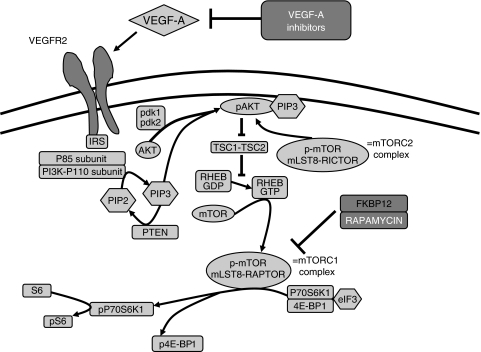
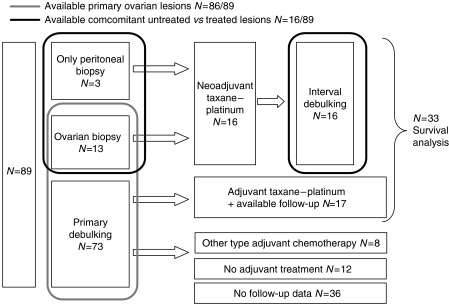
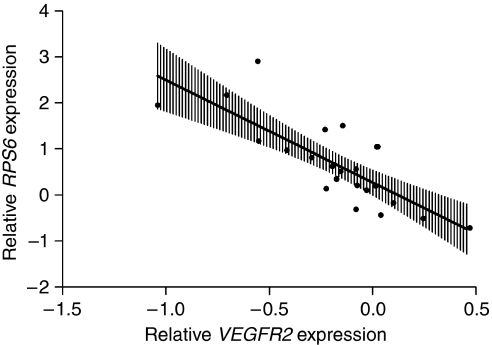
Vascular endothelial growth factor (VEGF)-A inhibitors exhibit unseen high responses and toxicity in recurrent epithelial ovarian cancer suggesting an important role for the VEGF/VEGFR pathway. We studied the correlation of VEGF signalling and AKT/mTOR signalling. Using a tissue microarray of clinical samples (N=86), tumour cell immunohistochemical staining of AKT/mTOR downstream targets, pS6 and p4E-BP1, together with tumour cell staining of VEGF-A and pVEGFR2 were semi-quantified. A correlation was found between the marker for VEGFR2 activation (pVEGFR2) and a downstream target of AKT/mTOR signalling (pS6) (R=0.29; P=0.002). Additional gene expression analysis in an independent cDNA microarray dataset (N=24) showed a negative correlation (R=-0.73, P<0.0001) between the RPS6 and the VEGFR2 gene, which is consistent as the gene expression and phosphorylation of S6 is inversely regulated. An activated tumour cell VEGFR2/AKT/mTOR pathway was associated with increased incidence of ascites (chi(2), P=0.002) and reduced overall survival of cisplatin-taxane-based patients with serous histology (N=32, log-rank test, P=0.04). These data propose that VEGF-A signalling acts on tumour cells as a stimulator of the AKT/mTOR pathway. Although VEGF-A inhibitors are classified as anti-angiogenic drugs, these data suggest that the working mechanism has an important additional modality of targeting the tumour cells directly.
血管内皮生长因子(VEGF)-A抑制剂在复发性上皮性卵巢癌中表现出前所未有的高反应率和毒性,这表明VEGF/VEGFR途径具有重要作用。我们研究了VEGF信号传导与AKT/mTOR信号传导之间的相关性。使用临床样本组织芯片(N = 86),对AKT/mTOR下游靶点pS6和p4E-BP1进行肿瘤细胞免疫组化染色,并对VEGF-A和pVEGFR2进行肿瘤细胞染色,进行半定量分析。发现VEGFR2激活标志物(pVEGFR2)与AKT/mTOR信号传导的下游靶点(pS6)之间存在相关性(R = 0.29;P = 0.002)。在独立的cDNA微阵列数据集(N = 24)中进行的额外基因表达分析显示,RPS6与VEGFR2基因之间呈负相关(R = -0.73,P < 0.0001),这与S6的基因表达和磷酸化受到反向调节一致。激活的肿瘤细胞VEGFR2/AKT/mTOR途径与腹水发生率增加相关(χ²,P = 0.002),并降低了基于顺铂-紫杉烷治疗的浆液性组织学患者的总生存率(N = 32,对数秩检验,P = 0.04)。这些数据表明,VEGF-A信号传导作为AKT/mTOR途径的刺激因子作用于肿瘤细胞。尽管VEGF-A抑制剂被归类为抗血管生成药物,但这些数据表明其作用机制还有直接靶向肿瘤细胞这一重要的额外方式。