Abad Xabi, Vera Maria, Jung Stephen P, Oswald Evelyn, Romero Inés, Amin Vaibhav, Fortes Puri, Gunderson Samuel I
Division of Hepatology and Gene Therapy, CIMA/UNAV. Pio XII, 55, 31008 Pamplona, Spain.
Nucleic Acids Res. 2008 Apr;36(7):2338-52. doi: 10.1093/nar/gkn068. Epub 2008 Feb 24.
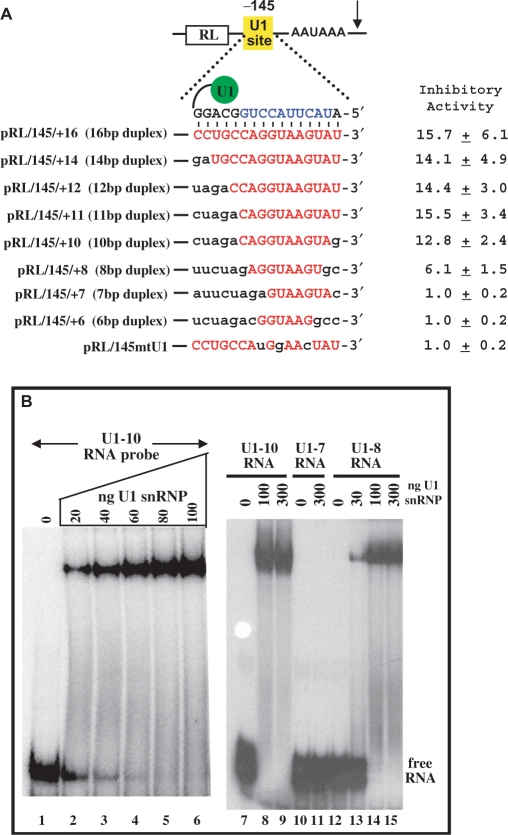
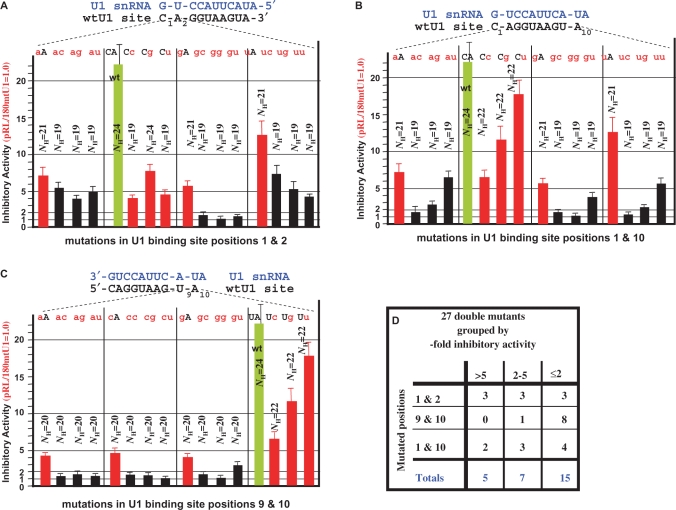
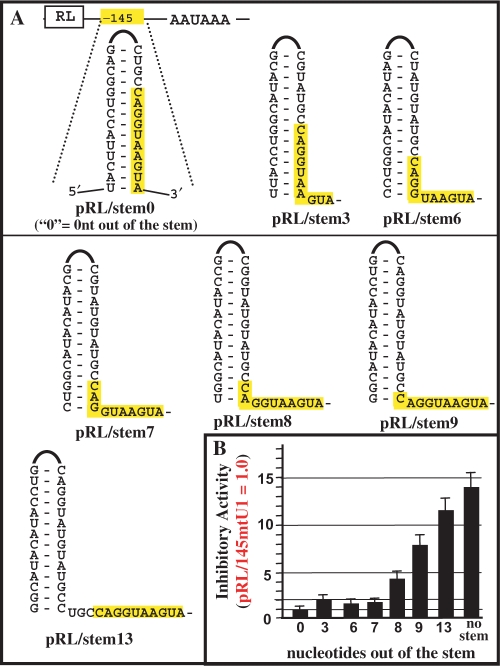
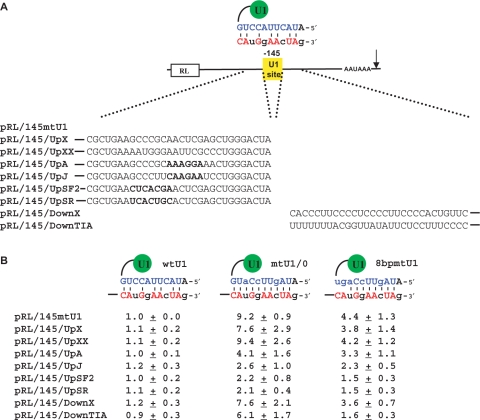
U1 interference (U1i) is a novel method to block gene expression. U1i requires expression of a 5'-end-mutated U1 snRNA designed to base pair to the 3'-terminal exon of the target gene's pre-mRNA that leads to inhibition of polyadenylation. Here, we show U1i is robust (> or =95%) and a 10-nt target length is sufficient for good silencing. Surprisingly, longer U1 snRNAs, which could increase annealing to the target, fail to improve silencing. Extensive mutagenesis of the 10-bp U1 snRNA:target duplex shows that any single mismatch different from GU at positions 3-8, destroys silencing. However, mismatches within the other positions give partial silencing, suggesting that off-target inhibition could occur. The specificity of U1i may be enhanced, however, by the fact that silencing is impaired by RNA secondary structure or by splicing factors binding nearby, the latter mediated by Arginine-Serine (RS) domains. U1i inhibition can be reconstituted in vivo by tethering of RS domains of U1-70K and U2AF65. These results help to: (i) define good target sites for U1i; (ii) identify and understand natural cellular examples of U1i; (iii) clarify the contribution of hydrogen bonding to U1i and to U1 snRNP binding to 5' splice sites and (iv) understand the mechanism of U1i.
U1干扰(U1i)是一种阻断基因表达的新方法。U1i需要表达一种5'端突变的U1 snRNA,该snRNA设计用于与靶基因前体mRNA的3'末端外显子碱基配对,从而导致多聚腺苷酸化受到抑制。在此,我们表明U1i作用强大(≥95%),10个核苷酸的靶标长度足以实现良好的沉默效果。令人惊讶的是,更长的U1 snRNAs虽能增加与靶标的退火,但并不能提高沉默效果。对10个碱基的U1 snRNA:靶标双链体进行广泛诱变表明,3至8位不同于GU的任何单个错配都会破坏沉默效果。然而,其他位置的错配会导致部分沉默,这表明可能会发生脱靶抑制。不过,由于RNA二级结构或附近结合的剪接因子(由精氨酸-丝氨酸(RS)结构域介导)会损害沉默效果,U1i的特异性可能会增强。通过连接U1-70K和U2AF65的RS结构域,可在体内重建U1i抑制作用。这些结果有助于:(i)确定U1i的良好靶位点;(ii)识别和理解U1i在天然细胞中的实例;(iii)阐明氢键对U1i以及U1 snRNP与5'剪接位点结合的作用;(iv)理解U1i的作用机制。