Department of Human Genetics and Donders Institute for Brain, Cognition and Behaviour, Radboud University Medical Center, 6525GA Nijmegen, The Netherlands.
Genes (Basel). 2019 Aug 28;10(9):654. doi: 10.3390/genes10090654.
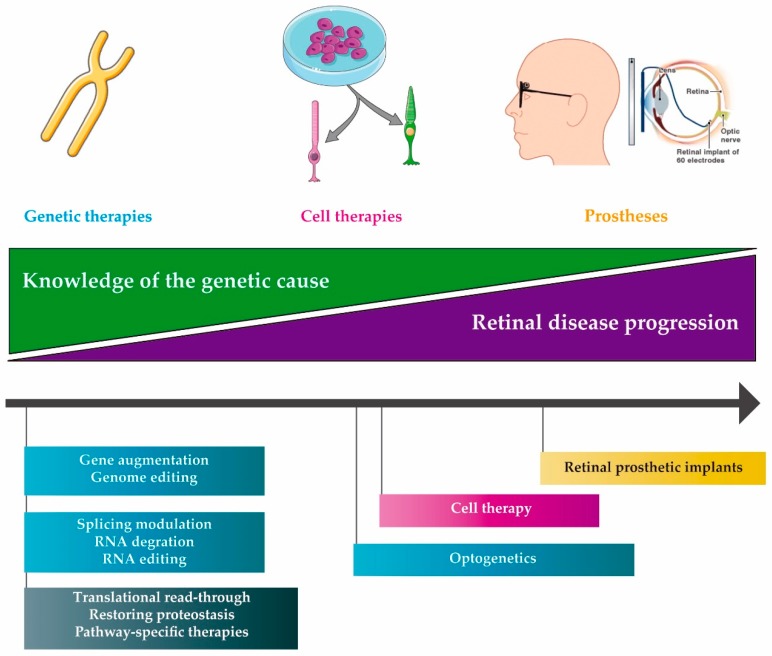
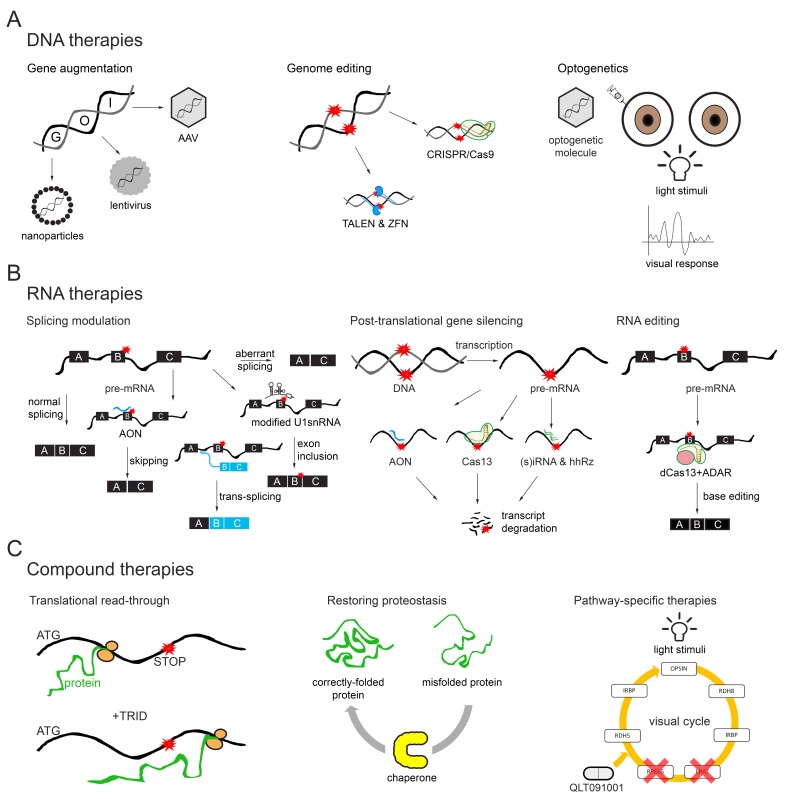
Inherited retinal diseases (IRDs) are both genetically and clinically highly heterogeneous and have long been considered incurable. Following the successful development of a gene augmentation therapy for biallelic -associated IRD, this view has changed. As a result, many different therapeutic approaches are currently being developed, in particular a large variety of molecular therapies. These are depending on the severity of the retinal degeneration, knowledge of the pathophysiological mechanism underlying each subtype of IRD, and the therapeutic target molecule. DNA therapies include approaches such as gene augmentation therapy, genome editing and optogenetics. For some genetic subtypes of IRD, RNA therapies and compound therapies have also shown considerable therapeutic potential. In this review, we summarize the current state-of-the-art of various therapeutic approaches, including the pros and cons of each strategy, and outline the future challenges that lie ahead in the combat against IRDs.
遗传性视网膜疾病(IRDs)在遗传和临床方面具有高度异质性,长期以来被认为是无法治愈的。随着双等位基因突变相关 IRD 的基因增强疗法的成功开发,这种观点发生了变化。因此,目前正在开发许多不同的治疗方法,特别是各种分子疗法。这些方法取决于视网膜变性的严重程度、对每种 IRD 亚型潜在病理生理机制的了解,以及治疗靶分子。DNA 疗法包括基因增强疗法、基因组编辑和光遗传学等方法。对于某些遗传亚型的 IRD,RNA 疗法和联合疗法也显示出相当大的治疗潜力。在这篇综述中,我们总结了各种治疗方法的最新进展,包括每种策略的优缺点,并概述了在对抗 IRD 方面未来面临的挑战。