Hieda Miki, Isokane Mayumi, Koizumi Michiko, Higashi Chiduru, Tachibana Taro, Shudou Masachika, Taguchi Tomohiko, Hieda Yohki, Higashiyama Shigeki
Department of Biochemistry and Molecular Genetics, Ehime University Graduate School of Medicine, Ehime 791-0295, Japan.
J Cell Biol. 2008 Feb 25;180(4):763-9. doi: 10.1083/jcb.200710022.
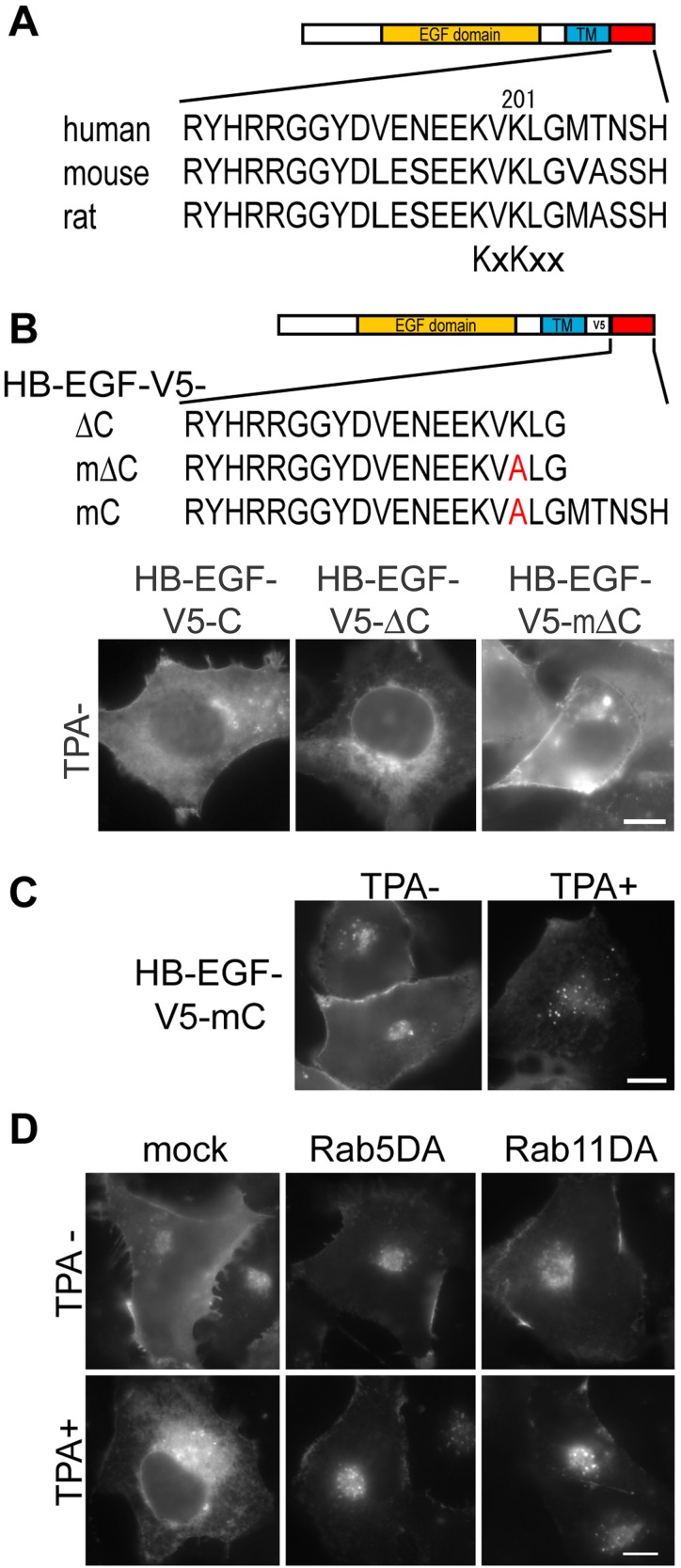
Heparin-binding EGF-like growth factor (HB-EGF) is synthesized as a type I transmembrane protein (proHB-EGF) and expressed on the cell surface. The ectodomain shedding of proHB-EGF at the extracellular region on the plasma membrane yields a soluble EGF receptor ligand and a transmembrane-cytoplasmic fragment (HB-EGF-CTF). The cytoplasmic domain of proHB-EGF (HB-EGF-cyto) interacts with transcriptional repressors to reverse their repressive activities. However, how HB-EGF-cyto accesses transcriptional repressors is yet unknown. The present study demonstrates that, after exposure to shedding stimuli, both HB-EGF-CTF and unshed proHB-EGF translocate to the nuclear envelope. Immunoelectron microscopy and digitonin-permeabilized cells showed that HB-EGF-cyto signals are at the inner nuclear membrane. A short sequence element within the HB-EGF-cyto allows a transmembrane protein to localize to the nuclear envelope. The dominant-active form of Rab5 and Rab11 suppressed nuclear envelope targeting. Collectively, these data demonstrate that membrane-anchored HB-EGF is targeted to the inner nuclear membrane via a retrograde membrane trafficking pathway.
肝素结合表皮生长因子样生长因子(HB-EGF)最初作为I型跨膜蛋白(前体HB-EGF)合成,并在细胞表面表达。前体HB-EGF在质膜的细胞外区域发生胞外域脱落,产生可溶性表皮生长因子受体配体和跨膜-细胞质片段(HB-EGF-CTF)。前体HB-EGF的细胞质结构域(HB-EGF-cyto)与转录抑制因子相互作用,以逆转它们的抑制活性。然而,HB-EGF-cyto如何与转录抑制因子结合尚不清楚。本研究表明,在受到脱落刺激后,HB-EGF-CTF和未脱落的前体HB-EGF均转移至核膜。免疫电子显微镜和洋地黄皂苷通透细胞显示,HB-EGF-cyto信号位于内核膜。HB-EGF-cyto内的一个短序列元件可使跨膜蛋白定位于核膜。Rab5和Rab11的显性活性形式抑制了核膜靶向。总体而言,这些数据表明,膜锚定的HB-EGF通过逆行膜运输途径靶向内核膜。