First Department of Orthopaedics, Zhongshan City People's Hospital Affiliated to Sun Yat-sen University, Zhongshan, Guangdong Province, China.
Arthritis Res Ther. 2022 Sep 6;24(1):215. doi: 10.1186/s13075-022-02902-x.
Fibroblasts are important structural cells in synovium and play key roles in maintaining the synovial homeostasis. By single-cell RNA sequencing (scRNA-seq), subpopulation of synovium-resident cells has been reported to protect intra-articular structures from chronic inflammation and promote tissue repair. However, a significant number of researchers have concentrated on the role of fibroblasts in the progress of rheumatoid arthritis (RA) while few reports had described the contribution of distinct fibroblast subsets in the RA remission. It is helpful to understand the role of fibroblast subpopulations in the RA process to provide predictive biomarkers and address RA remission mechanisms. Here, we found HBEGF+ fibroblasts that contributed to RA remission by integrating scRNA-seq datasets and bulk RNA sequencing (bulk RNA-seq) datasets.
Three single-cell RNA datasets of cells harvested from RA patients were processed and integrated by Seurat and Harmony R packages. After identifying cell types by classic marker genes, the integrated dataset was used to run CellChat for analysis of cell-cell communication. Specially, EGF signaling pathway was found and HBEGF+ fibroblasts were identified based on HBEGF expression. Differential expressed genes of HBEGF+ were shown in heatmap and volcano plot and used to run gene ontology (GO) enrichment analysis. Next, bulk RNA-seq datasets of synovium under different conditions (health, osteoarthritis (OA), rheumatoid arthritis, before and after classical treatment) were compared to show expression change of HBEGF and gene markers that are mainly expressed by HBEGF+ fibroblasts such as CLIC5, PDGFD, BDH2, and ENPP1. Finally, two single-cell RNA sequencing datasets of synovial cells from mice were integrated to identify Hbegf+ fibroblasts and calculate the population of Hbegf+ fibroblasts under different joint conditions (health, K/BxN serum transfer arthritis (STA), and remission of STA).
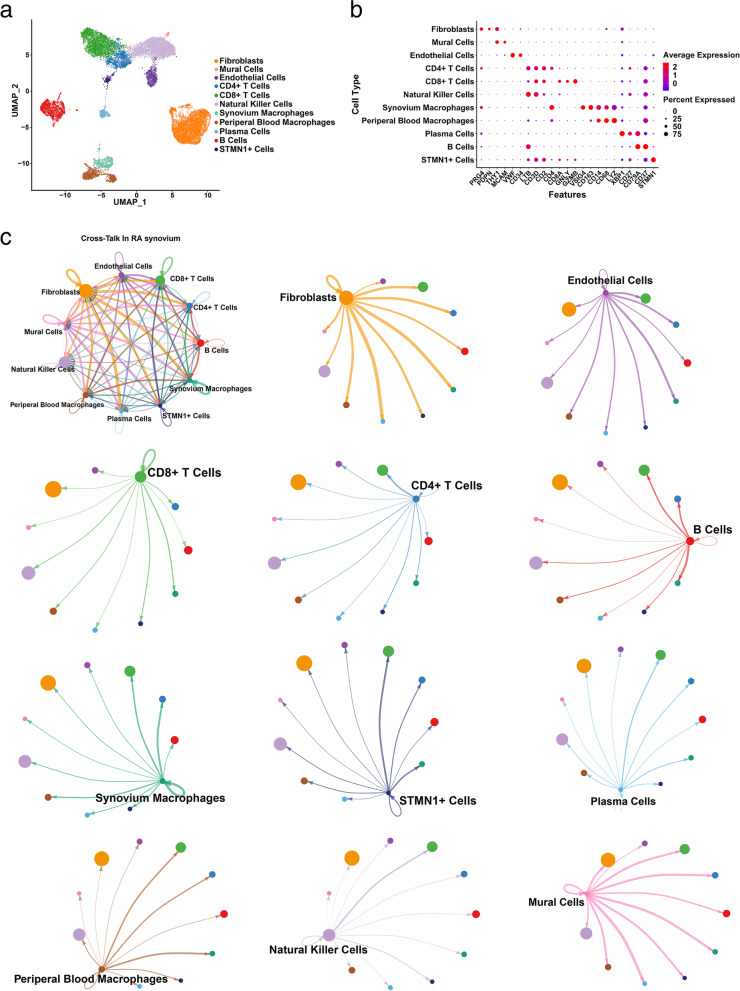
After integrating three single-cell RNA sequencing datasets, we identified 11 clusters of synovial cells, such as fibroblasts, mural cells, endothelial cells, CD4+ T cells, CD8+ T cells, natural killer cells, synovium macrophage, peripheral blood macrophages, plasma cells, B cells, and STMN1+ cells. We found fibroblasts had an extensive communication network with other clusters and interacted with synovial macrophages through EGF signaling pathway via analysis of cell-cell communication between synovial cells. HBEGF, ligand to EGF signaling pathway, was highly expressed by a subset of fibroblasts and macrophages, and EGFR, receptor to EGF signaling pathway, was highly expressed by fibroblasts and meniscus cells. Moreover, HBEGF was downregulated under RA state and it had an increase after classical treatment. We then defined fibroblasts with high expression of HBEGF as HBEGF+ fibroblasts. In addition, we also found that HBEGF+ fibroblasts highly expressed CRTAC1, ITGB8, SCARA5, THBS4, and ITGBL1, genes relative to encoding extracellular matrix proteins and engaged in positive regulation of cell migration and motility, cellular component movement, and cell growth by GO enrichment analysis. We eventually identified HBEGF+ fibroblasts specially expressed CLIC5, PDGFD, BDH2, and ENPP1, which positively correlated with the expression of HBEGF. Moreover, the expression of CLIC5, PDGFD, BDH2, and ENPP1 was downregulated under RA state and elevated by classical therapy. On the contrary, the HBEGF+ macrophages specially expressed SLAMF8, GK, L1RN, and JAK2, which negatively correlated with the expression of HBEGF. The expression was upregulated in SLAMF8, GK, L1RN, and JAK2 under the RA state, whereas it was decreased after classical treatment. In mice, the number of Hbegf+ fibroblasts was reduced in the RA synovium but increased in the RA remitting synovium.
HBEGF+ fibroblasts play a role in the remission of rheumatoid arthritis, and HBEGF has potential to become a novel biomarker for prediction of RA progress.
成纤维细胞是滑膜中重要的结构细胞,在维持滑膜稳态方面发挥着关键作用。通过单细胞 RNA 测序(scRNA-seq),已经报道了滑膜驻留细胞的亚群可以保护关节内结构免受慢性炎症的影响,并促进组织修复。然而,大量研究人员集中研究了成纤维细胞在类风湿关节炎(RA)进展中的作用,而很少有报道描述了不同成纤维细胞亚群在 RA 缓解中的贡献。了解成纤维细胞亚群在 RA 过程中的作用有助于提供预测性生物标志物,并解决 RA 缓解机制。在这里,我们通过整合 scRNA-seq 数据集和批量 RNA 测序(bulk RNA-seq)数据集,发现了 HBEGF+成纤维细胞在 RA 缓解中的作用。
对来自 RA 患者的细胞的三个单细胞 RNA 数据集进行处理和整合,使用 Seurat 和 Harmony R 包进行分析。通过经典标记基因鉴定细胞类型后,使用整合数据集运行 CellChat 进行细胞间通讯分析。特别是根据 HBEGF 的表达鉴定出 EGF 信号通路和 HBEGF+成纤维细胞。在热图和火山图中显示 HBEGF+的差异表达基因,并进行基因本体(GO)富集分析。接下来,比较不同条件(健康、骨关节炎(OA)、类风湿关节炎、经典治疗前后)下的滑膜批量 RNA-seq 数据集,以显示 HBEGF 和主要由 HBEGF+成纤维细胞表达的基因标记物(如 CLIC5、PDGFD、BDH2 和 ENPP1)的表达变化。最后,整合两个滑膜细胞的单细胞 RNA 测序数据集,以鉴定 Hbegf+成纤维细胞,并计算不同关节状态(健康、K/BxN 血清转移关节炎(STA)和 STA 缓解)下 Hbegf+成纤维细胞的数量。
整合三个单细胞 RNA 测序数据集后,我们鉴定出 11 个滑膜细胞簇,如成纤维细胞、壁细胞、内皮细胞、CD4+T 细胞、CD8+T 细胞、自然杀伤细胞、滑膜巨噬细胞、外周血巨噬细胞、浆细胞、B 细胞和 STMN1+细胞。我们发现成纤维细胞与其他簇之间存在广泛的通讯网络,并通过 EGF 信号通路与滑膜巨噬细胞相互作用,通过分析滑膜细胞之间的细胞间通讯。HBEGF 是 EGF 信号通路的配体,高度表达于成纤维细胞和巨噬细胞中的一个亚群,EGFR 是 EGF 信号通路的受体,高度表达于成纤维细胞和半月板细胞。此外,在 RA 状态下 HBEGF 下调,经典治疗后增加。我们随后将高表达 HBEGF 的成纤维细胞定义为 HBEGF+成纤维细胞。此外,我们还发现 HBEGF+成纤维细胞高度表达 CRTAC1、ITGB8、SCARA5、THBS4 和 ITGBL1,这些基因相对编码细胞外基质蛋白,并通过 GO 富集分析参与细胞迁移和运动、细胞成分运动和细胞生长的正调控。我们最终鉴定出 HBEGF+成纤维细胞专门表达 CLIC5、PDGFD、BDH2 和 ENPP1,这些基因与 HBEGF 的表达呈正相关。此外,CLIC5、PDGFD、BDH2 和 ENPP1 的表达在 RA 状态下下调,经经典治疗后升高。相反,HBEGF+巨噬细胞专门表达 SLAMF8、GK、L1RN 和 JAK2,与 HBEGF 的表达呈负相关。在 RA 状态下,SLAMF8、GK、L1RN 和 JAK2 的表达上调,而经典治疗后表达降低。在小鼠中,RA 滑膜中的 Hbegf+成纤维细胞数量减少,而 RA 缓解滑膜中的数量增加。
HBEGF+成纤维细胞在类风湿关节炎的缓解中起作用,HBEGF 有可能成为预测 RA 进展的新型生物标志物。