D'Agata Erika, Mitchell Susan L
Division of Infectious Diseases, Department of Medicine, Beth Israel Deaconess Medical Center, Boston, MA 02215, USA.
Arch Intern Med. 2008 Feb 25;168(4):357-62. doi: 10.1001/archinternmed.2007.104.
Nursing home residents with advanced dementia are at high risk of infections and antimicrobial exposure near the end of life. Detailed studies quantifying antimicrobial prescribing practices among these residents have not been performed.
A cohort of 214 residents with advanced dementia from 21 Boston-area nursing homes were followed up prospectively for 18 months or until death. We analyzed antimicrobial use, including type, indication, and quantity, by days of therapy per 1000 resident-days.
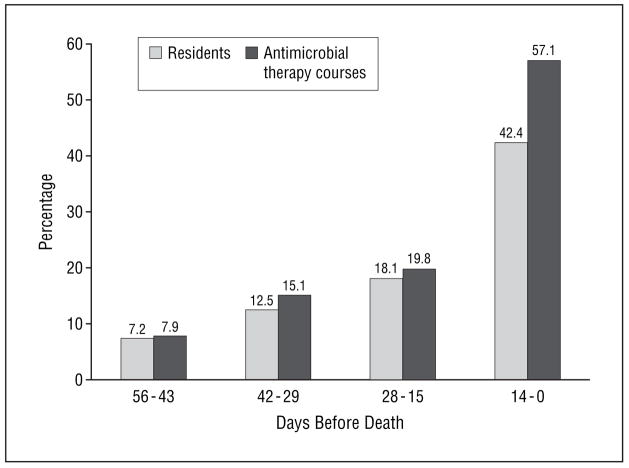
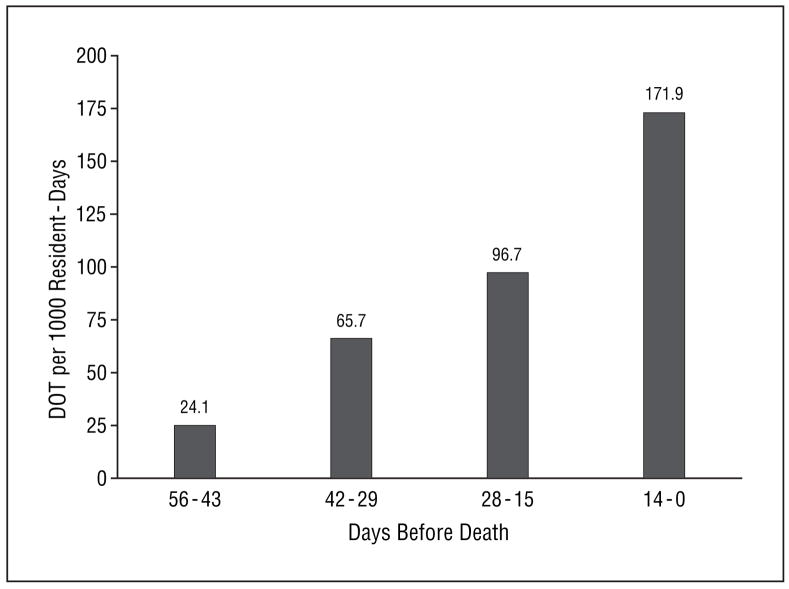
During an average of 322 days of follow-up, 142 residents (66.4%) with advanced dementia received at least 1 course of antimicrobial therapy (mean [SD] number of courses per resident, 4.0 [3.7]). The mean (SD) number of days of therapy per 1000 resident-days for the entire cohort was 53.0 (4.3). Quinolones and third-generation cephalosporins were the most commonly prescribed antimicrobials, accounting for 38.3% and 15.2%, respectively, of 540 prescribed antimicrobial therapy courses. A respiratory tract infection was the most common indication (46.7% of all antimicrobial therapy courses). Among 99 decedents, 42 (42.4%) received antimicrobials during the 2 weeks before death, of which 30 of 72 courses (41.7%) were administered via the parenteral route. The number of decedents receiving antimicrobials (P < .001), the number of antimicrobials prescribed (P = .01), and the days of therapy per 1000 resident-days (P < .001) increased significantly as subjects approached death.
Persons with advanced dementia are frequently exposed to antimicrobials, especially during the 2 weeks before death. The implications of this practice from the perspective of the individual treatment burden near the end of life and its contribution to the emergence of antimicrobial resistance in the nursing home setting need further evaluation.
患有晚期痴呆症的养老院居民在生命末期面临感染和接触抗菌药物的高风险。尚未开展详细研究来量化这些居民的抗菌药物处方行为。
对来自波士顿地区21家养老院的214名晚期痴呆症居民进行了为期18个月的前瞻性随访,直至其死亡。我们按每1000居民日的治疗天数分析了抗菌药物的使用情况,包括类型、用药指征和用药量。
在平均322天的随访期间,142名(66.4%)晚期痴呆症居民接受了至少1个疗程的抗菌药物治疗(每位居民的平均[标准差]疗程数为4.0[3.7])。整个队列每1000居民日的平均(标准差)治疗天数为53.0(4.3)。喹诺酮类和第三代头孢菌素是最常开具的抗菌药物,分别占540个抗菌药物治疗疗程的38.3%和15.2%。呼吸道感染是最常见的用药指征(占所有抗菌药物治疗疗程的46.7%)。在99名死者中,42名(42.4%)在死亡前2周内接受了抗菌药物治疗,其中72个疗程中的30个(41.7%)通过肠外途径给药。随着受试者临近死亡,接受抗菌药物治疗的死者人数(P<.001)、开具的抗菌药物数量(P=.01)以及每1000居民日的治疗天数(P<.001)均显著增加。
晚期痴呆症患者经常接触抗菌药物,尤其是在死亡前2周内。从生命末期个体治疗负担的角度以及这种做法对养老院环境中抗菌药物耐药性产生的影响来看,需要进一步评估。