Wang J, Cao L G, Wang Y L, Pederson T
Cell Biology Group, Worcester Foundation for Experimental Biology, Shrewsbury, MA 01545.
Proc Natl Acad Sci U S A. 1991 Aug 15;88(16):7391-5. doi: 10.1073/pnas.88.16.7391.
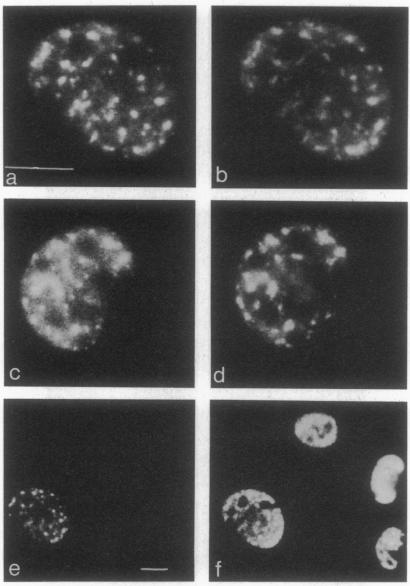
We have studied the nuclear localization of rhodamine-labeled pre-mRNA after microinjection into nuclei of cultured rat kidney epithelial cells. Intranuclear localization of the injected RNA was followed in the living cells by fluorescence microscopy and digital image processing. Injected human beta-globin pre-mRNA became localized in 30-60 discrete nuclear sites that were coincident with loci defined by monoclonal antibodies against small nuclear ribonucleoproteins (Sm) or another spliceosome component (SC-35) in parallel immunocytochemical studies on the same nuclei. Similar patterns of nuclear localization were observed with a rat proenkephalin pre-mRNA. Nuclear microinjection of an intronlacking beta-globin RNA, a splicing-defective beta-globin mutant pre-mRNA, or an antisense beta-globin pre-mRNA did not result in localization at discrete sites. These results indicate that pre-mRNA binds preferentially to nuclear Sm and SC-35 antibody-reactive sites in vivo and that the binding requires intron sequences.
我们研究了将罗丹明标记的前体mRNA显微注射到培养的大鼠肾上皮细胞核中后的核定位情况。通过荧光显微镜和数字图像处理在活细胞中追踪注射RNA的核内定位。在对相同细胞核进行的平行免疫细胞化学研究中,注射的人β-珠蛋白前体mRNA定位于30 - 60个离散的核位点,这些位点与针对小核核糖核蛋白(Sm)或另一种剪接体成分(SC-35)的单克隆抗体所定义的位点一致。用大鼠前脑啡肽原前体mRNA观察到了类似的核定位模式。对缺乏内含子的β-珠蛋白RNA、剪接缺陷型β-珠蛋白突变体前体mRNA或反义β-珠蛋白前体mRNA进行核显微注射,并未导致其在离散位点定位。这些结果表明,前体mRNA在体内优先与核Sm和SC-35抗体反应位点结合,且这种结合需要内含子序列。