Martínez-Chantar M Luz, Vázquez-Chantada Mercedes, Ariz Usue, Martínez Nuria, Varela Marta, Luka Zigmund, Capdevila Antonieta, Rodríguez Juan, Aransay Ana M, Matthiesen Rune, Yang Heping, Calvisi Diego F, Esteller Manel, Fraga Mario, Lu Shelly C, Wagner Conrad, Mato José M
CIC bioGUNE, CIBERehd, Technology Park of Bizkaia, Bizkaia, Spain.
Hepatology. 2008 Apr;47(4):1191-9. doi: 10.1002/hep.22159.
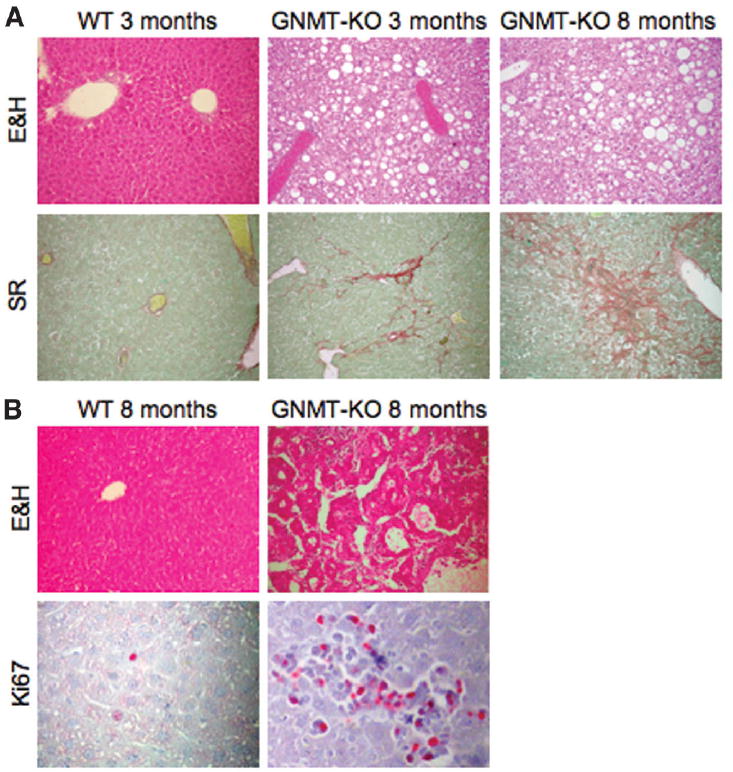
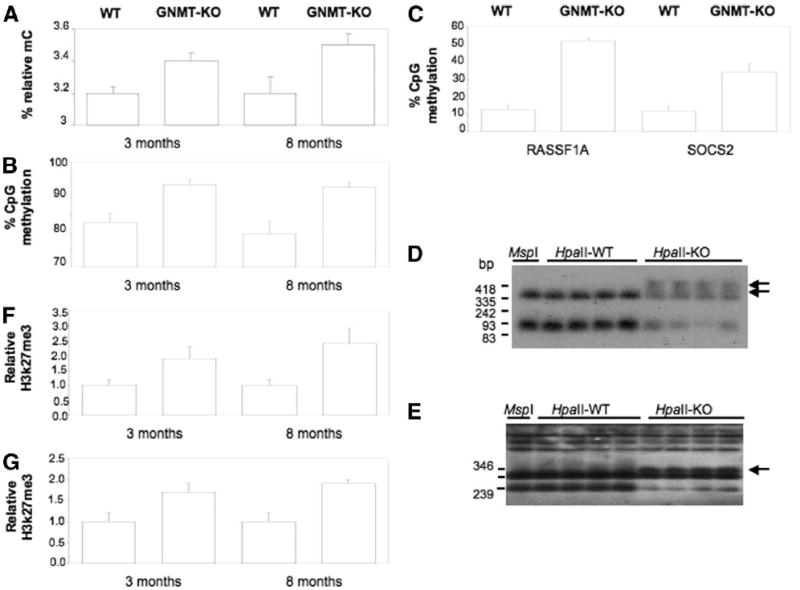
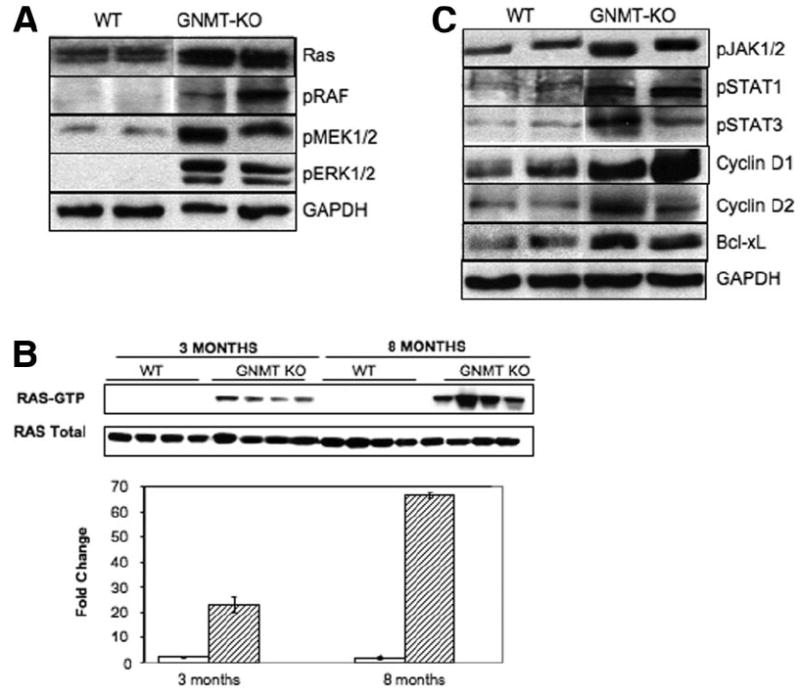
Glycine N-methyltransferase (GNMT) is the main enzyme responsible for catabolism of excess hepatic S-adenosylmethionine (SAMe). GNMT is absent in hepatocellular carcinoma (HCC), messenger RNA (mRNA) levels are significantly lower in livers of patients at risk of developing HCC, and GNMT has been proposed to be a tumor-susceptibility gene for liver cancer. The identification of several children with liver disease as having mutations of the GNMT gene further suggests that this enzyme plays an important role in liver function. In the current study we studied development of liver pathologies including HCC in GNMT-knockout (GNMT-KO) mice. GNMT-KO mice have elevated serum aminotransferase, methionine, and SAMe levels and develop liver steatosis, fibrosis, and HCC. We found that activation of the Ras and Janus kinase (JAK)/signal transducer and activator of transcription (STAT) pathways was increased in liver tumors from GNMT-KO mice coincidently with the suppression of the Ras inhibitors Ras-association domain family/tumor suppressor (RASSF) 1 and 4 and the JAK/STAT inhibitors suppressor of cytokine signaling (SOCS) 1-3 and cytokine-inducible SH2-protein. Finally, we found that methylation of RASSF1 and SOCS2 promoters and the binding of trimethylated lysine 27 in histone 3 to these 2 genes was increased in HCC from GNMT-KO mice.
These data demonstrate that loss of GNMT induces aberrant methylation of DNA and histones, resulting in epigenetic modulation of critical carcinogenic pathways in mice.
甘氨酸N-甲基转移酶(GNMT)是负责肝脏中过量S-腺苷甲硫氨酸(SAMe)分解代谢的主要酶。肝细胞癌(HCC)中不存在GNMT,有患HCC风险患者的肝脏中信使核糖核酸(mRNA)水平显著降低,并且GNMT已被认为是肝癌的肿瘤易感基因。鉴定出几名患有肝病的儿童存在GNMT基因突变,这进一步表明该酶在肝功能中起重要作用。在当前研究中,我们研究了GNMT基因敲除(GNMT-KO)小鼠中包括HCC在内的肝脏病理发展情况。GNMT-KO小鼠血清转氨酶、甲硫氨酸和SAMe水平升高,并出现肝脂肪变性、纤维化和HCC。我们发现,GNMT-KO小鼠肝脏肿瘤中Ras和Janus激酶(JAK)/信号转导子和转录激活子(STAT)途径的激活增加,同时Ras抑制剂Ras关联结构域家族/肿瘤抑制因子(RASSF)1和4以及JAK/STAT抑制剂细胞因子信号转导抑制因子(SOCS)1 - 3和细胞因子诱导的SH2蛋白受到抑制。最后,我们发现GNMT-KO小鼠的HCC中RASSF1和SOCS2启动子的甲基化以及组蛋白3中赖氨酸27三甲基化与这两个基因的结合增加。
这些数据表明,GNMT缺失诱导DNA和组蛋白的异常甲基化,导致小鼠关键致癌途径发生表观遗传调控。