Jacob Matthias, Chappell Daniel, Conzen Peter, Wilkes Mahlon M, Becker Bernhard F, Rehm Markus
Klinik für Anästhesiologie, Ludwig-Maximilians-Universität, Klinikum Grosshadern, Nussbaumstrasse 20, D-80336 Munich, Germany.
Crit Care. 2008;12(2):R34. doi: 10.1186/cc6812. Epub 2008 Mar 4.
Small-volume resuscitation can rapidly correct hypovolemia. Hyperoncotic albumin solutions, long in clinical use, are suitable for small-volume resuscitation; however, their clinical benefits remain uncertain.
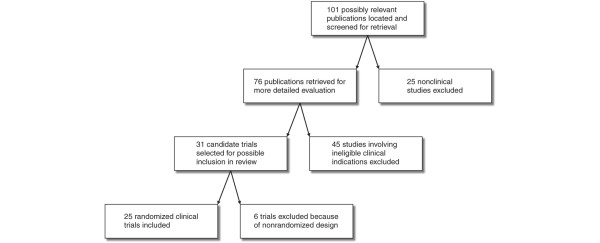
Randomized clinical trials comparing hyperoncotic albumin with a control regimen for volume expansion were sought by multiple methods, including computer searches of bibliographic databases, perusal of reference lists, and manual searching. Major findings were qualitatively summarized. In addition, a quantitative meta-analysis was performed on available survival data.
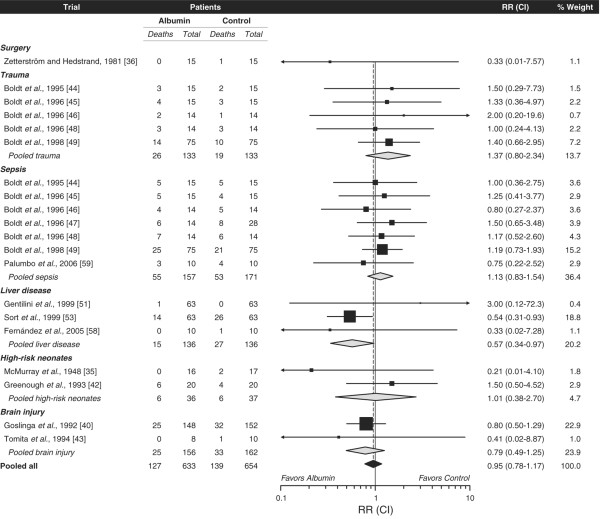
In all, 25 randomized clinical trials with a total of 1,485 patients were included. In surgery, hyperoncotic albumin preserved renal function and reduced intestinal edema compared with control fluids. In trauma and sepsis, cardiac index and oxygenation were higher after administration of hydroxyethyl starch than hyperoncotic albumin. Improved treatment response and renal function, shorter hospital stay and lower costs of care were reported in patients with liver disease receiving hyperoncotic albumin. Edema and morbidity were decreased in high-risk neonates after hyperoncotic albumin administration. Disability was reduced by therapy with hyperoncotic albumin in brain injury. There was no evidence of deleterious effects attributable to hyperoncotic albumin. Survival was unaffected by hyperoncotic albumin (pooled relative risk, 0.95; 95% confidence interval 0.78 to 1.17).
In some clinical indications, randomized trial evidence has suggested certain benefits of hyperoncotic albumin such as reductions in morbidity, renal impairment and edema. However, further clinical trials are needed, particularly in surgery, trauma and sepsis.
小容量复苏可迅速纠正低血容量。临床长期使用的高渗白蛋白溶液适用于小容量复苏;然而,其临床益处仍不确定。
通过多种方法寻找比较高渗白蛋白与扩容对照方案的随机临床试验,包括计算机检索文献数据库、查阅参考文献列表和手工检索。对主要研究结果进行定性总结。此外,对可用生存数据进行了定量荟萃分析。
共纳入25项随机临床试验,总计1485例患者。在外科手术中,与对照液体相比,高渗白蛋白可保护肾功能并减轻肠道水肿。在创伤和脓毒症中,给予羟乙基淀粉后心脏指数和氧合高于高渗白蛋白。据报道,接受高渗白蛋白治疗的肝病患者治疗反应改善、肾功能改善、住院时间缩短且护理成本降低。高渗白蛋白给药后高危新生儿的水肿和发病率降低。高渗白蛋白治疗可减轻脑损伤患者的残疾程度。没有证据表明高渗白蛋白有有害影响。高渗白蛋白对生存无影响(合并相对危险度,0.95;95%置信区间0.78至1.17)。
在某些临床适应证中,随机试验证据表明高渗白蛋白有一定益处,如降低发病率、肾功能损害和水肿。然而,仍需要进一步的临床试验,特别是在外科手术、创伤和脓毒症方面。