Clarke Jihong Liu, Spetz Carl, Haugslien Sissel, Xing Shaochen, Dees Merete W, Moe Roar, Blystad Dag-Ragnar
Plant Health and Plant Protection Division, Norwegian Institute for Agricultural and Environmental Research, Hoegskoleveien 7, 1432 Aas, Norway.
Plant Cell Rep. 2008 Jun;27(6):1027-38. doi: 10.1007/s00299-008-0526-9. Epub 2008 Mar 8.
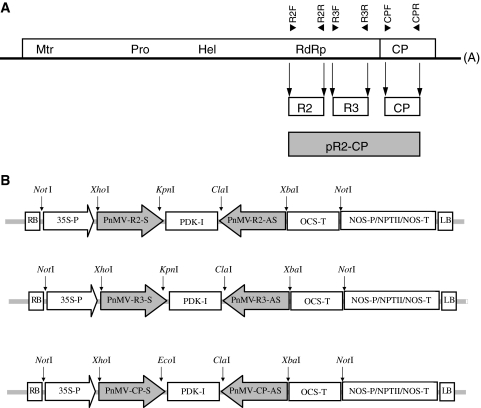
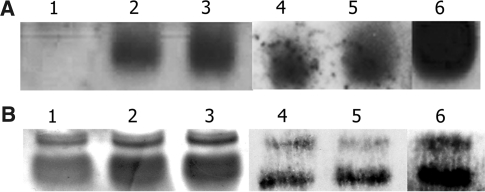
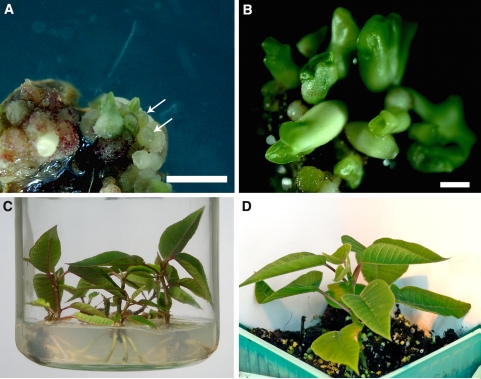
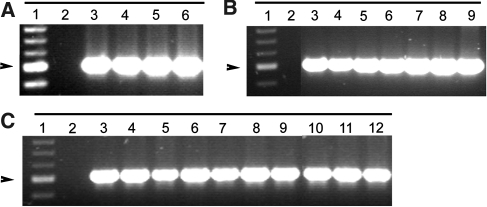
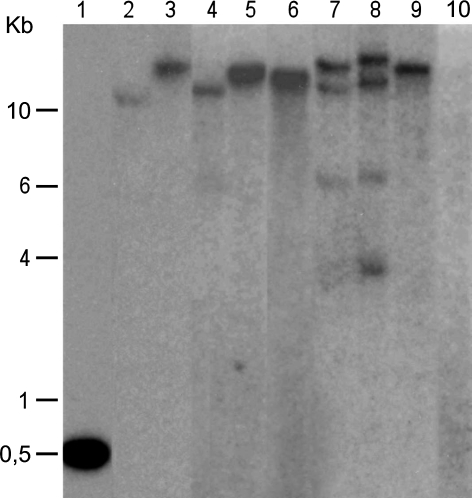
Agrobacterium-mediated transformation for poinsettia (Euphorbia pulcherrima Willd. Ex Klotzsch) is reported here for the first time. Internode stem explants of poinsettia cv. Millenium were transformed by Agrobacterium tumefaciens, strain LBA 4404, harbouring virus-derived hairpin (hp) RNA gene constructs to induce RNA silencing-mediated resistance to Poinsettia mosaic virus (PnMV). Prior to transformation, an efficient somatic embryogenesis system was developed for poinsettia cv. Millenium in which about 75% of the explants produced somatic embryos. In 5 experiments utilizing 868 explants, 18 independent transgenic lines were generated. An average transformation frequency of 2.1% (range 1.2-3.5%) was revealed. Stable integration of transgenes into the poinsettia nuclear genome was confirmed by PCR and Southern blot analysis. Both single- and multiple-copy transgene integration into the poinsettia genome were found among transformants. Transgenic poinsettia plants showing resistance to mechanical inoculation of PnMV were detected by double antibody sandwich enzyme-linked immunosorbent assay (DAS-ELISA). Northern blot analysis of low molecular weight RNA revealed that transgene-derived small interfering (si) RNA molecules were detected among the poinsettia transformants prior to inoculation. The Agrobacterium-mediated transformation methodology developed in the current study should facilitate improvement of this ornamental plant with enhanced disease resistance, quality improvement and desirable colour alteration. Because poinsettia is a non-food, non-feed plant and is not propagated through sexual reproduction, this is likely to be more acceptable even in areas where genetically modified crops are currently not cultivated.
本文首次报道了根癌农杆菌介导的一品红(Euphorbia pulcherrima Willd. Ex Klotzsch)转化。一品红品种Millenium的节间茎外植体被携带病毒衍生发夹(hp)RNA基因构建体的根癌农杆菌菌株LBA 4404转化,以诱导RNA沉默介导的对一品红花叶病毒(PnMV)的抗性。在转化之前,为一品红品种Millenium开发了一种高效的体细胞胚胎发生系统,其中约75%的外植体产生了体细胞胚。在利用868个外植体的5次实验中,产生了18个独立的转基因株系。平均转化频率为2.1%(范围为1.2 - 3.5%)。通过PCR和Southern杂交分析证实了转基因稳定整合到一品红核基因组中。在转化体中发现了单拷贝和多拷贝转基因整合到一品红基因组中的情况。通过双抗体夹心酶联免疫吸附测定(DAS - ELISA)检测到对PnMV机械接种表现出抗性的转基因一品红植株。低分子量RNA的Northern杂交分析表明,在接种前的一品红转化体中检测到了转基因衍生的小干扰(si)RNA分子。本研究中开发的根癌农杆菌介导的转化方法应有助于通过增强抗病性、改善品质和实现理想的颜色改变来改良这种观赏植物。由于一品红是一种非食用、非饲料植物,且不通过有性繁殖繁殖,即使在目前不种植转基因作物的地区,这也可能更容易被接受。