Xue Xiangyang, Zhang Qingfeng, Huang Yufu, Feng Le, Pan Weiqing
Institute for Infectious Diseases and Vaccine Development, Tongji University College of Medicine, 1239 Siping Road, Shanghai 200092, China.
Malar J. 2008 Mar 10;7:47. doi: 10.1186/1475-2875-7-47.
The transcriptional regulation of Plasmodium during its complex life cycle requires sequential activation and/or repression of different genetic programmes. MicroRNAs (miRNAs) are a highly conserved class of non-coding RNAs that are important in regulating diverse cellular functions by sequence-specific inhibition of gene expression. What is know about double-stranded RNA-mediated gene silencing (RNAi) and posttranscriptional gene silencing (PTGS) in Plasmodium parasites entice us to speculate whether miRNAs can also function in Plasmodium-infected RBCs.
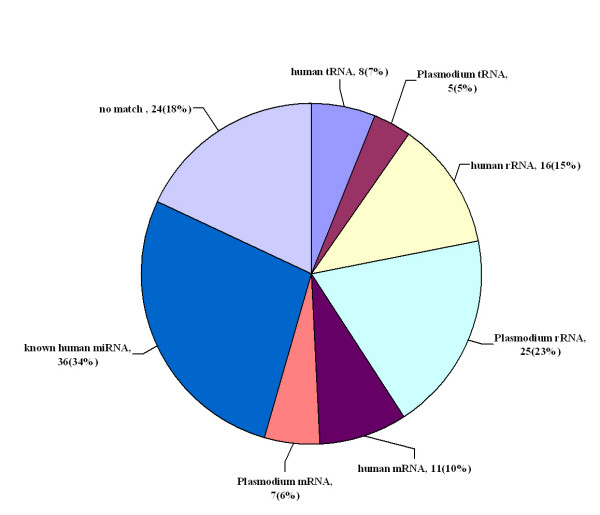
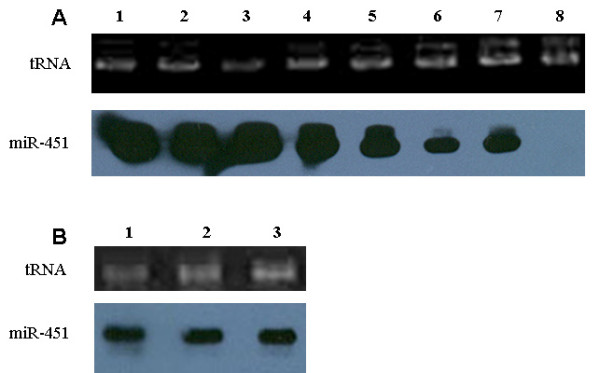
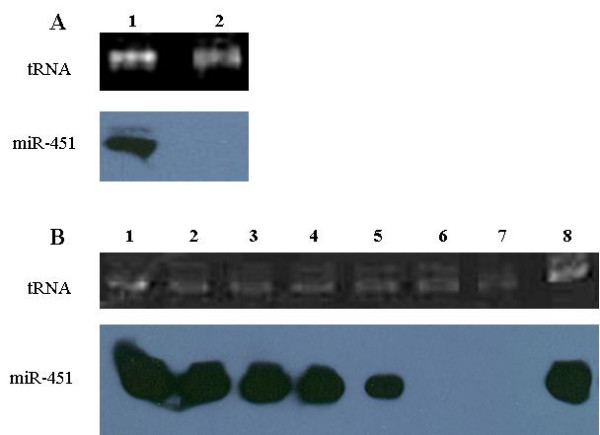
Of 132 small RNA sequences, no Plasmodium-specific miRNAs have been found. However, a human miRNA, miR-451, was highly expressed, comprising approximately one third of the total identified miRNAs. Further analysis of miR-451 expression and malaria infection showed no association between the accumulation of miR-451 in Plasmodium falciparum-iRBCs, the life cycle stage of P. falciparum in the erythrocyte, or of P. berghei in mice. Moreover, treatment with an antisense oligonucleotide to miR-451 had no significant effect on the growth of the erythrocytic-stage P. falciparum.
Short RNAs from a mixed-stage of P. falciparum-iRBC were separated in a denaturing polyacrylamide gel and cloned into T vectors to create a cDNA library. Individual clones were then sequenced and further analysed by bioinformatics prediction to discover probable miRNAs in P. falciparum-iRBC. The association between miR-451 expression and the parasite were analysed by Northern blotting and antisense oligonucleotide (ASO) of miR-451.
These results contribute to eliminate the probability of miRNAs in P. falciparum. The absence of miRNA in P. falciparum could be correlated with absence of argonaute/dicer genes. In addition, the miR-451 accumulation in Plasmodium-infected RBCs is independent of parasite infection. Its accumulation might be only the residual of erythroid differentiation or a component to maintain the normal function of mature RBCs.
疟原虫在其复杂生命周期中的转录调控需要不同遗传程序的顺序激活和/或抑制。微小RNA(miRNA)是一类高度保守的非编码RNA,通过序列特异性抑制基因表达在调节多种细胞功能中起重要作用。关于疟原虫中双链RNA介导的基因沉默(RNAi)和转录后基因沉默(PTGS)的了解促使我们推测miRNA是否也能在疟原虫感染的红细胞中发挥作用。
在132个小RNA序列中,未发现疟原虫特异性miRNA。然而,一种人类miRNA,即miR-451,高度表达,约占已鉴定miRNA总数的三分之一。对miR-451表达与疟疾感染的进一步分析表明,miR-451在恶性疟原虫感染的红细胞中的积累、恶性疟原虫在红细胞中的生命周期阶段或伯氏疟原虫在小鼠中的生命周期阶段之间均无关联。此外,用针对miR-451的反义寡核苷酸处理对恶性疟原虫红细胞期的生长没有显著影响。
将来自恶性疟原虫感染红细胞混合阶段的短RNA在变性聚丙烯酰胺凝胶中分离,并克隆到T载体中以创建cDNA文库。然后对单个克隆进行测序,并通过生物信息学预测进一步分析,以发现恶性疟原虫感染红细胞中可能的miRNA。通过Northern印迹和miR-451的反义寡核苷酸(ASO)分析miR-与寄生虫之间的关联。
这些结果有助于排除恶性疟原虫中存在miRNA的可能性。恶性疟原虫中不存在miRNA可能与缺乏AGO/ Dicer基因有关。此外,miR-451在疟原虫感染的红细胞中的积累与寄生虫感染无关。其积累可能只是红细胞分化的残余物或维持成熟红细胞正常功能的一个组成部分。