Li Li, Ekström Eva-Charlotte, Goessler Walter, Lönnerdal Bo, Nermell Barbro, Yunus Mohammad, Rahman Anisur, El Arifeen Shams, Persson Lars Ake, Vahter Marie
Institute of Environmental Medicine, Karolinska Institutet, Stockholm, Sweden.
Environ Health Perspect. 2008 Mar;116(3):315-21. doi: 10.1289/ehp.10639.
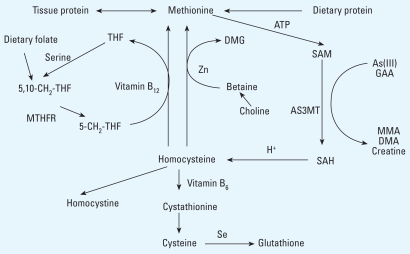
The interindividual variation in metabolism of inorganic arsenic (iAs), involving methylation via one-carbon metabolism, has been well documented, but the reasons remain unclear.
In this population-based study we aimed to elucidate the effect of nutrition on As methylation among women in Matlab, Bangladesh, where people are chronically exposed to iAs via drinking water.
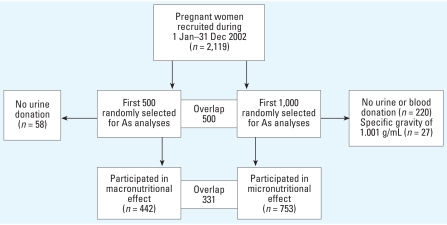
We studied effects of macronutrient status using body mass index (BMI) among 442 women in early pregnancy (gestational week 8), and effects of micronutrient status (plasma folate, vitamin B12, zinc, ferritin, and selenium) among 753 women at gestational week 14. Arsenic metabolites in urine were measured by HPLC combined with hydride generation inductively coupled plasma mass spectrometry.
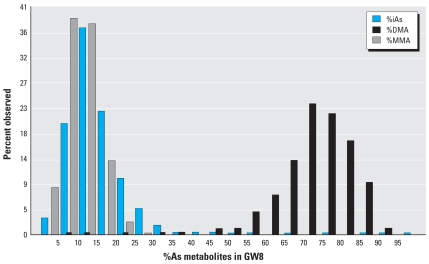
The median concentration of As in urine was 97 microg/L (range, 5-1,216 microg/L, adjusted by specific gravity). The average proportions of iAs, monomethylarsonic acid, and dimethylarsinic acid in urine in gestational week 8 were 15%, 11%, and 74%, respectively. Thus, the women had efficient As methylation in spite of being poorly nourished (one-third had BMIs < 18.5 kg/m2) and having elevated As exposure, both of which are known to decrease As methylation. The metabolism of iAs was only marginally influenced by micronutrient status, probably because women, especially in pregnancy and with low folate intake, have an efficient betaine-mediated remethylation of homocysteine, which is essential for an efficient As methylation.
In spite of the high As exposure and prevalent malnutrition, overall As methylation in women in early pregnancy was remarkably efficient. The As exposure level had the greatest impact on As methylation among the studied factors.
无机砷(iAs)代谢存在个体差异,涉及一碳代谢介导的甲基化,这一点已有充分记录,但原因尚不清楚。
在这项基于人群的研究中,我们旨在阐明营养对孟加拉国马特莱地区妇女砷甲基化的影响,该地区居民长期通过饮用水接触iAs。
我们在442名孕早期(妊娠第8周)妇女中利用体重指数(BMI)研究常量营养素状态的影响,并在753名妊娠第14周妇女中研究微量营养素状态(血浆叶酸、维生素B12、锌、铁蛋白和硒)的影响。通过高效液相色谱结合氢化物发生电感耦合等离子体质谱法测量尿液中的砷代谢产物。
尿液中砷的中位浓度为97μg/L(范围为5 - 1216μg/L,经比重校正)。妊娠第8周时,尿液中iAs、一甲基砷酸和二甲基砷酸的平均比例分别为15%、11%和74%。因此,尽管这些妇女营养状况不佳(三分之一的人体重指数<18.5kg/m²)且砷暴露水平升高,但她们的砷甲基化效率较高,而这两个因素都已知会降低砷甲基化。iAs的代谢仅受到微量营养素状态的轻微影响,可能是因为女性,尤其是孕期且叶酸摄入量低的女性,具有高效的甜菜碱介导的同型半胱氨酸再甲基化作用,这对高效的砷甲基化至关重要。
尽管砷暴露水平高且普遍存在营养不良,但孕早期妇女的总体砷甲基化效率显著。在所研究的因素中,砷暴露水平对砷甲基化的影响最大。