Mancia Filippo, Assur Zahra, Herman Ariel G, Siegel Risa, Hendrickson Wayne A
Department of Biochemistry and Molecular Biophysics, Columbia University, New York, NY 10032, USA.
EMBO Rep. 2008 Apr;9(4):363-9. doi: 10.1038/embor.2008.27. Epub 2008 Mar 14.
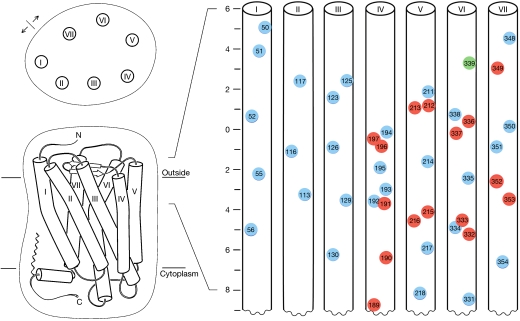
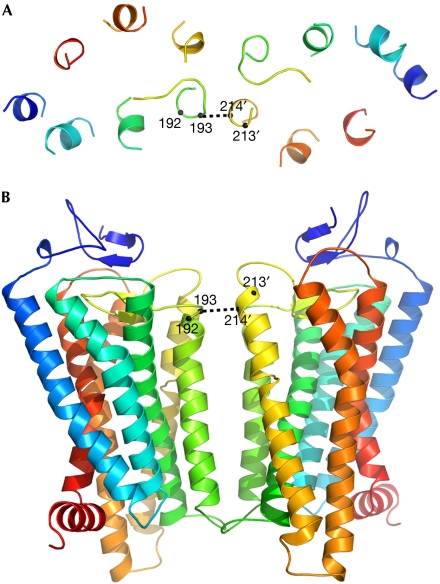
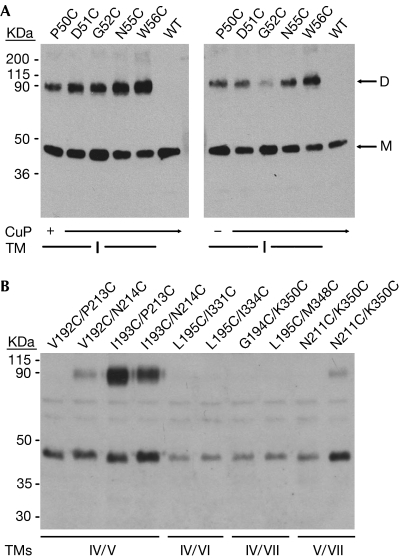
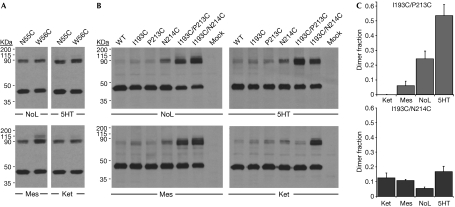
G-protein-coupled receptors (GPCRs) respond to external stimuli by activating heterotrimeric G proteins inside the cell. There is increasing evidence that many GPCRs exist as dimers or higher oligomers, but the biochemical nature of such dimers and what roles they have, if any, in signal transduction remains unclear. We conducted a comprehensive study of dimerization of the 5HT2c serotonin receptor using disulphide-trapping experiments. We found a dimer interface between transmembrane (TM) helices IV and V that is markedly sensitive to the state of receptor activation. This dimer seems to be quasisymmetrical in interfacial geometry and asymmetrical in its association with its cognate G alpha protein. We also found a second interface at TM I helices, which is insensitive to the state of activation.
G蛋白偶联受体(GPCRs)通过激活细胞内的异源三聚体G蛋白来响应外部刺激。越来越多的证据表明,许多GPCRs以二聚体或更高阶寡聚体的形式存在,但此类二聚体的生化性质以及它们在信号转导中是否发挥作用(如果有)仍不清楚。我们使用二硫键捕获实验对5HT2c血清素受体的二聚化进行了全面研究。我们发现跨膜(TM)螺旋IV和V之间存在一个二聚体界面,该界面明显对受体激活状态敏感。这个二聚体在界面几何形状上似乎是准对称的,而在与同源Gα蛋白的结合上是不对称的。我们还在TM I螺旋处发现了第二个界面,该界面对激活状态不敏感。