Chiara Federica, Castellaro Diego, Marin Oriano, Petronilli Valeria, Brusilow William S, Juhaszova Magdalena, Sollott Steven J, Forte Michael, Bernardi Paolo, Rasola Andrea
CNR Institute of Neuroscience and Department of Biomedical Sciences, University of Padova, Padova, Italy.
PLoS One. 2008 Mar 19;3(3):e1852. doi: 10.1371/journal.pone.0001852.
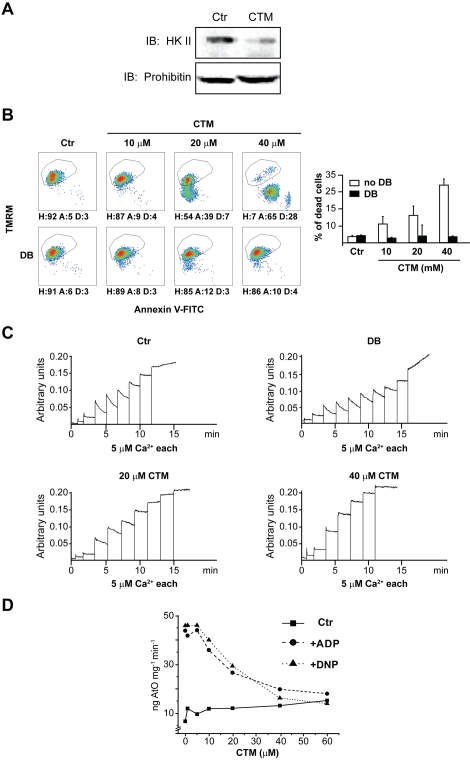
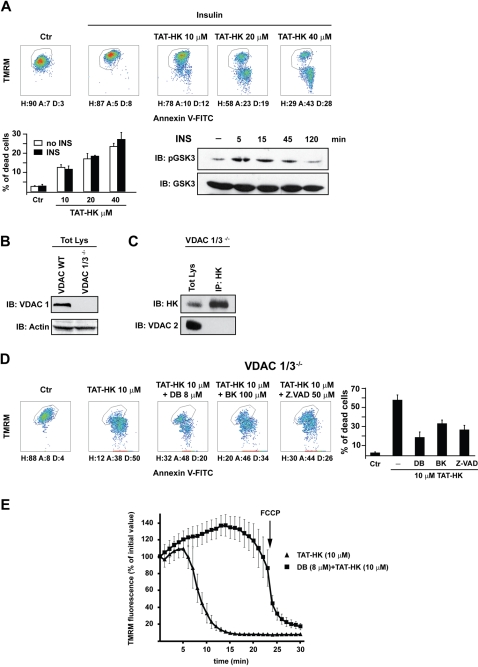
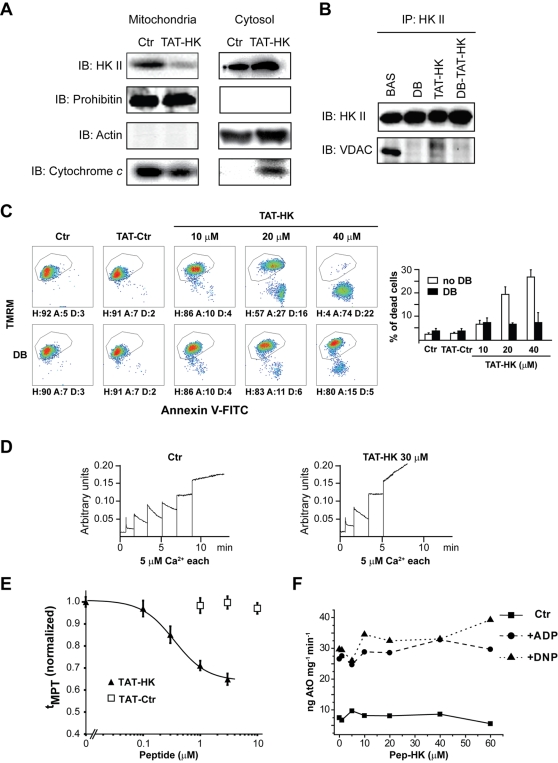
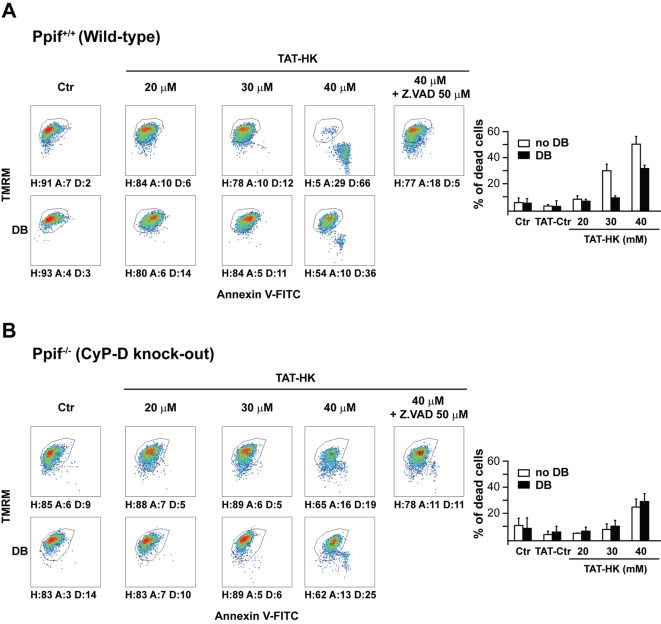
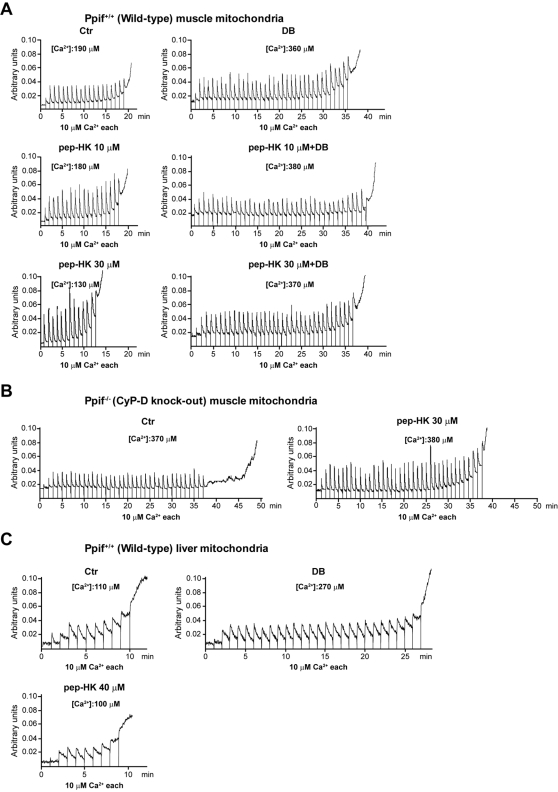
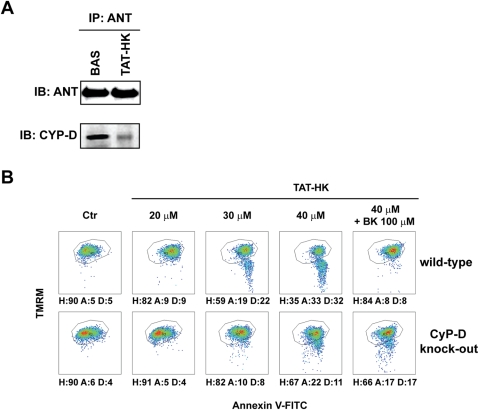
Type II hexokinase is overexpressed in most neoplastic cells, and it mainly localizes on the outer mitochondrial membrane. Hexokinase II dissociation from mitochondria triggers apoptosis. The prevailing model postulates that hexokinase II release from its mitochondrial interactor, the voltage-dependent anion channel, prompts outer mitochondrial membrane permeabilization and the ensuing release of apoptogenic proteins, and that these events are inhibited by growth factor signalling. Here we show that a hexokinase II N-terminal peptide selectively detaches hexokinase II from mitochondria and activates apoptosis. These events are abrogated by inhibiting two established permeability transition pore modulators, the adenine nucleotide translocator or cyclophilin D, or in cyclophilin D knock-out cells. Conversely, insulin stimulation or genetic ablation of the voltage-dependent anion channel do not affect cell death induction by the hexokinase II peptide. Therefore, hexokinase II detachment from mitochondria transduces a permeability transition pore opening signal that results in cell death and does not require the voltage-dependent anion channel. These findings have profound implications for our understanding of the pathways of outer mitochondrial membrane permeabilization and their inactivation in tumors.
II型己糖激酶在大多数肿瘤细胞中过表达,且主要定位于线粒体外膜。己糖激酶II从线粒体解离会触发细胞凋亡。目前流行的模型假定,己糖激酶II从其线粒体相互作用蛋白——电压依赖性阴离子通道释放,会促使线粒体外膜通透性增加以及随后凋亡蛋白的释放,并且这些事件会受到生长因子信号传导的抑制。在此我们表明,一种己糖激酶II N端肽可选择性地使己糖激酶II从线粒体上脱离并激活细胞凋亡。通过抑制两种已确定的通透性转换孔调节剂——腺嘌呤核苷酸转位酶或亲环素D,或在亲环素D基因敲除细胞中,这些事件可被消除。相反,胰岛素刺激或电压依赖性阴离子通道的基因缺失并不影响己糖激酶II肽诱导的细胞死亡。因此,己糖激酶II从线粒体的脱离传递了一个通透性转换孔开放信号,导致细胞死亡,且不需要电压依赖性阴离子通道。这些发现对于我们理解线粒体外膜通透性增加的途径及其在肿瘤中的失活具有深远意义。