School of Exercise and Nutrition Sciences, Deakin University, 221 Burwood Hwy, Burwood, VIC 3125, Australia.
Int J Behav Nutr Phys Act. 2008 Mar 20;5:16. doi: 10.1186/1479-5868-5-16.
Policy is frequently identified in the behavioural nutrition and physical activity research literature as a necessary component of effective research and practice. The purpose of this commentary is to promote a dialogue to contribute towards the further development of conceptual understandings and theories of the relationship between policy practice and behavioural research and how these two activities might work synergistically to improve public health outcomes.
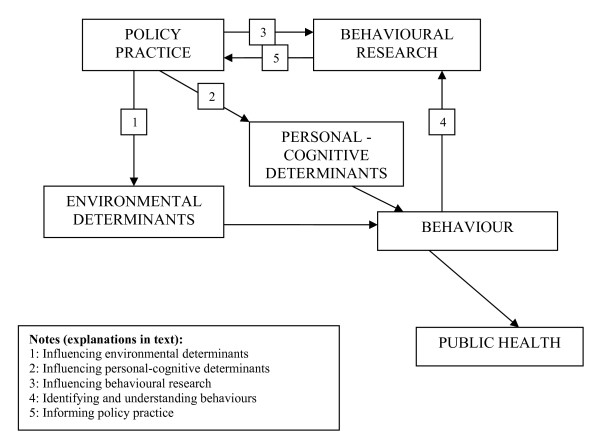
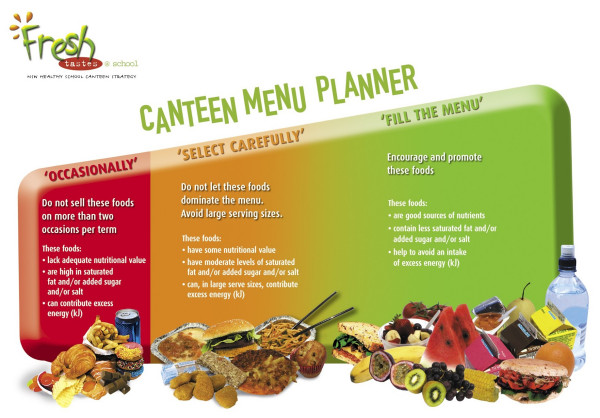
Drawing on policy and public health literature, this commentary presents a a conceptual model of the interaction and mediation between nutrition and physical activity-relevant policy and behavioural nutrition and physical activity research, environments, behaviours and public health implications. The selling of food in school canteens in several Australian states is discussed to illustrate components of the relationship and the interactions among its components.
The model depicts a relationship that is interdependent and cyclic. Policy contributes to the relationship through its role in shaping environmental and personal-cognitive determinants of behaviours and through these determinants it can induce behaviour change. Behavioural research describes behaviours, identifies determinants of behaviour change and therefore helps inform policy development and monitor and evaluate its impact.
The model has implications for guiding behavioural research and policy practice priorities to promote public health outcomes. In particular, we propose that policy practice and behavioural research activities can be strengthened by applying to each other the theories from the scientific disciplines informing these respective activities. Behavioural science theories can be applied to help understand policy-making and assist with disseminating research into policy and practice. In turn, policy science theories can be applied to support the 'institutionalisation' of commitments to ongoing behavioural research.
政策在行为营养和身体活动研究文献中经常被确定为有效研究和实践的必要组成部分。本评论的目的是促进对话,为进一步发展政策实践与行为研究之间关系的概念理解和理论做出贡献,以及这两个活动如何协同工作以改善公共卫生结果。
本评论借鉴政策和公共卫生文献,提出了一个关于营养和身体活动相关政策与行为营养和身体活动研究、环境、行为和公共卫生影响之间相互作用和中介的概念模型。讨论了澳大利亚几个州学校食堂的食品销售,以说明关系的组成部分及其组成部分之间的相互作用。
该模型描绘了一种相互依存和循环的关系。政策通过其在塑造行为的环境和个人认知决定因素中的作用为这种关系做出贡献,并通过这些决定因素诱导行为改变。行为研究描述行为,确定行为改变的决定因素,从而有助于为政策制定提供信息,并监测和评估其影响。
该模型对指导行为研究和政策实践重点以促进公共卫生结果具有重要意义。特别是,我们提出,通过将各自活动所依据的科学学科的理论应用于彼此,政策实践和行为研究活动可以得到加强。行为科学理论可以应用于帮助理解决策制定,并协助将研究传播到政策和实践中。反过来,政策科学理论可以应用于支持对持续行为研究的“制度化”承诺。