Müller Petra, Bulnheim Ulrike, Diener Annette, Lüthen Frank, Teller Marianne, Klinkenberg Ernst-Dieter, Neumann Hans-Georg, Nebe Barbara, Liebold Andreas, Steinhoff Gustav, Rychly Joachim
Cell Biology Laboratory, Medical Faculty, University of Rostock, Rostock, Germany.
J Cell Mol Med. 2008 Jan-Feb;12(1):281-91. doi: 10.1111/j.1582-4934.2007.00103.x.
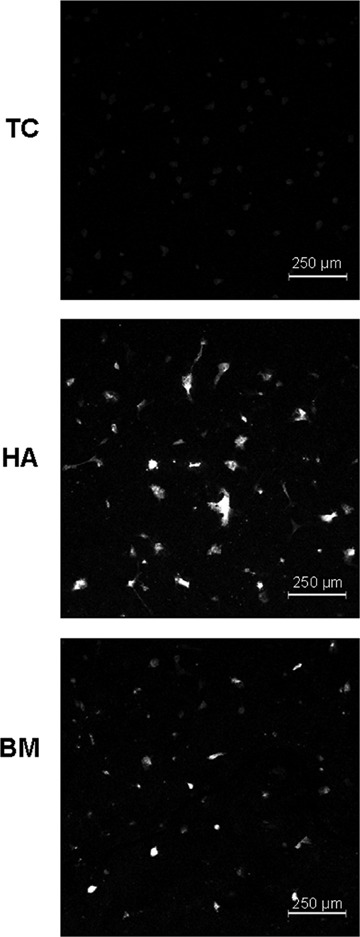
Although studies in vivo revealed promising results in bone regeneration after implantation of scaffolds together with osteogenic progenitor cells, basic questions remain how material surfaces control the biology of mesenchymal stem cells (MSC). We used human MSC derived from bone marrow and studied the osteogenic differentiation on calcium phosphate surfaces. In osteogenic differentiation medium MSC differentiated to osteoblasts on hydroxyapatite and BONITmatrix, a degradable xerogel composite, within 14 days. Cells revealed a higher alkaline phosphatase (ALP) activity and increased RNA expression of collagen I and osteocalcin using real-time RTPCR compared with cells on tissue culture plastic. To test whether material surface characteristics alone are able to stimulate osteogenic differentiation, MSC were cultured on the materials in expansion medium without soluble additives for osteogenic differentiation. Indeed, cells on calcium phosphate without osteogenic differentiation additives developed to osteoblasts as shown by increased ALP activity and expression of osteogenic genes, which was not the case on tissue culture plastic. Because we reasoned that the stimulating effect on osteogenesis by calcium phosphate surfaces depends on an altered cell-extracellular matrix interaction we studied the dynamic behaviour of focal adhesions using cells transfected with GFP labelled vinculin. On BONITmatrix, an increased mobility of focal adhesions was observed compared with cells on tissue culture plastic. In conclusion, calcium phosphate surfaces are able to drive MSC to osteoblasts in the absence of osteogenic differentiation supplements in the medium. An altered dynamic behaviour of focal adhesions on calcium phosphate surfaces might be involved in the molecular mechanisms which promote osteogenic differentiation.
尽管体内研究显示,在植入支架并同时植入成骨祖细胞后,骨再生方面取得了令人鼓舞的结果,但关于材料表面如何控制间充质干细胞(MSC)生物学特性的一些基本问题仍然存在。我们使用源自骨髓的人MSC,研究了其在磷酸钙表面的成骨分化情况。在成骨分化培养基中,MSC在羟基磷灰石和BONITmatrix(一种可降解的干凝胶复合材料)表面于14天内分化为成骨细胞。与在组织培养塑料上培养的细胞相比,这些细胞通过实时RT-PCR显示出更高的碱性磷酸酶(ALP)活性以及I型胶原蛋白和骨钙素的RNA表达增加。为了测试仅材料表面特性是否能够刺激成骨分化,将MSC在无用于成骨分化的可溶性添加剂的扩增培养基中培养在这些材料上。实际上,在没有成骨分化添加剂的磷酸钙上培养的细胞如通过增加的ALP活性和成骨基因表达所示,分化为成骨细胞,而在组织培养塑料上则不然。因为我们推断磷酸钙表面对成骨的刺激作用取决于细胞与细胞外基质相互作用的改变,所以我们使用转染了绿色荧光蛋白标记纽蛋白的细胞研究了粘着斑的动态行为。与在组织培养塑料上培养的细胞相比,在BONITmatrix上观察到粘着斑的迁移率增加。总之,在培养基中不存在成骨分化补充剂的情况下,磷酸钙表面能够促使MSC分化为成骨细胞。磷酸钙表面粘着斑动态行为的改变可能参与了促进成骨分化的分子机制。