Mao Jinghe, Habib Tanwir, Shenwu Ming, Kang Baobin, Allen Wilbur, Robertson LaShonda, Yang Jack Y, Deng Youping
Department of Biology, Tougaloo College, Tougaloo, MS 39174, USA.
BMC Genomics. 2008;9 Suppl 1(Suppl 1):S14. doi: 10.1186/1471-2164-9-S1-S14.
The budding yeast Saccharomyces cerevisiae is a eukaryotic organism with extensive genetic redundancy. Large-scale gene deletion analysis has shown that over 80% of the ~6200 predicted genes are nonessential and that the functions of 30% of all ORFs remain unclassified, implying that yeast cells can tolerate deletion of a substantial number of individual genes. For example, a class of zinc finger proteins containing C2H2 zinc fingers in tandem arrays of two or three is predicted to be transcription factors; however, seven of the thirty-one predicted genes of this class are nonessential, and their functions are poorly understood. In this study we completed a transcriptomic profiling of three mutants lacking C2H2 zinc finger proteins, ypr013cDelta,ypr015cDelta and ypr013cDeltaypr015cDelta.
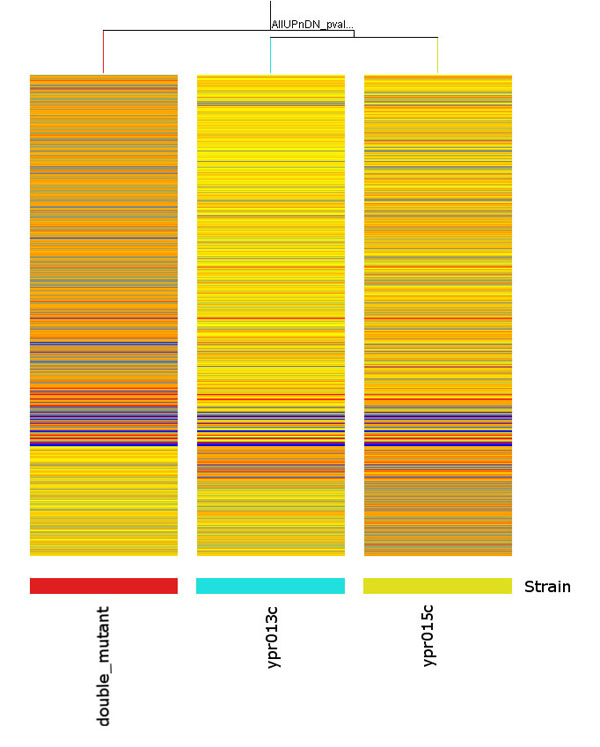
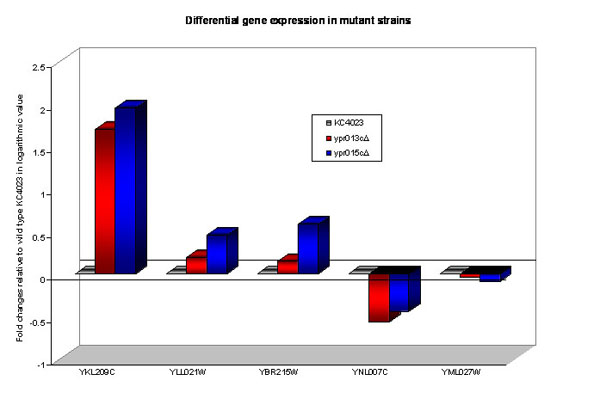
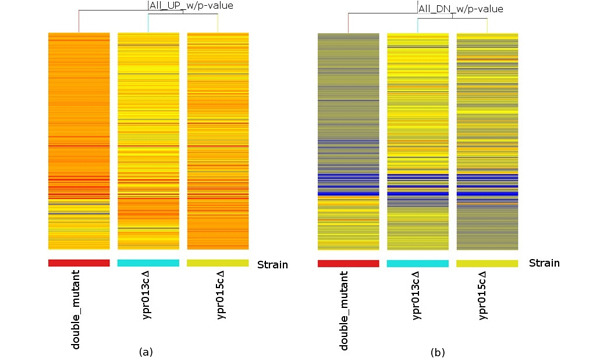
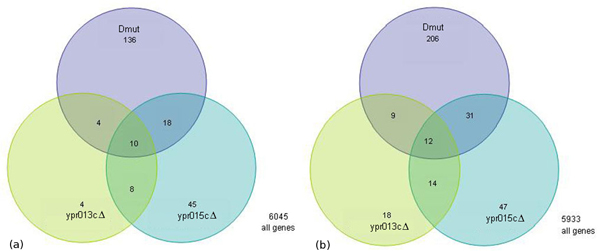
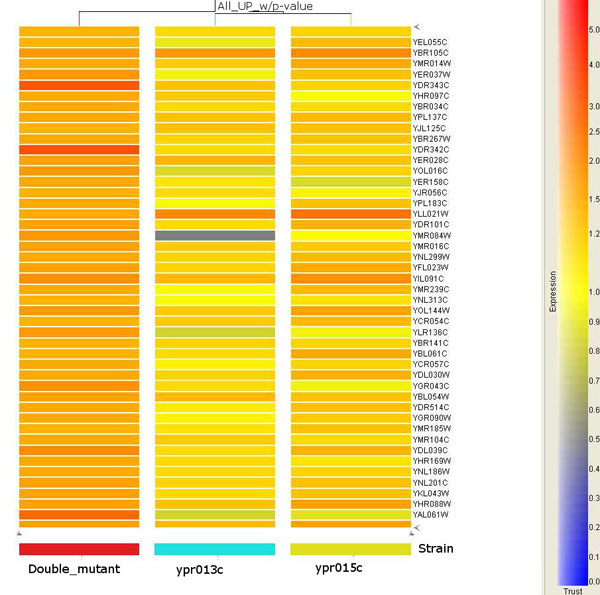
Gene expression patterns were remarkably different between wild type and the mutants. The results indicate altered expression of 79 genes in ypr013cDelta, 185 genes in ypr015cDelta and 426 genes in the double mutant when compared with that of the wild type strain. More than 80% of the alterations in the double mutants were not observed in either one of the single deletion mutants. Functional categorization based on Munich Information Center for Protein Sequences (MIPS) revealed up-regulation of genes related to transcription and down-regulation of genes involving cell rescue and defense, suggesting a decreased response to stress conditions. Genes related to cell cycle and DNA processing whose expression was affected by single or double deletions were also identified.
Our results suggest that microarray analysis can define the biological roles of zinc finger proteins with unknown functions and identify target genes that are regulated by these putative transcriptional factors. These findings also suggest that both YPR013C and YPR015C have biological processes in common, in addition to their own regulatory pathways.
出芽酵母酿酒酵母是一种具有广泛基因冗余的真核生物。大规模基因缺失分析表明,在约6200个预测基因中,超过80%是非必需的,并且所有开放阅读框(ORF)中有30%的功能仍未分类,这意味着酵母细胞能够耐受大量单个基因的缺失。例如,一类含有两个或三个串联C2H2锌指的锌指蛋白被预测为转录因子;然而,该类别的31个预测基因中有7个是非必需的,并且对其功能了解甚少。在本研究中,我们完成了三个缺乏C2H2锌指蛋白的突变体ypr013cΔ、ypr015cΔ和ypr013cΔypr015cΔ的转录组分析。
野生型和突变体之间的基因表达模式存在显著差异。结果表明,与野生型菌株相比,ypr013cΔ中有79个基因表达改变,ypr015cΔ中有185个基因表达改变,双突变体中有426个基因表达改变。双突变体中超过80%的改变在单个缺失突变体中均未观察到。基于慕尼黑蛋白质序列信息中心(MIPS)的功能分类显示,与转录相关的基因上调,而涉及细胞拯救和防御的基因下调,这表明对应激条件的反应降低。还鉴定了其表达受单缺失或双缺失影响的与细胞周期和DNA加工相关的基因。
我们的结果表明,微阵列分析可以确定功能未知的锌指蛋白的生物学作用,并鉴定受这些假定转录因子调控的靶基因。这些发现还表明,除了它们自己的调控途径外,YPR013C和YPR015C都有共同的生物学过程。