Murphy Dennis, Dancis Barry, Brown James R
Bioinformatics, Molecular Discovery Research, GlaxoSmithKline, 1250 South Collegeville Road, UP1345, Collegeville, Pennsylvania 19426, USA.
BMC Evol Biol. 2008 Mar 25;8:92. doi: 10.1186/1471-2148-8-92.
MicroRNAs (miRNAs) are a recently discovered class of non-coding RNAs (ncRNAs) which play important roles in eukaryotic gene regulation. miRNA biogenesis and activation is a complex process involving multiple protein catalysts and involves the large macromolecular RNAi Silencing Complex or RISC. While phylogenetic analyses of miRNA genes have been previously published, the evolution of miRNA biogenesis itself has been little studied. In order to better understand the origin of miRNA processing in animals and plants, we determined the phyletic occurrences and evolutionary relationships of four major miRNA pathway protein components; Dicer, Argonaute, RISC RNA-binding proteins, and Exportin-5.
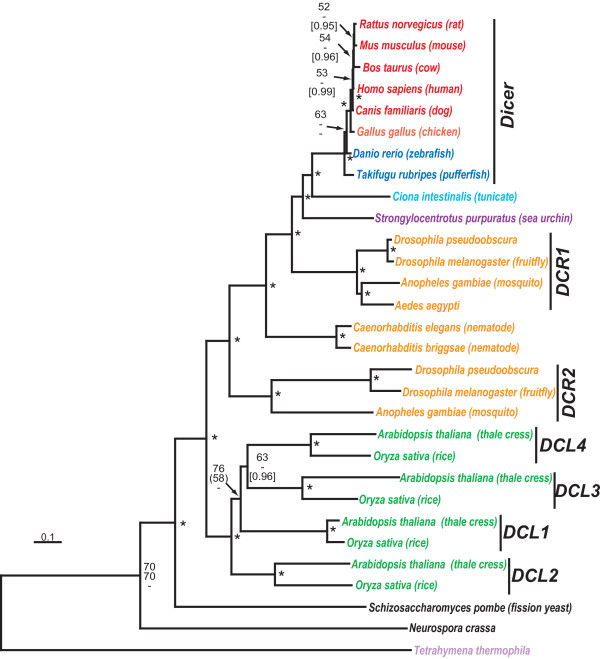
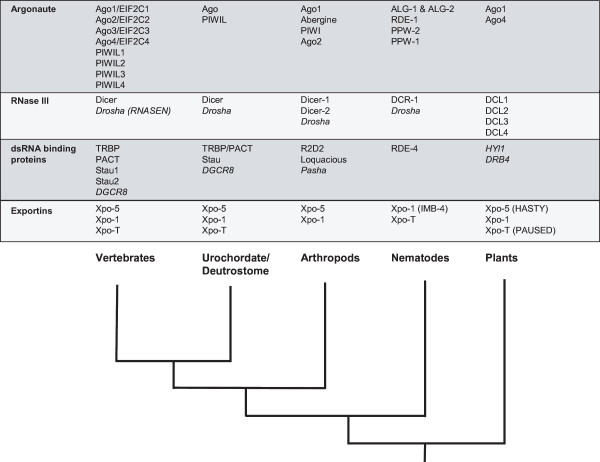
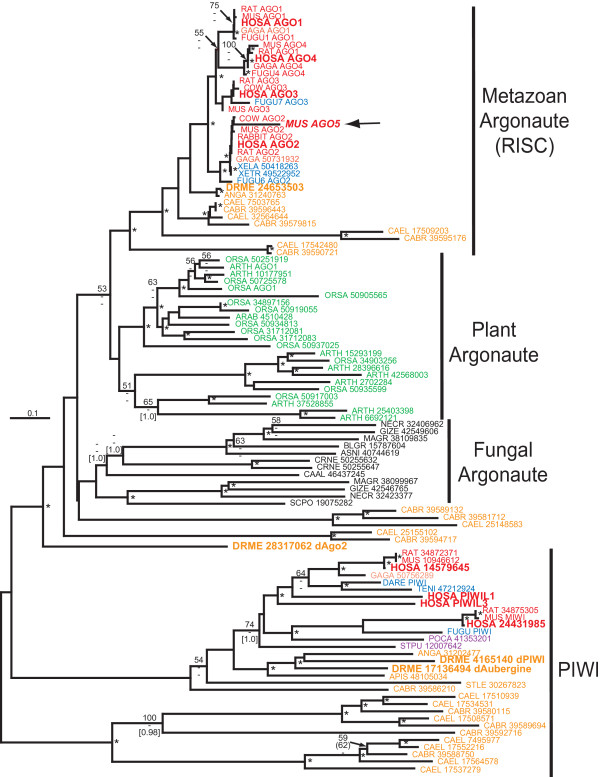
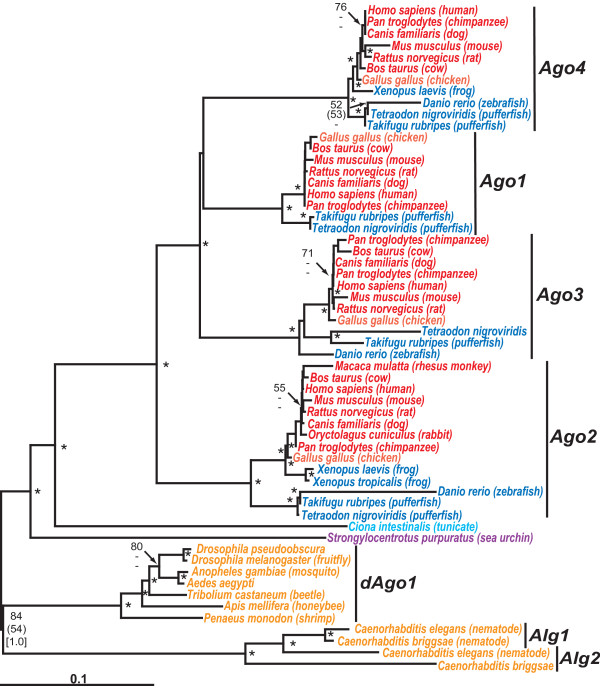
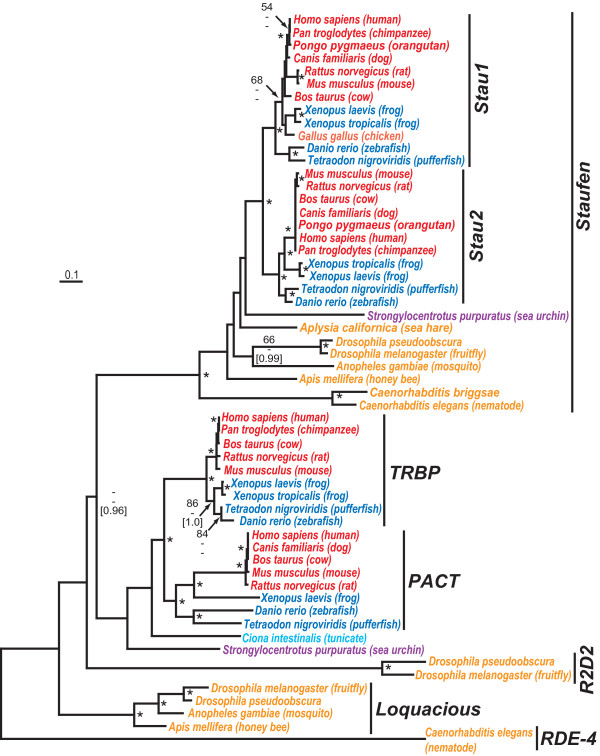
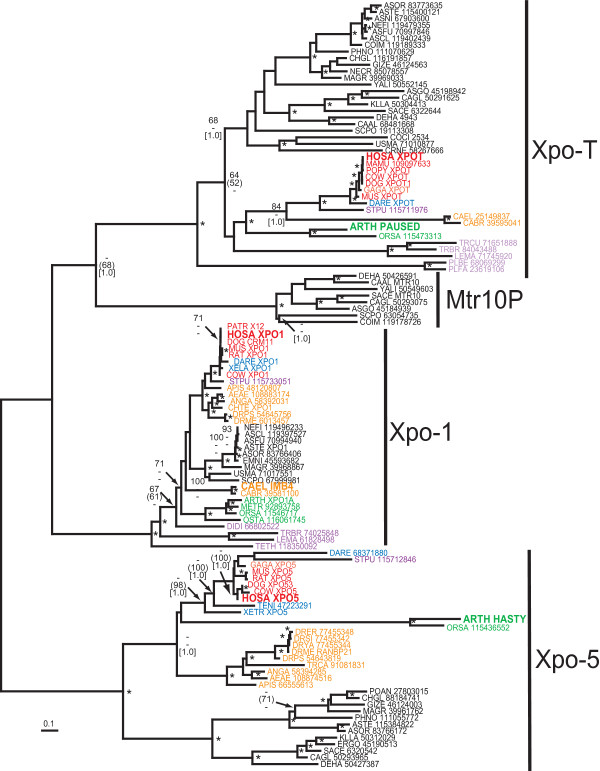
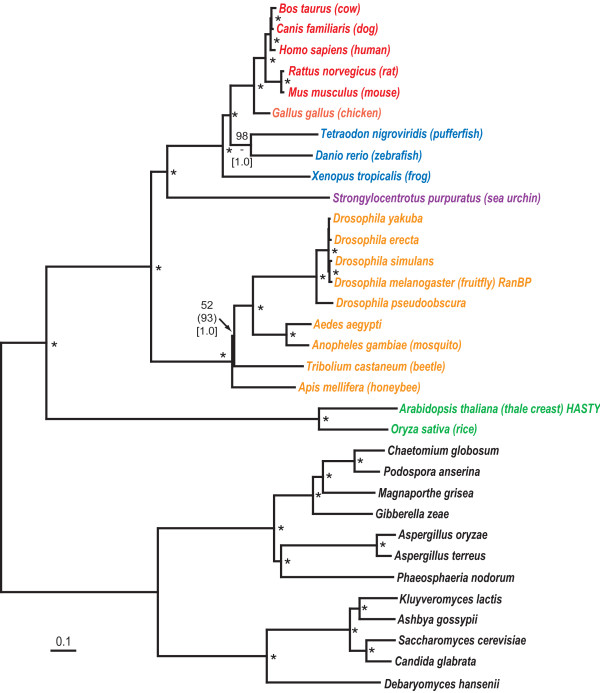
Phylogenetic analyses show that all four miRNA pathway proteins were derived from large multiple protein families. As an example, vertebrate and invertebrate Argonaute (Ago) proteins diverged from a larger family of PIWI/Argonaute proteins found throughout eukaryotes. Further gene duplications among vertebrates after the evolution of chordates from urochordates but prior to the emergence of fishes lead to the evolution of four Ago paralogues. Invertebrate RISC RNA-binding proteins R2D2 and Loquacious are related to other RNA-binding protein families such as Staufens as well as vertebrate-specific TAR (HIV trans-activator RNA) RNA-binding protein (TRBP) and protein kinase R-activating protein (PACT). Export of small RNAs from the nucleus, including miRNA, is facilitated by three closely related karyopherin-related nuclear transporters, Exportin-5, Exportin-1 and Exportin-T. While all three exportins have direct orthologues in deutrostomes, missing exportins in arthropods (Exportin-T) and nematodes (Exportin-5) are likely compensated by dual specificities of one of the other exportin paralogues.
Co-opting particular isoforms from large, diverse protein families seems to be a common theme in the evolution of miRNA biogenesis. Human miRNA biogenesis proteins have direct, orthologues in cold-blooded fishes and, in some cases, urochordates and deutrostomes. However, lineage specific expansions of Dicer in plants and invertebrates as well as Argonaute and RNA-binding proteins in vertebrates suggests that novel ncRNA regulatory mechanisms can evolve in relatively short evolutionary timeframes. The occurrence of multiple homologues to RNA-binding and Argonaute/PIWI proteins also suggests the possible existence of further pathways for additional types of ncRNAs.
微小RNA(miRNA)是最近发现的一类非编码RNA(ncRNA),在真核基因调控中发挥重要作用。miRNA的生物合成与激活是一个涉及多种蛋白质催化剂的复杂过程,且涉及大型大分子RNA干扰沉默复合体或RNA诱导沉默复合体(RISC)。虽然此前已发表过miRNA基因的系统发育分析,但miRNA生物合成本身的进化却鲜有研究。为了更好地理解动植物中miRNA加工的起源,我们确定了四种主要miRNA通路蛋白成分的系统发生出现情况和进化关系;即Dicer、AGO蛋白、RISC RNA结合蛋白和Exportin-5。
系统发育分析表明,所有四种miRNA通路蛋白均源自大型多蛋白家族。例如,脊椎动物和无脊椎动物的AGO蛋白与整个真核生物中发现的更大的PIWI/AGO蛋白家族分化而来。在脊索动物从尾索动物进化而来但在鱼类出现之前,脊椎动物中的进一步基因复制导致了四种AGO旁系同源物的进化。无脊椎动物RISC RNA结合蛋白R2D2和Loquacious与其他RNA结合蛋白家族相关,如Staufen以及脊椎动物特有的HIV反式激活因子RNA(TAR)RNA结合蛋白(TRBP)和蛋白激酶R激活蛋白(PACT)。包括miRNA在内的小RNA从细胞核的输出由三种密切相关的核转运蛋白相关核转运体Exportin-5、Exportin-1和Exportin-T促进。虽然所有这三种输出蛋白在后口动物中都有直接的直系同源物,但节肢动物(Exportin-T)和线虫(Exportin-5)中缺失的输出蛋白可能由其他输出蛋白旁系同源物之一的双重特异性来补偿。
从大型多样的蛋白家族中选择特定的异构体似乎是miRNA生物合成进化中的一个共同主题。人类miRNA生物合成蛋白在冷血鱼类中,在某些情况下,在尾索动物和后口动物中有直接的直系同源物。然而,植物和无脊椎动物中Dicer以及脊椎动物中AGO和RNA结合蛋白的谱系特异性扩增表明,新的ncRNA调控机制可以在相对较短的进化时间框架内进化。RNA结合蛋白和AGO/PIWI蛋白的多个同源物的出现也表明可能存在其他类型ncRNA的进一步通路。