Jungers Courtney F, Djuranovic Sergej
Department of Cell Biology and Physiology, Washington University School of Medicine, St. Louis, MO, United States.
Front Mol Biosci. 2022 Feb 14;9:832916. doi: 10.3389/fmolb.2022.832916. eCollection 2022.
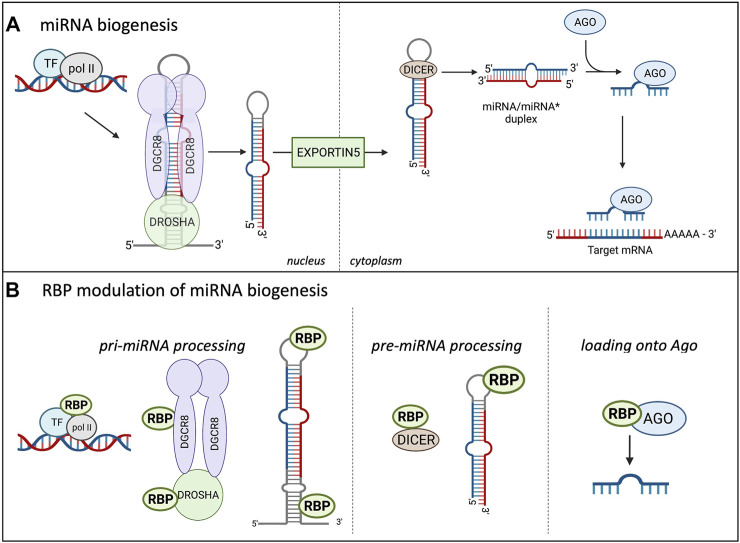
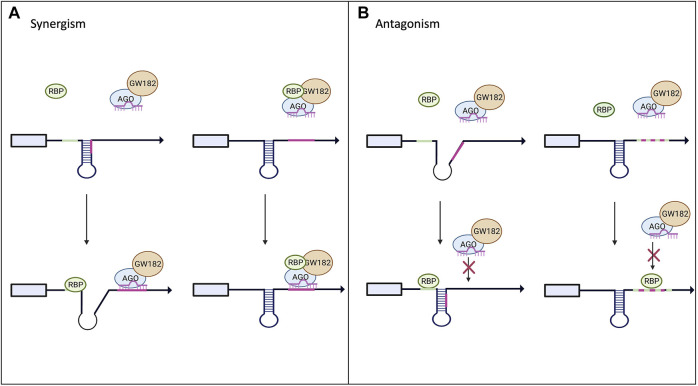
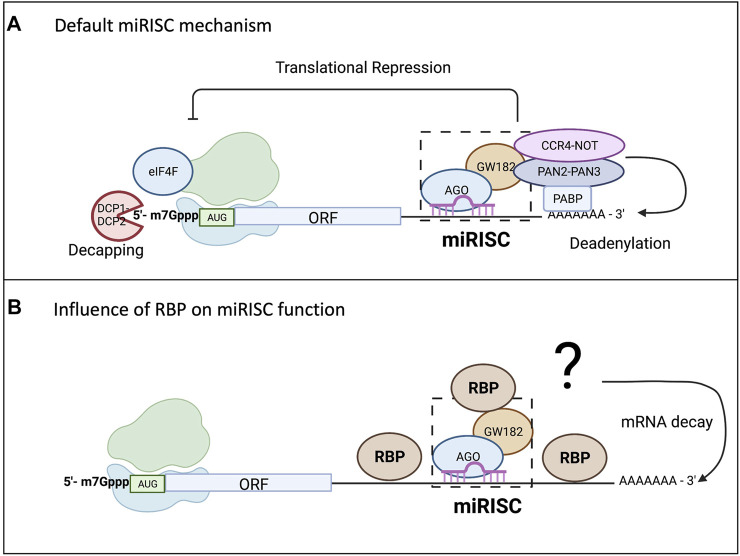
Gene expression is regulated at multiple levels in eukaryotic cells. Regulation at the post-transcriptional level is modulated by various -acting factors that bind to specific sequences in the messenger RNA (mRNA). The binding of different factors influences various aspects of the mRNA such as degradation rate, translation efficiency, splicing, localization, etc. MicroRNAs (miRNAs) are short endogenous ncRNAs that combine with the Argonaute to form the microRNA-induced silencing complex (miRISC), which uses base-pair complementation to silence the target transcript. RNA-binding proteins (RBPs) contribute to post-transcriptional control by influencing the mRNA stability and translation upon binding to -elements within the mRNA transcript. RBPs have been shown to impact gene expression through influencing the miRISC biogenesis, composition, or miRISC-mRNA target interaction. While there is clear evidence that those interactions between RBPs, miRNAs, miRISC and target mRNAs influence the efficiency of miRISC-mediated gene silencing, the exact mechanism for most of them remains unclear. This review summarizes our current knowledge on gene expression regulation through interactions of miRNAs and RBPs.
在真核细胞中,基因表达在多个水平上受到调控。转录后水平的调控由各种与信使核糖核酸(mRNA)中特定序列结合的反式作用因子介导。不同因子的结合会影响mRNA的各个方面,如降解速率、翻译效率、剪接、定位等。微小RNA(miRNA)是短的内源性非编码RNA,其与AGO蛋白结合形成微小RNA诱导沉默复合体(miRISC),该复合体利用碱基互补配对使靶转录本沉默。RNA结合蛋白(RBP)通过与mRNA转录本中的元件结合影响mRNA稳定性和翻译,从而对转录后调控发挥作用。研究表明,RBP通过影响miRISC的生物发生、组成或miRISC与mRNA靶标的相互作用来影响基因表达。虽然有明确证据表明RBP、miRNA、miRISC和靶mRNA之间的相互作用会影响miRISC介导的基因沉默效率,但其中大多数的确切机制仍不清楚。本综述总结了我们目前关于通过miRNA与RBP相互作用进行基因表达调控的知识。