Pelissier Patrick, Delourme Didier, Germot Agnes, Blanchet Xavier, Becila Samira, Maftah Abderrahman, Leveziel Hubert, Ouali Ahmed, Bremaud Laure
INRA, UMR 1061 Unité de Génétique Moléculaire Animale, Université de Limoges, IFR 145, Faculté des Sciences et Techniques, 87060 Limoges, France.
BMC Genomics. 2008 Apr 2;9:151. doi: 10.1186/1471-2164-9-151.
The superfamily of serine proteinase inhibitors (serpins) is involved in numerous fundamental biological processes as inflammation, blood coagulation and apoptosis. Our interest is focused on the SERPINA3 sub-family. The major human plasma protease inhibitor, alpha1-antichymotrypsin, encoded by the SERPINA3 gene, is homologous to genes organized in clusters in several mammalian species. However, although there is a similar genic organization with a high degree of sequence conservation, the reactive-centre-loop domains, which are responsible for the protease specificity, show significant divergences.
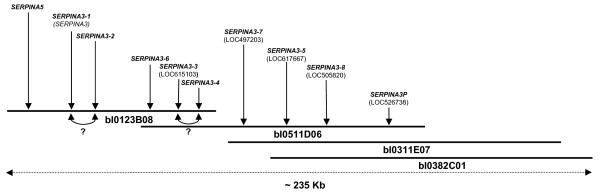
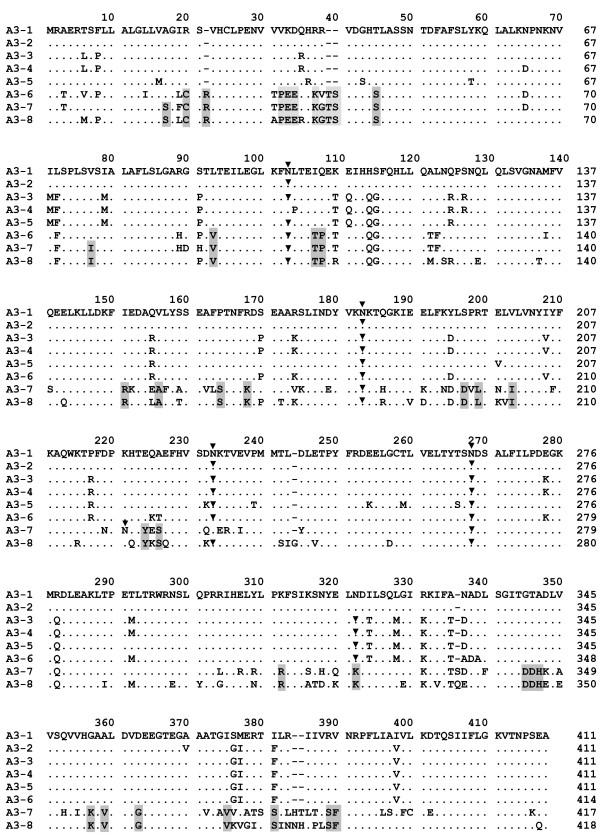
We provide additional information by analyzing the situation of SERPINA3 in the bovine genome. A cluster of eight genes and one pseudogene sharing a high degree of identity and the same structural organization was characterized. Bovine SERPINA3 genes were localized by radiation hybrid mapping on 21q24 and only spanned over 235 Kilobases. For all these genes, we propose a new nomenclature from SERPINA3-1 to SERPINA3-8. They share approximately 70% of identity with the human SERPINA3 homologue. In the cluster, we described an original sub-group of six members with an unexpected high degree of conservation for the reactive-centre-loop domain, suggesting a similar peptidase inhibitory pattern. Preliminary expression analyses of these bovSERPINA3s showed different tissue-specific patterns and diverse states of glycosylation and phosphorylation. Finally, in the context of phylogenetic analyses, we improved our knowledge on mammalian SERPINAs evolution.
Our experimental results update data of the bovine genome sequencing, substantially increase the bovSERPINA3 sub-family and enrich the phylogenetic tree of serpins. We provide new opportunities for future investigations to approach the biological functions of this unusual subset of serine proteinase inhibitors.
丝氨酸蛋白酶抑制剂(serpins)超家族参与众多基础生物学过程,如炎症、血液凝固和细胞凋亡。我们的研究兴趣集中在SERPINA3亚家族。由SERPINA3基因编码的主要人类血浆蛋白酶抑制剂α1 - 抗糜蛋白酶,与几种哺乳动物物种中以簇状组织的基因同源。然而,尽管存在相似的基因组织且序列保守程度较高,但负责蛋白酶特异性的反应中心环结构域却存在显著差异。
我们通过分析牛基因组中SERPINA3的情况提供了更多信息。鉴定出一个由八个基因和一个假基因组成的簇,它们具有高度的同一性和相同的结构组织。通过辐射杂种图谱将牛SERPINA3基因定位在21q24,且仅跨越235千碱基。对于所有这些基因,我们提出了从SERPINA3 - 1到SERPINA3 - 8的新命名法。它们与人类SERPINA3同源物大约有70%的同一性。在该簇中,我们描述了一个由六个成员组成的原始亚组,其反应中心环结构域具有意想不到的高度保守性,表明其具有相似的肽酶抑制模式。对这些牛SERPINA3的初步表达分析显示出不同的组织特异性模式以及糖基化和磷酸化的不同状态。最后,在系统发育分析的背景下,我们增进了对哺乳动物serpins进化的了解。
我们的实验结果更新了牛基因组测序数据,大幅增加了牛SERPINA3亚家族并丰富了serpins的系统发育树。我们为未来研究这个不寻常的丝氨酸蛋白酶抑制剂子集的生物学功能提供了新机会。