Embi Peter J, Jain Anil, Harris C Martin
Center for Health Informatics and Department of Medicine, University of Cincinnati Academic Health Center, 231 Albert Sabin Way, PO Box 670840, Cincinnati, Ohio, USA.
BMC Med Inform Decis Mak. 2008 Apr 2;8:13. doi: 10.1186/1472-6947-8-13.
Physician participation in clinical research recruitment efforts is critical to many studies' success, but it is often limited. Use of an Electronic Health Record (EHR)-based, point-of-care Clinical Trial Alert (CTA) approach has led to significant increases in physician-generated recruitment and holds promise for wider benefit. However, little is known about physicians' decision-making regarding recruitment in EHR-equipped settings or the use of such EHR-based approaches. We sought to assess physicians' perceptions about recruitment in general and using the CTA approach in particular.
We developed and delivered a Web-based survey consisting of 15 multiple-choice and free-text questions. Participants included the 114 physician subjects (10 endocrinologists and 104 general internists) who were exposed to CTAs during our preceding 4-month intervention study. Response data were descriptively analyzed, and key findings were compared between groups using appropriate statistical tests.
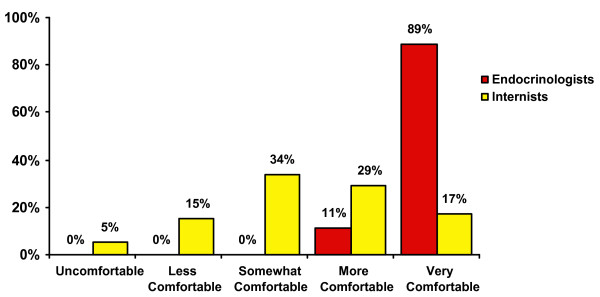
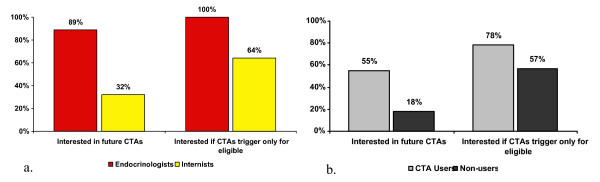
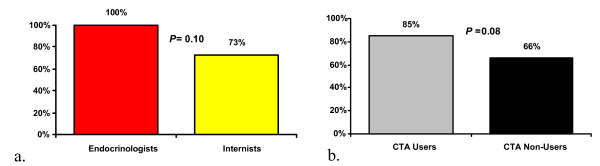
Sixty-nine physicians (61%) responded during the 10-week survey period. Respondents and non-respondents did not differ significantly. Twenty-seven percent of respondents felt very comfortable recruiting patients to trials in general, and 77% appreciated being reminded about a trial via a CTA. Only 11% percent felt the CTA was difficult to use, and 27% felt it was more than somewhat intrusive. Among those who ignored all CTAs, 37% cited a lack of time, 28% knowledge of the patient's ineligibility, and 13% limited knowledge about the trial as their most common reason. Thirty-eight percent wanted more information about the trial presented in the CTA, and 73% were interested in seeing CTAs for future trials. Comments and suggestions were submitted by 33% of respondents and included suggestions for improvement of the CTA approach.
Most physicians were comfortable recruiting patients for clinical trials at the point-of-care, found the EHR-based CTA approach useful and would like to see it used in the future. These findings provide insight into the perceived utility of this EHR-based approach to subject recruitment, suggest ways it might be improved, and add to the limited body of knowledge regarding physicians' attitudes toward clinical trial recruitment in EHR-equipped settings.
医生参与临床研究招募工作对许多研究的成功至关重要,但这种参与往往有限。采用基于电子健康记录(EHR)的即时护理临床试验提醒(CTA)方法已使医生促成的招募人数显著增加,并有望带来更广泛的益处。然而,对于在配备EHR的环境中医生关于招募的决策或此类基于EHR的方法的使用情况,人们了解甚少。我们试图评估医生对一般招募情况的看法,特别是对使用CTA方法的看法。
我们开发并提供了一项基于网络的调查,其中包含15个多项选择题和自由文本问题。参与者包括在我们之前为期4个月的干预研究中接触过CTA的114名医生受试者(10名内分泌学家和104名普通内科医生)。对回复数据进行描述性分析,并使用适当的统计检验在组间比较关键发现。
在为期10周的调查期内,69名医生(61%)做出了回复。回复者和未回复者之间没有显著差异。27%的回复者总体上对招募患者参加试验感到非常自在,77%的人对通过CTA收到试验提醒表示感激。只有11%的人认为CTA难以使用,27%的人认为它有些过于侵扰。在那些忽略所有CTA的人中,37%的人表示缺乏时间,28%的人表示知道患者不符合资格,13%的人表示对试验了解有限是他们最常见的原因。38%的人希望CTA中提供更多关于试验的信息,73%的人对未来试验的CTA感兴趣。33%的回复者提交了评论和建议,包括对CTA方法改进的建议。
大多数医生对在即时护理时招募患者参加临床试验感到自在,认为基于EHR的CTA方法有用,并希望在未来看到它被使用。这些发现深入了解了这种基于EHR的受试者招募方法的感知效用,提出了可能的改进方法,并增加了关于医生在配备EHR的环境中对临床试验招募态度的有限知识。