Svendsen Soshana, Zimprich Chad, McDougall Mark G, Klaubert Dieter H, Los Georgyi V
Promega Corporation 2800 Woods Hollow Road, Madison, WI 53711, USA.
BMC Cell Biol. 2008 Apr 2;9:17. doi: 10.1186/1471-2121-9-17.
The ability to specifically label proteins within living cells can provide information about their dynamics and function. To study a membrane protein, we fused a multi-functional reporter protein, HaloTag, to the extracellular domain of a truncated integrin.
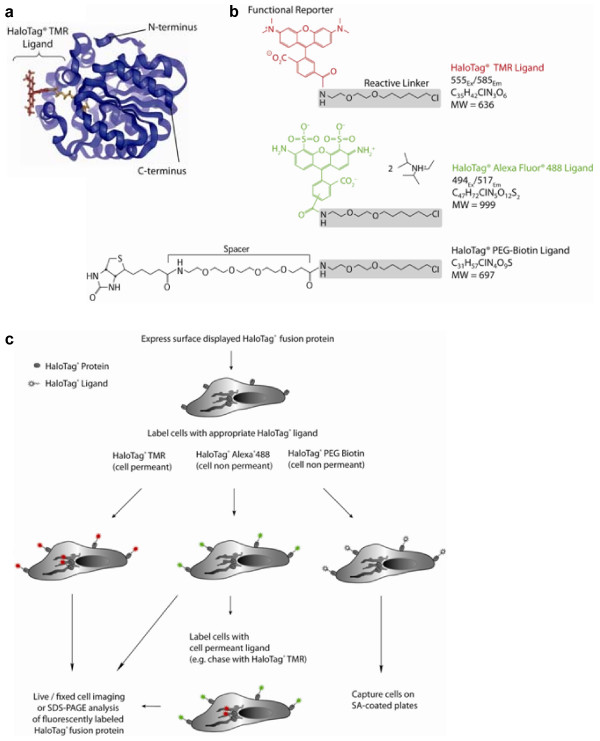
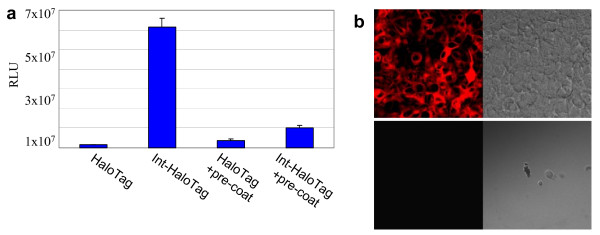
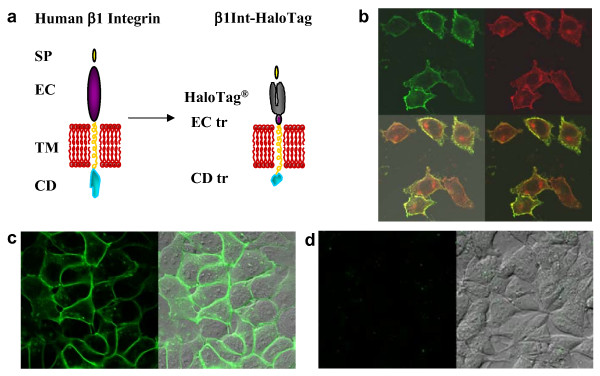
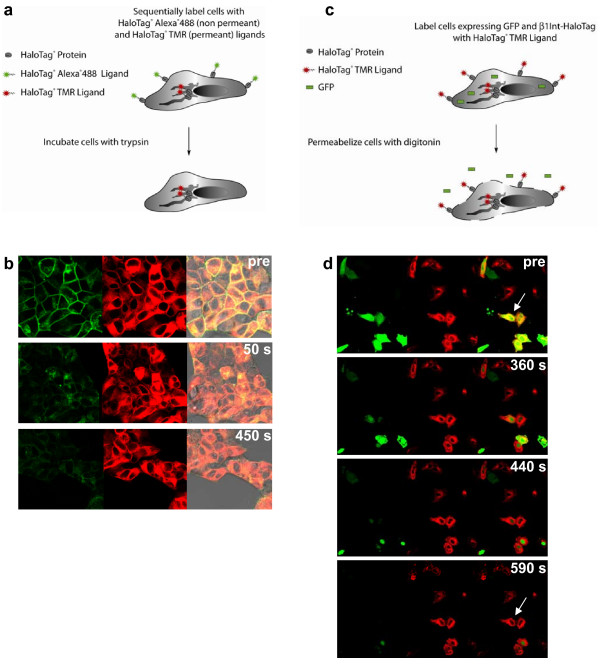
Using the HaloTag technology, we could study the localization, trafficking and processing of an integrin-HaloTag fusion, which we showed had cellular dynamics consistent with native integrins. By labeling live cells with different fluorescent impermeable and permeable ligands, we showed spatial separation of plasma membrane and internal pools of the integrin-HaloTag fusion, and followed these protein pools over time to study bi-directional trafficking. In addition to combining the HaloTag reporter protein with different fluorophores, we also employed an affinity tag to achieve cell capture.
The HaloTag technology was used successfully to study expression, trafficking, spatial separation and real-time translocation of an integrin-HaloTag fusion, thereby demonstrating that this technology can be a powerful tool to investigate membrane protein biology in live cells.
在活细胞内特异性标记蛋白质的能力能够提供有关其动态变化和功能的信息。为了研究一种膜蛋白,我们将一种多功能报告蛋白HaloTag与截短整合素的胞外结构域融合。
利用HaloTag技术,我们能够研究整合素-HaloTag融合蛋白的定位、运输和加工过程,结果表明其细胞动态变化与天然整合素一致。通过用不同的荧光非渗透性和渗透性配体标记活细胞,我们展示了整合素-HaloTag融合蛋白在质膜和内部库之间的空间分离,并随着时间追踪这些蛋白库以研究双向运输。除了将HaloTag报告蛋白与不同的荧光团结合外,我们还使用了一种亲和标签来实现细胞捕获。
HaloTag技术成功用于研究整合素-HaloTag融合蛋白的表达、运输、空间分离和实时转运,从而证明该技术可成为研究活细胞中膜蛋白生物学的有力工具。