Ditlevson Jennifer V, Tornaletti Silvia, Belotserkovskii Boris P, Teijeiro Virginia, Wang Guliang, Vasquez Karen M, Hanawalt Philip C
Department of Biological Sciences, Stanford University, Stanford, CA, 94305, USA.
Nucleic Acids Res. 2008 Jun;36(10):3163-70. doi: 10.1093/nar/gkn136. Epub 2008 Apr 9.
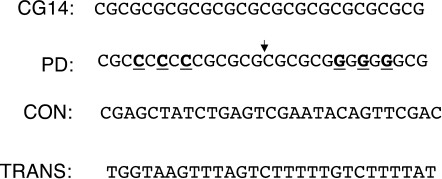
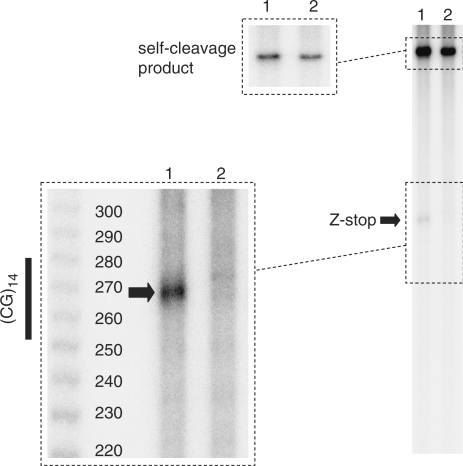
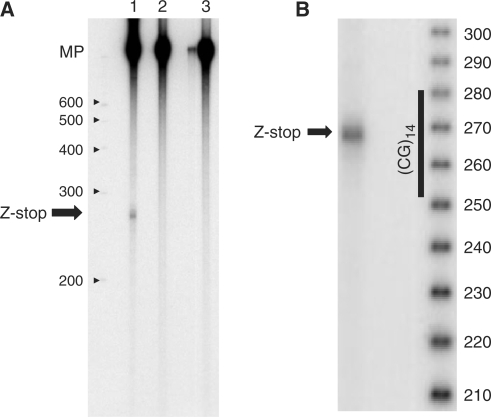
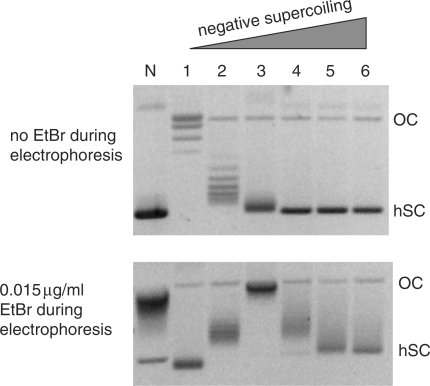
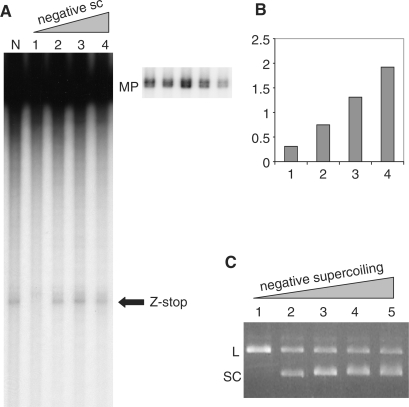
DNA sequences capable of forming unusual secondary structures can be a source of genomic instability. In some cases that instability might be affected by transcription, as recently shown for the Z-DNA forming sequence (CG)(14), which causes genomic instability both in mammalian cells and in bacteria, and this effect increases with its transcription. We have investigated the effect of this (CG)(14) sequence on transcription with T7 RNA polymerase in vitro. We detected partial transcription blockage within the sequence; the blockage increased with negative supercoiling of the template DNA. This effect was not observed in a control self-complementary sequence of identical length and base composition as the (CG)(14) sequence, when the purine-pyrimidine alternation required for Z-DNA formation was disrupted. These findings suggest that the inhibitory effect on T7 transcription results from Z-DNA formation in the (CG)(14) sequence rather than from an effect of the sequence composition or from hairpin formation in either the DNA or the RNA product.
能够形成异常二级结构的DNA序列可能是基因组不稳定的一个来源。在某些情况下,这种不稳定性可能会受到转录的影响,正如最近对形成Z-DNA的序列(CG)(14)所显示的那样,该序列在哺乳动物细胞和细菌中都会导致基因组不稳定,并且这种效应会随着其转录而增加。我们已经在体外研究了这个(CG)(14)序列对T7 RNA聚合酶转录的影响。我们在该序列内检测到了部分转录阻断;随着模板DNA的负超螺旋增加,阻断作用增强。当破坏Z-DNA形成所需的嘌呤-嘧啶交替时,在与(CG)(14)序列长度和碱基组成相同的对照自互补序列中未观察到这种效应。这些发现表明,对T7转录的抑制作用是由(CG)(14)序列中Z-DNA的形成引起的,而不是由序列组成的影响或DNA或RNA产物中发夹结构的形成引起的。