Savage Ceri, Howell Peter
The Institute of Psychiatry, Kings College London, United Kingdom.
J Commun Disord. 2008 Nov-Dec;41(6):459-84. doi: 10.1016/j.jcomdis.2008.01.004. Epub 2008 Mar 10.
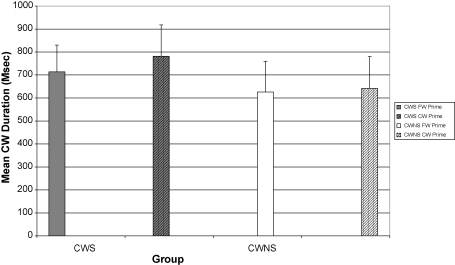
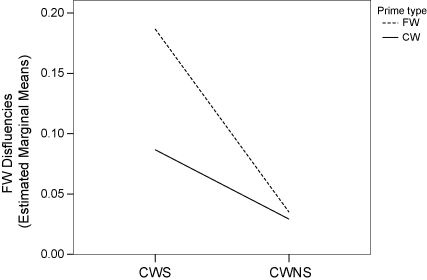
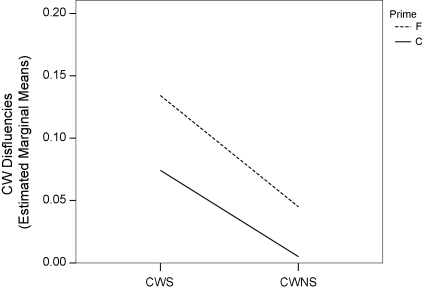
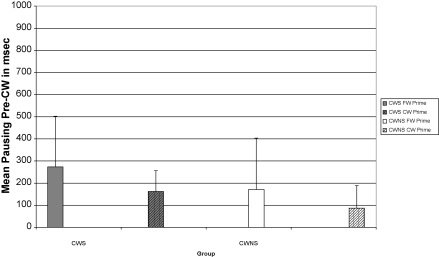
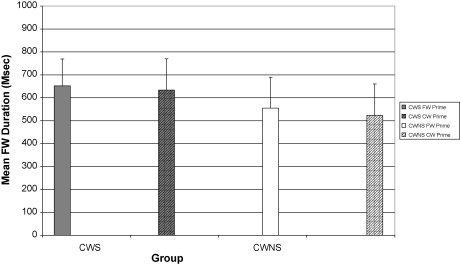
The specific mechanisms that underlie childhood stuttering are not fully understood. The current study investigated these mechanisms by comparing the effect on fluency of priming different components of a short sentence. The main findings were that: (1) both children who stutter (CWS) (n=12, M age=6;3) and children who do not stutter (CWNS) (n=12, M age=6;6) were more fluent after function word (FW) priming than content word (CW) priming, (2) this effect was significantly greater for CWS than for CWNS, and (3) after FW priming, CWS produced CWs with significantly longer duration than did CWNS. These findings are discussed in relation to two competing theories of stuttering: the covert repair hypothesis (CRH) [Kolk, H., & Postma, A. (1997). Stuttering as a covert repair phenomenon. In R. F. Curlee & G. M. Siegel (Eds.), Nature and treatments of stuttering: New directions (pp. 182-203). Needham Heights, MA: Allyn & Bacon] and the developmentally focused model of Howell and Au-Yeung [Howell, P., & Au-Yeung, J. (2002). The EXPLAN theory of fluency control and the diagnosis of stuttering. In E. Fava (Ed.), Current issues in linguistic theory series: Pathology and therapy of speech disorders (pp. 75-94). Amsterdam: John Benjamins].
After reading this article, the reader will be able to: (1) understand which linguistic levels can be primed in children who stutter; (2) see why EXPLAN predicts asymmetrical effects on fluency when function or content words are primed; (3) appreciate the distinguishing characteristics of CRH and EXPLAN theories.
导致儿童口吃的具体机制尚未完全明确。本研究通过比较启动一个短句的不同成分对流畅性的影响来探究这些机制。主要研究结果如下:(1)口吃儿童(CWS)(n = 12,平均年龄 = 6岁3个月)和非口吃儿童(CWNS)(n = 12,平均年龄 = 6岁6个月)在功能词(FW)启动后比在实词(CW)启动后更流畅;(2)这种效应在口吃儿童中比在非口吃儿童中显著更大;(3)在功能词启动后,口吃儿童说出实词的时长显著长于非口吃儿童。本文结合两种相互竞争的口吃理论对这些结果进行了讨论:隐性修复假说(CRH)[科尔克,H.,& 波斯特马,A.(1997年)。口吃作为一种隐性修复现象。载于R. F. 柯利 & G. M. 西格尔(编),《口吃的本质与治疗:新方向》(第182 - 203页)。马萨诸塞州尼德姆高地:艾琳与培根出版社]以及豪厄尔和欧阳基于发展的模型[豪厄尔,P.,& 欧阳,J.(2002年)。流畅性控制的EXPLAN理论与口吃的诊断。载于E. 法瓦(编),《语言理论系列当前问题:言语障碍的病理学与治疗》(第75 - 94页)。阿姆斯特丹:约翰·本杰明斯出版社]。
阅读本文后,读者将能够:(1)了解口吃儿童中哪些语言层面可以被启动;(2)明白为什么EXPLAN理论预测当启动功能词或实词时对流畅性会产生不对称效应;(3)理解CRH理论和EXPLAN理论的区别特征。