Department of Hearing and Speech Sciences, Vanderbilt University, United States.
J Fluency Disord. 2009 Dec;34(4):257-78. doi: 10.1016/j.jfludis.2009.10.005. Epub 2009 Oct 30.
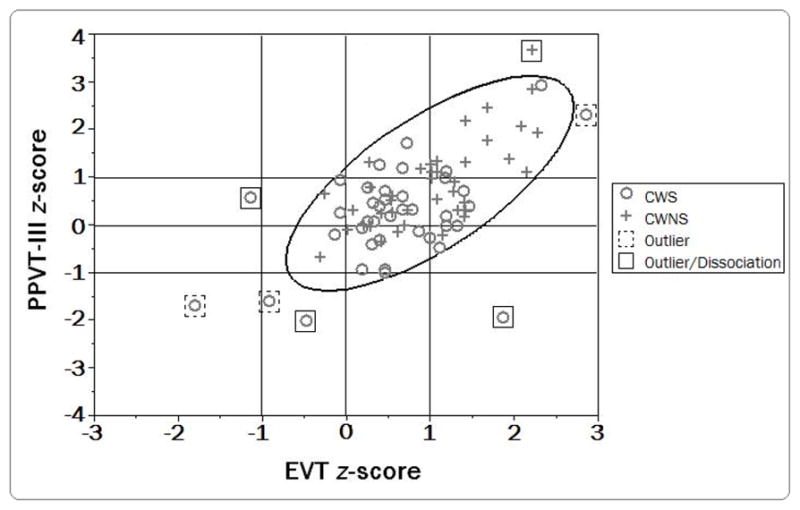
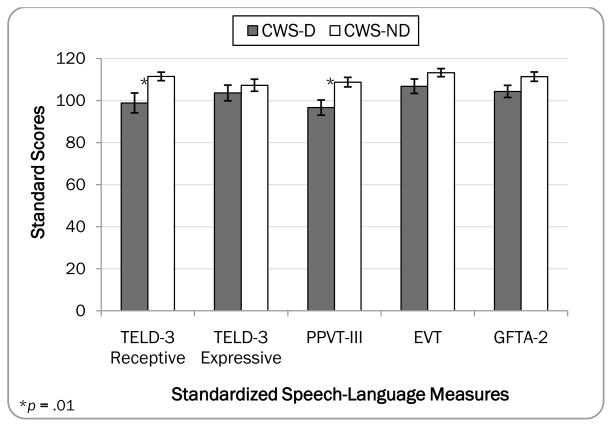
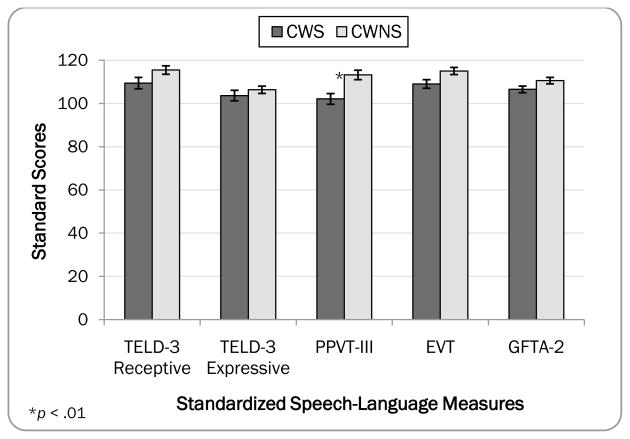
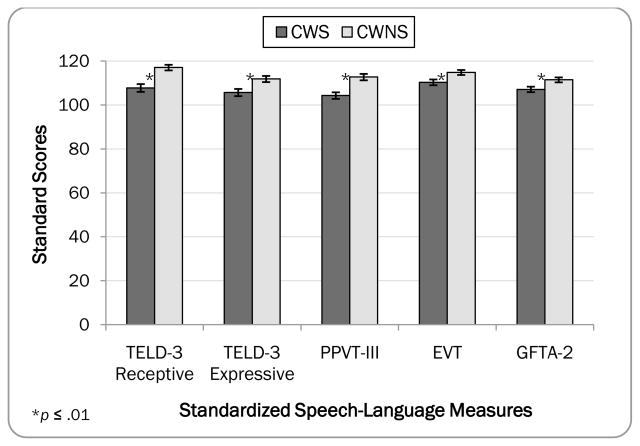
The purpose of this investigation was to replicate the methods of Anderson, Pellowski, and Conture (2005) to determine whether a different sample of preschool children who stutter (CWS) exhibit more dissociations in speech-language abilities than children who do not stutter (CWNS; Study 1) and to examine the relation between dissociations and specific characteristics of stuttering (e.g., most common disfluency type) using a much larger sample size (Study 2). Participants for Study 1 were 40 CWS and 40 CWNS between the ages of 3;0 and 5;11. Participants for Study 2 were the same as for Study 1 plus the 45 CWS and 45 CWNS used by Anderson et al. (2005) for a total of 85 CWS and 85 CWNS. Participants were administered five standardized speech-language (sub)tests and a conversational speech sample was obtained from each participant for the analyses of speech disfluencies/stuttering. Standard scores from the standardized speech-language tests were analyzed using a correlation-based statistical procedure (Bates, Applebaum, Sacedo, Saygin, & Pizzamiglio, 2003) to identify possible dissociations among the speech-language measures. Findings from Study 1 supported Anderson et al.'s findings that CWS exhibited significantly more speech-language dissociations than CWNS. Results from Study 2 further revealed that CWS who exhibited dissociations were more likely to exhibit non-stuttered (other) disfluencies as their most common disfluency type. Findings provide further support for the possibility that dissociations among various aspects of the speech-language system may contribute to the difficulties that some children have establishing normally fluent speech.
The reader will be able to: (a) summarize findings from previous studies examining the speech and language performance of children who do and do not stutter; (b) describe the concept of "dissociations" in the speech and language skills of young children; (c) compare the results of the present study with previous work in this area; and (d) discuss speculations concerning the manner in which dissociations might affect fluency development in children who stutter.
本研究旨在复制 Anderson、Pellowski 和 Conture(2005)的方法,以确定是否有不同样本的口吃学龄前儿童(CWS)比不口吃的儿童(CWNS;研究 1)表现出更多的言语语言能力分离,并使用更大的样本量检查分离与口吃的特定特征之间的关系(例如,最常见的不流畅类型)(研究 2)。研究 1 的参与者为年龄在 3 岁 0 个月至 5 岁 11 个月之间的 40 名 CWS 和 40 名 CWNS。研究 2 的参与者与研究 1 相同,再加上 Anderson 等人(2005 年)使用的 45 名 CWS 和 45 名 CWNS,总共有 85 名 CWS 和 85 名 CWNS。参与者接受了五项标准化言语语言(亚)测试,并从每位参与者获得了会话言语样本,以分析言语不流畅/口吃。标准化言语语言测试的标准分数使用基于相关性的统计程序(Bates、Applebaum、Sacedo、Saygin 和 Pizzamiglio,2003)进行分析,以确定言语测量之间可能存在的分离。研究 1 的结果支持 Anderson 等人的发现,即 CWS 表现出明显更多的言语语言分离,而 CWNS 则不然。研究 2 的结果进一步表明,表现出分离的 CWS 更有可能表现出非口吃(其他)不流畅作为他们最常见的不流畅类型。研究结果进一步支持了这样一种可能性,即言语语言系统各个方面的分离可能导致一些儿童在建立正常流畅言语方面存在困难。
读者将能够:(a)总结先前研究检查口吃和不口吃儿童的言语和语言表现的结果;(b)描述幼儿言语语言技能中“分离”的概念;(c)将本研究的结果与该领域的先前工作进行比较;(d)讨论关于分离可能影响口吃儿童流畅性发展的方式的推测。