Yan Huimin, Takamoto Masaya, Sugane Kazuo
Department of Infection and Host Defense, Division of Immunology and Infectious Diseases, Shinshu University Graduate School of Medicine, Matsumoto, Japan.
Environ Health Perspect. 2008 Apr;116(4):514-9. doi: 10.1289/ehp.10829.
Bisphenol A (BPA) is a widespread endocrine-disrupting chemical that can affect humans and animals.
We investigated the effects of adult or prenatal exposure to BPA on T-helper (T(H))1/T(H)2 immune responses and the mechanisms underlying these effects.
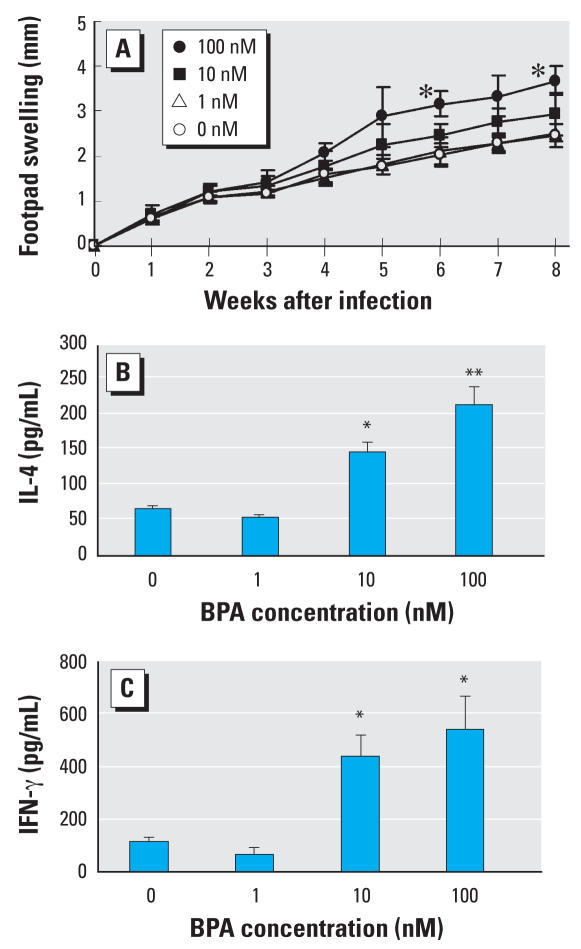
To evaluate the effects of exposure to BPA in adulthood, male Leishmania major-susceptible BALB/c and -resistant C57BL/6 mice were subcutaneously injected with 0.625, 1.25, 2.5, and 5 micromol BPA 1 week before being infected with L. major. To evaluate prenatal exposure, female mice were given BPA-containing drinking water at concentrations of 1, 10, and 100 nM for 2 weeks, then mated, and given BPA for another week. Male 10-week-old offspring were infected with L. major. Footpad swelling was assessed as a measure of the course of infection.
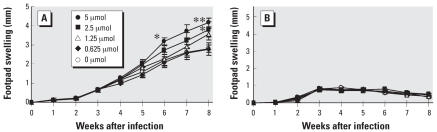
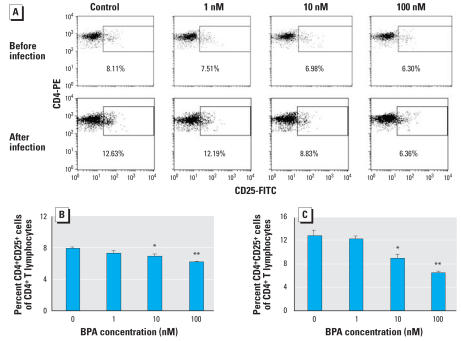
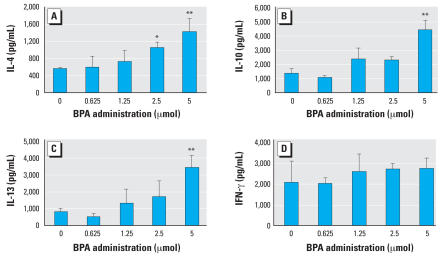
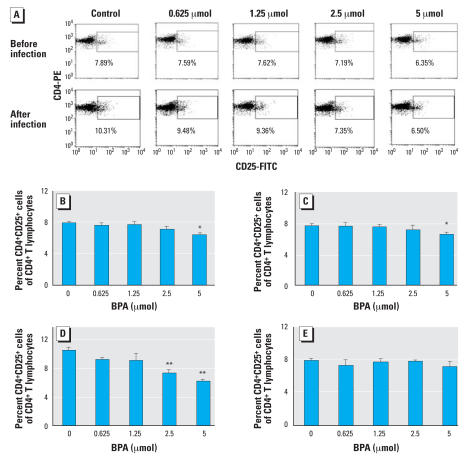
Mice exposed to BPA prenatally or in adulthood showed a dose-dependent increase in footpad swelling after being infected with L. major. Exposure to BPA in adulthood significantly promoted antigen-stimulated production of interleukin (IL)-4, IL-10, and IL-13 but not interferon-gamma (IFN-gamma). However, mice prenatally exposed to BPA showed increased production of not only IL-4 but also IFN-gamma. The percentages of CD4(+)CD25(+) cells were decreased in mice exposed to BPA either prenatally or in adulthood. Effects of prenatal BPA exposure were far more pronounced than effects of exposure in adulthood.
BPA promotes the development of T(H)2 cells in adulthood and both T(H)1 and T(H)2 cells in prenatal stages by reducing the number of regulatory T cells.
双酚A(BPA)是一种广泛存在的内分泌干扰化学物质,可影响人类和动物。
我们研究了成年期或孕期暴露于双酚A对辅助性T(Th)1/Th2免疫反应的影响及其潜在机制。
为评估成年期暴露于双酚A的影响,对利什曼原虫易感的雄性BALB/c小鼠和抗性C57BL/6小鼠,在感染硕大利什曼原虫前1周皮下注射0.625、1.25、2.5和5微摩尔双酚A。为评估孕期暴露,给雌性小鼠饮用含1、10和100纳摩尔双酚A的饮用水2周,然后交配,并继续饮用双酚A 1周。对10周龄雄性后代感染硕大利什曼原虫。评估足垫肿胀情况以衡量感染进程。
孕期或成年期暴露于双酚A的小鼠在感染硕大利什曼原虫后足垫肿胀呈剂量依赖性增加。成年期暴露于双酚A显著促进抗原刺激的白细胞介素(IL)-4、IL-10和IL-13的产生,但不促进干扰素-γ(IFN-γ)的产生。然而,孕期暴露于双酚A的小鼠不仅IL-4的产生增加,IFN-γ的产生也增加。孕期或成年期暴露于双酚A的小鼠中CD4(+)CD25(+)细胞百分比降低。孕期双酚A暴露的影响比成年期暴露的影响更为明显。
双酚A通过减少调节性T细胞数量,在成年期促进Th2细胞发育,在孕期促进Th1和Th2细胞发育。