Rodríguez J J, Davies H A, Errington M L, Verkhratsky A, Bliss T V P, Stewart M G
Faculty of Life Sciences, The University of Manchester, Manchester, UK.
J Cell Mol Med. 2008 Apr;12(2):671-8. doi: 10.1111/j.1582-4934.2007.00105.x.
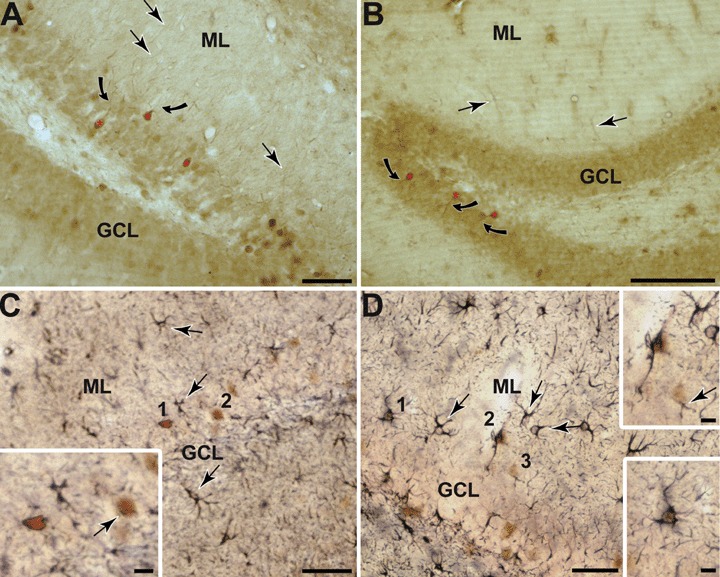
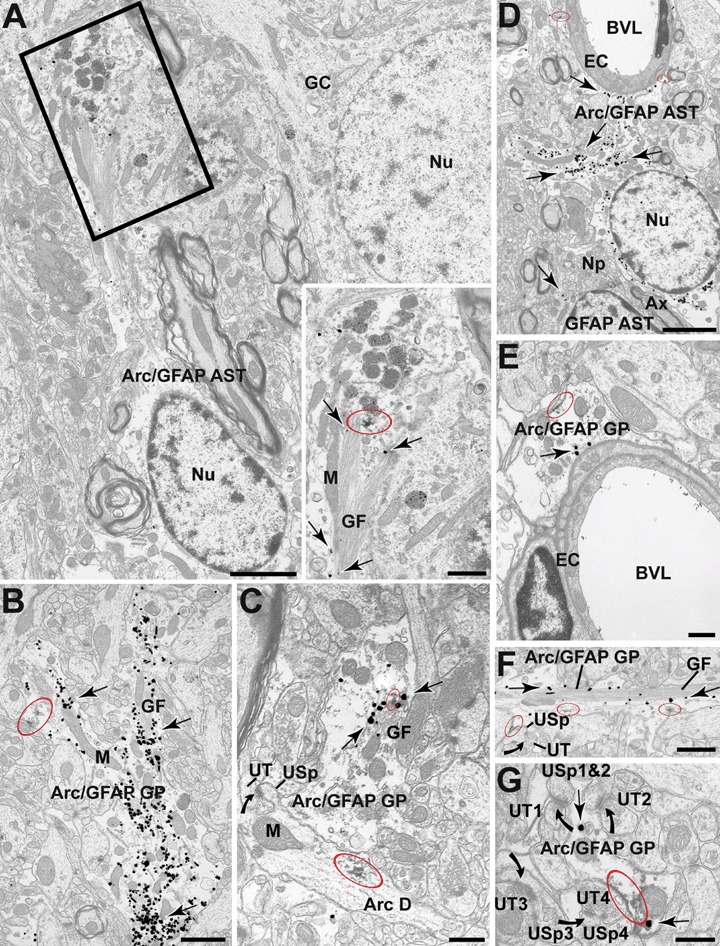
Synaptic efficacy following long-term potentiation (LTP) and memory consolidation is associated with changes in the expression of immediate early genes (IEGs). These changes are often accompanied by increased expression of glial fibrillary acidic protein (GFAP). While the protein products of the majority of IEGs are mainly restricted to the cell body, Arg3.1/Arc product is rapidly delivered to dendrites, where it accumulates close to synaptic sites. Arg3.1/Arc protein was originally considered neurone specific; however, we have recently found Arg3.1/Arc immunoreactivity (Arg3.1/Arc-IR) within glial cells and demonstrated its increased expression after LTP in the hippocampal dentate gyrus (DG). Here, we have further investigated this novel finding, using electron microscopic immunocytochemistry to determine the localization and sub-cellular distribution of Arg3.1/Arc protein in GFAP positive glia (GFAP-IR) in the DG. Arg3.1/Arc labelling was seen prominently in GFAP-IR glial cell bodies and in large- and medium-sized glial filamentous processes. GFAP-labelled medium-small peri-synaptic glial profiles also displayed Arg3.1/Arc-IR; however, the very thin and distal glial filaments only displayed Arc-IR. Arc-IR was distributed throughout the cytoplasm, often associated with GFAP filaments, and along the plasma membrane of glial processes. Peri-synaptic glial Arg3.1/Arc-IR processes were apposed to pre- and/or post-synaptic profiles at asymmetric axospinous synapses. These data, taken with our earlier study which provided evidence for an increase in astrocytic Arg3.1/Arc-IR after the induction of LTP, suggest a role for glial Arg3.1/Arc in structural and synaptic plasticity which may be critical for the maintenance of cognitive functions.
长期增强作用(LTP)和记忆巩固后的突触效能与即刻早期基因(IEGs)表达的变化有关。这些变化通常伴随着胶质纤维酸性蛋白(GFAP)表达的增加。虽然大多数IEGs的蛋白质产物主要局限于细胞体,但Arg3.1/Arc产物会迅速转运至树突,并在靠近突触部位积累。Arg3.1/Arc蛋白最初被认为是神经元特异性的;然而,我们最近在胶质细胞中发现了Arg3.1/Arc免疫反应性(Arg3.1/Arc-IR),并证明在海马齿状回(DG)中LTP后其表达增加。在此,我们使用电子显微镜免疫细胞化学进一步研究了这一新发现,以确定DG中GFAP阳性胶质细胞(GFAP-IR)中Arg3.1/Arc蛋白的定位和亚细胞分布。在GFAP-IR胶质细胞体以及大中型胶质丝状突起中可明显看到Arg3.1/Arc标记。GFAP标记的中小型突触周围胶质轮廓也显示出Arg3.1/Arc-IR;然而,非常细的远端胶质丝仅显示Arc-IR。Arc-IR分布于整个细胞质中,常与GFAP丝相关,并沿胶质突起的质膜分布。突触周围胶质的Arg3.1/Arc-IR突起在不对称轴棘突触处与突触前和/或突触后轮廓相邻。这些数据与我们早期的研究结果相结合,该研究为LTP诱导后星形胶质细胞Arg3.1/Arc-IR增加提供了证据,表明胶质细胞的Arg3.1/Arc在结构和突触可塑性中发挥作用,这可能对维持认知功能至关重要。