Sgraja Tanja, Alphey Magnus S, Ghilagaber Stephanos, Marquez Rudi, Robertson Murray N, Hemmings Jennifer L, Lauw Susan, Rohdich Felix, Bacher Adelbert, Eisenreich Wolfgang, Illarionova Victoria, Hunter William N
Division of Biological Chemistry and Drug Discovery, University of Dundee, UK.
FEBS J. 2008 Jun;275(11):2779-94. doi: 10.1111/j.1742-4658.2008.06418.x. Epub 2008 Apr 16.
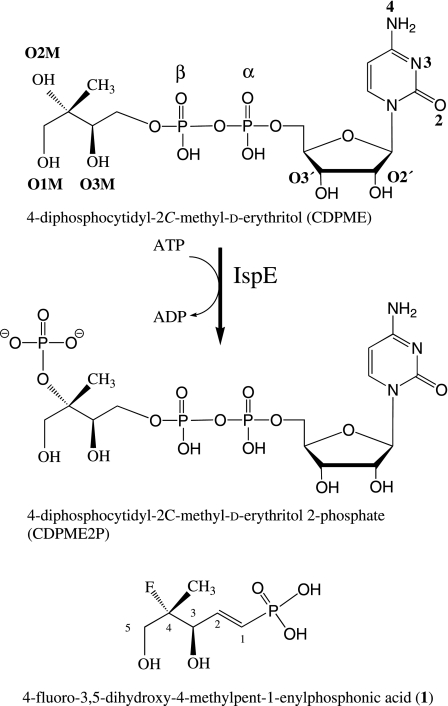
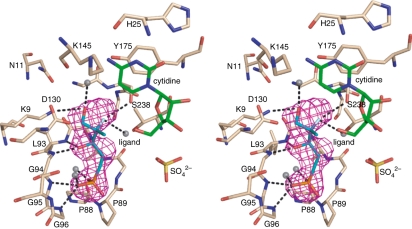
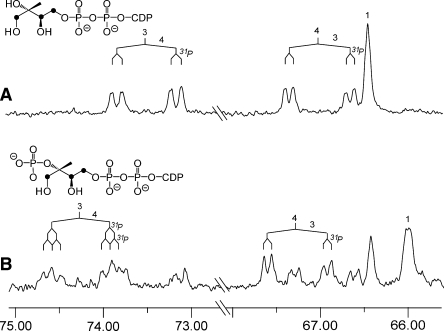
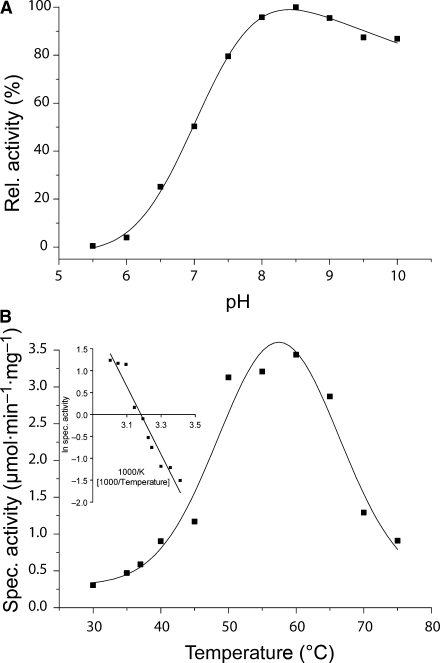
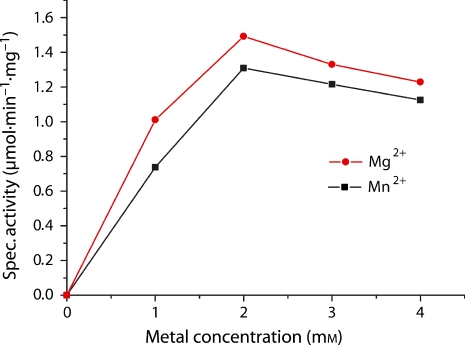
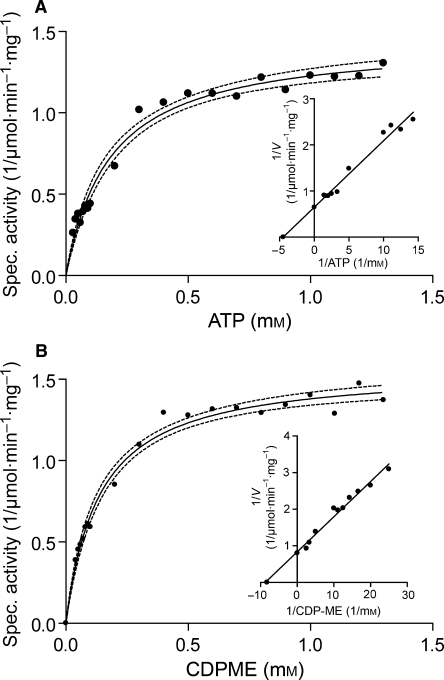
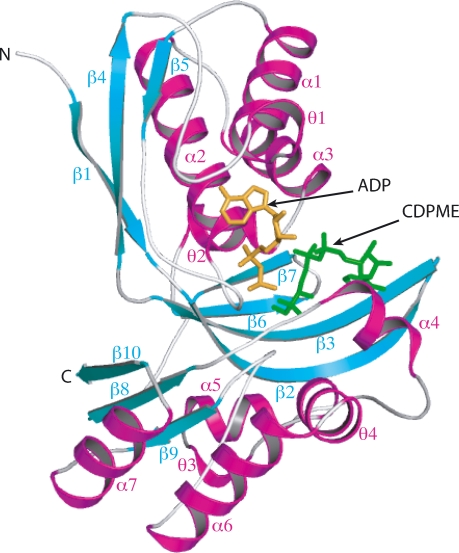
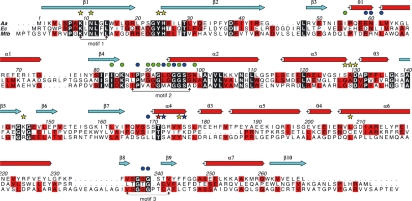
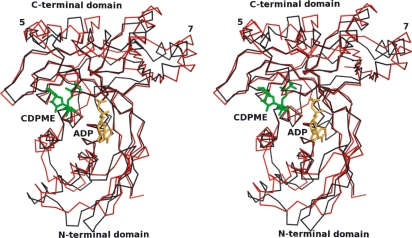
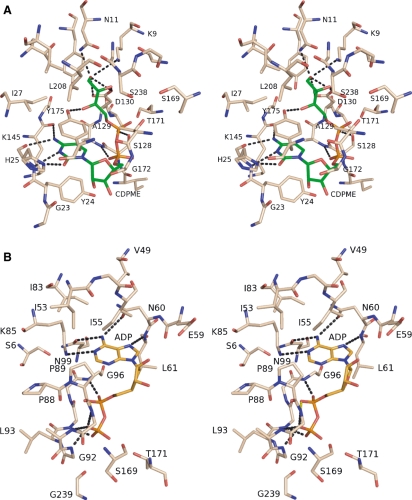
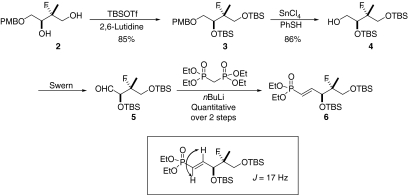
4-Diphosphocytidyl-2C-methyl-D-erythritol kinase (IspE) catalyses the ATP-dependent conversion of 4-diphosphocytidyl-2C-methyl-D-erythritol (CDPME) to 4-diphosphocytidyl-2C-methyl-d-erythritol 2-phosphate with the release of ADP. This reaction occurs in the non-mevalonate pathway of isoprenoid precursor biosynthesis and because it is essential in important microbial pathogens and absent from mammals it represents a potential target for anti-infective drugs. We set out to characterize the biochemical properties, determinants of molecular recognition and reactivity of IspE and report the cloning and purification of recombinant Aquifex aeolicus IspE (AaIspE), kinetic data, metal ion, temperature and pH dependence, crystallization and structure determination of the enzyme in complex with CDP, CDPME and ADP. In addition, 4-fluoro-3,5-dihydroxy-4-methylpent-1-enylphosphonic acid (compound 1) was designed to mimic a fragment of the substrate, a synthetic route to 1 was elucidated and the complex structure determined. Surprisingly, this ligand occupies the binding site for the ATP alpha-phosphate not the binding site for the methyl-D-erythritol moiety of CDPME. Gel filtration and analytical ultracentrifugation indicate that AaIspE is a monomer in solution. The enzyme displays the characteristic alpha/beta galacto-homoserine-mevalonate-phosphomevalonate kinase fold, with the catalytic centre positioned in a deep cleft between the ATP- and CDPME-binding domains. Comparisons indicate a high degree of sequence conservation on the IspE active site across bacterial species, similarities in structure, specificity of substrate recognition and mechanism. The biochemical characterization, attainment of well-ordered and reproducible crystals and the models resulting from the analyses provide reagents and templates to support the structure-based design of broad-spectrum antimicrobial agents.
4-二磷酸胞苷-2-C-甲基-D-赤藓醇激酶(IspE)催化4-二磷酸胞苷-2-C-甲基-D-赤藓醇(CDPME)依赖ATP转化为4-二磷酸胞苷-2-C-甲基-D-赤藓醇2-磷酸,并释放出ADP。该反应发生在类异戊二烯前体生物合成的非甲羟戊酸途径中,由于它在重要的微生物病原体中至关重要且在哺乳动物中不存在,因此它是抗感染药物的潜在靶点。我们着手表征IspE的生化特性、分子识别和反应性的决定因素,并报告重组嗜热栖热菌IspE(AaIspE)的克隆和纯化、动力学数据、金属离子、温度和pH依赖性、与CDP、CDPME和ADP形成复合物的酶的结晶和结构测定。此外,设计了4-氟-3,5-二羟基-4-甲基戊-1-烯基膦酸(化合物1)以模拟底物的片段,阐明了化合物1的合成路线并确定了复合物结构。令人惊讶的是,该配体占据的是ATPα-磷酸的结合位点,而不是CDPME的甲基-D-赤藓醇部分的结合位点。凝胶过滤和分析超速离心表明AaIspE在溶液中是单体。该酶呈现出典型的α/β半乳糖-高丝氨酸-甲羟戊酸-磷酸甲羟戊酸激酶折叠,催化中心位于ATP结合域和CDPME结合域之间的深裂隙中。比较表明,细菌物种间IspE活性位点的序列保守性很高,在结构、底物识别特异性和机制方面具有相似性。生化表征、获得有序且可重复的晶体以及分析得出的模型为基于结构的广谱抗菌剂设计提供了试剂和模板。