Kishimoto Takashi Kei, Viswanathan Karthik, Ganguly Tanmoy, Elankumaran Subbiah, Smith Sean, Pelzer Kevin, Lansing Jonathan C, Sriranganathan Nammalwar, Zhao Ganlin, Galcheva-Gargova Zoya, Al-Hakim Ali, Bailey Gregory Scott, Fraser Blair, Roy Sucharita, Rogers-Cotrone Thomas, Buhse Lucinda, Whary Mark, Fox James, Nasr Moheb, Dal Pan Gerald J, Shriver Zachary, Langer Robert S, Venkataraman Ganesh, Austen K Frank, Woodcock Janet, Sasisekharan Ram
Momenta Pharmaceuticals, the Harvard-Massachusetts Institute of Technology Division of Health Sciences and Technology, Koch Institute for Integrative Cancer Research, Cambridge, MA 02139, USA.
N Engl J Med. 2008 Jun 5;358(23):2457-67. doi: 10.1056/NEJMoa0803200. Epub 2008 Apr 23.
There is an urgent need to determine whether oversulfated chondroitin sulfate (OSCS), a compound contaminating heparin supplies worldwide, is the cause of the severe anaphylactoid reactions that have occurred after intravenous heparin administration in the United States and Germany.
Heparin procured from the Food and Drug Administration, consisting of suspect lots of heparin associated with the clinical events as well as control lots of heparin, were screened in a blinded fashion both for the presence of OSCS and for any biologic activity that could potentially link the contaminant to the observed clinical adverse events. In vitro assays for the activation of the contact system and the complement cascade were performed. In addition, the ability of OSCS to recapitulate key clinical manifestations in vivo was tested in swine.
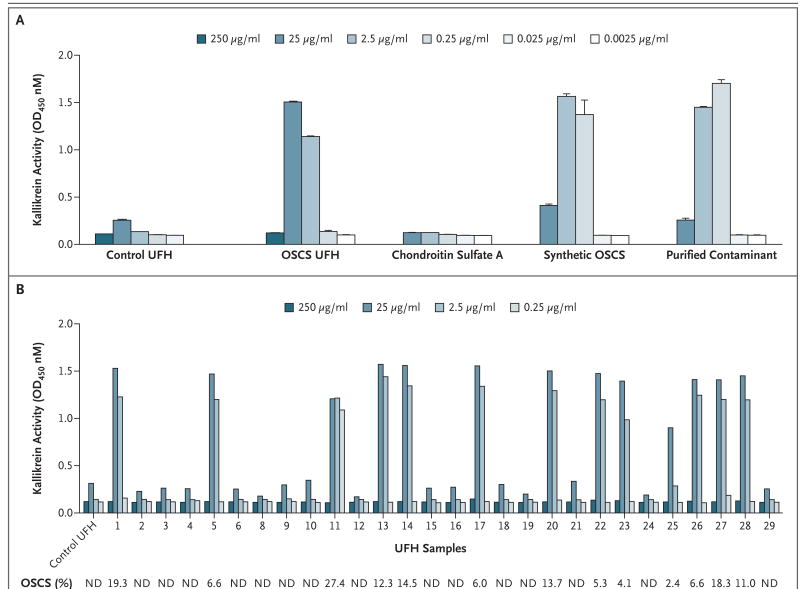
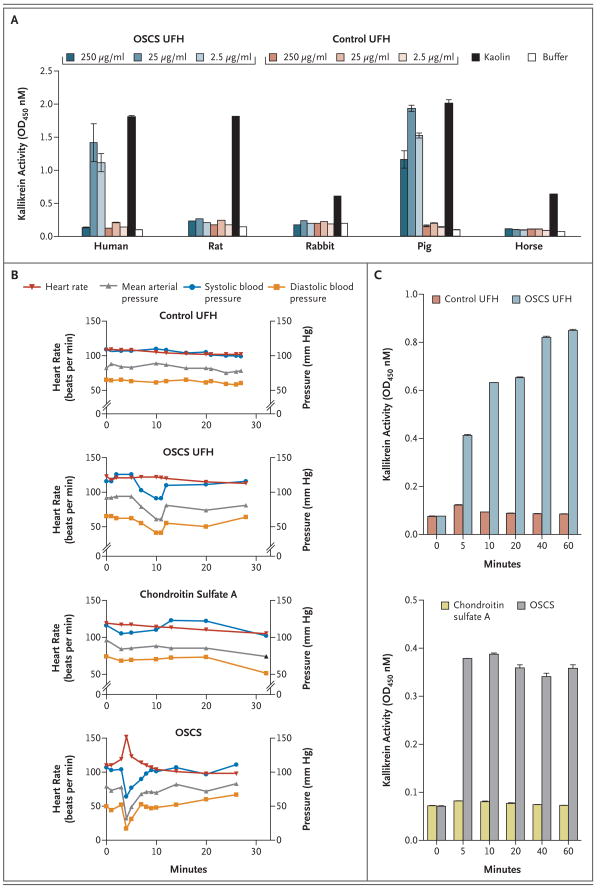
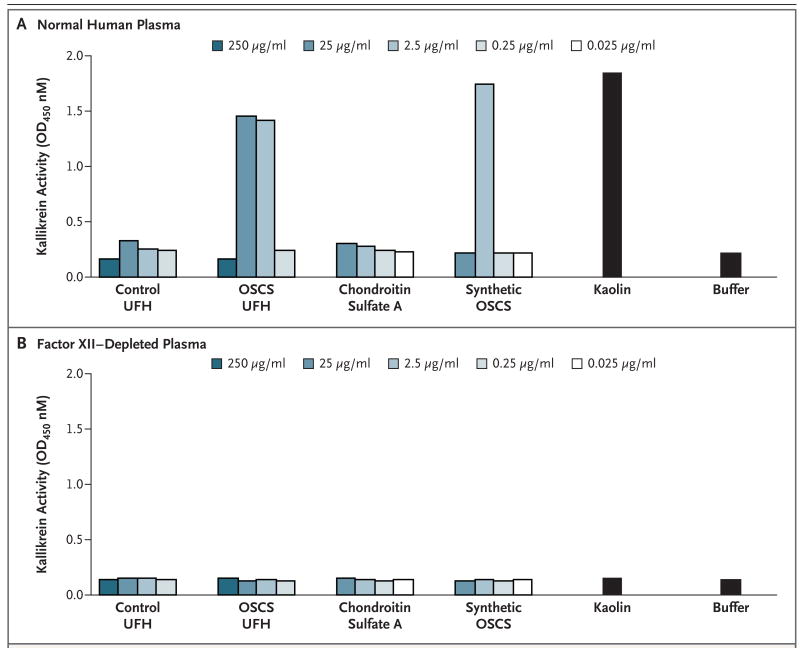
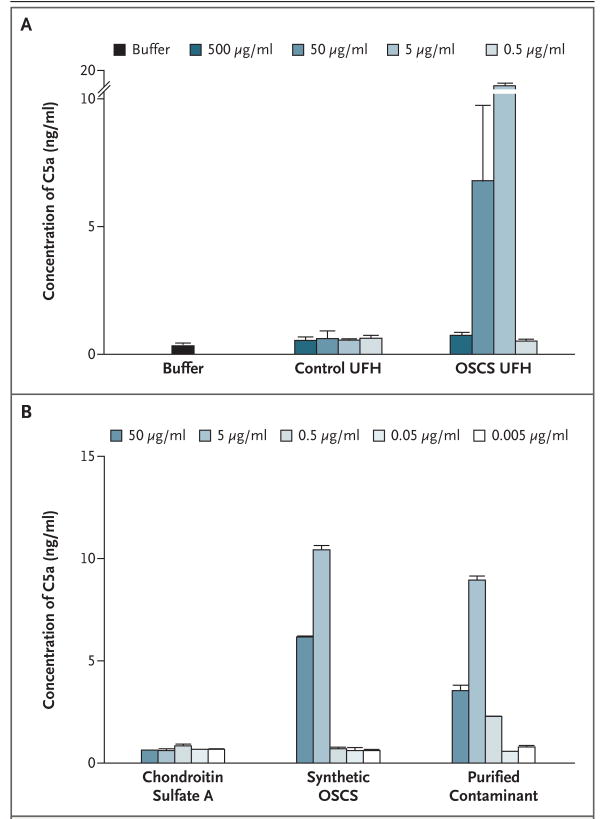
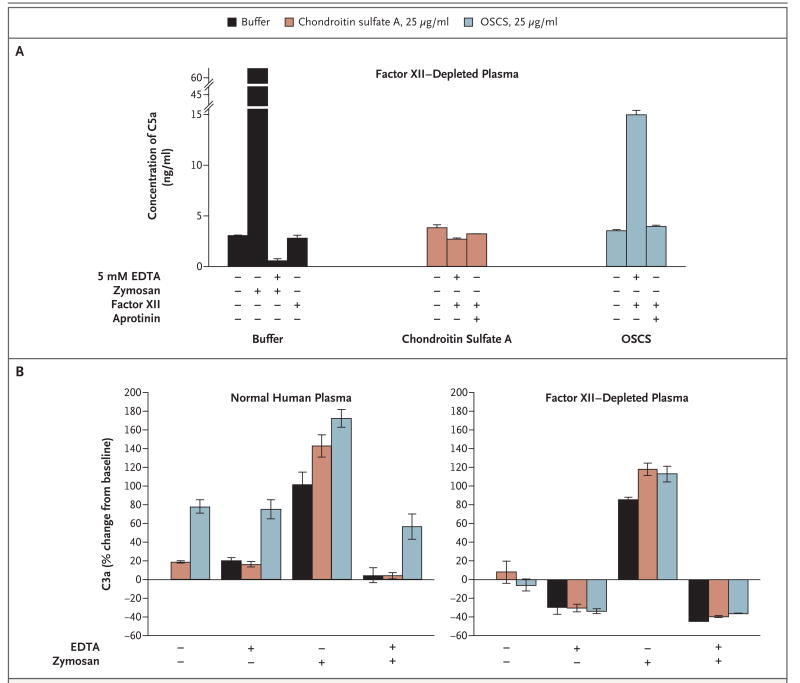
The OSCS found in contaminated lots of unfractionated heparin, as well as a synthetically generated OSCS reference standard, directly activated the kinin-kallikrein pathway in human plasma, which can lead to the generation of bradykinin, a potent vasoactive mediator. In addition, OSCS induced generation of C3a and C5a, potent anaphylatoxins derived from complement proteins. Activation of these two pathways was unexpectedly linked and dependent on fluid-phase activation of factor XII. Screening of plasma samples from various species indicated that swine and humans are sensitive to the effects of OSCS in a similar manner. OSCS-containing heparin and synthetically derived OSCS induced hypotension associated with kallikrein activation when administered by intravenous infusion in swine.
Our results provide a scientific rationale for a potential biologic link between the presence of OSCS in suspect lots of heparin and the observed clinical adverse events. An assay to assess the amidolytic activity of kallikrein can supplement analytic tests to protect the heparin supply chain by screening for OSCS and other highly sulfated polysaccharide contaminants of heparin that can activate the contact system.
迫切需要确定硫酸皮肤素(OSCS),一种在全球范围内污染肝素供应的化合物,是否是美国和德国静脉注射肝素后发生严重类过敏反应的原因。
从美国食品药品监督管理局采购的肝素,包括与临床事件相关的可疑批次肝素以及对照批次肝素,以盲法进行筛选,检测其中是否存在OSCS以及是否存在任何可能将该污染物与观察到的临床不良事件联系起来的生物活性。进行了体外接触系统激活和补体级联反应的检测。此外,还在猪身上测试了OSCS在体内重现关键临床表现的能力。
在未分级肝素的污染批次中发现的OSCS,以及合成生成的OSCS参考标准品,直接激活了人血浆中的激肽-激肽释放酶途径,这可能导致生成缓激肽,一种强效血管活性介质。此外,OSCS诱导了C3a和C5a的生成,这是源自补体蛋白的强效过敏毒素。这两条途径的激活意外地相互关联,并且依赖于因子XII的液相激活。对来自不同物种的血浆样本进行筛选表明,猪和人对OSCS的作用敏感方式相似。含OSCS的肝素和合成来源的OSCS在猪静脉输注时会诱导与激肽释放酶激活相关的低血压。
我们的结果为可疑批次肝素中存在OSCS与观察到的临床不良事件之间潜在的生物学联系提供了科学依据。一种评估激肽释放酶酰胺水解活性的检测方法可以补充分析检测,通过筛选OSCS和其他可激活接触系统的肝素高度硫酸化多糖污染物来保护肝素供应链。