Lijovic Marijana, Davis Susan R, Fradkin Pam, La China Maria, Farrugia Helen, Wolfe Rory, Bell Robin J
Women's Health Program, Department of Medicine, Monash University, Alfred Hospital, Prahran, Victoria 3181, Australia.
BMC Cancer. 2008 May 2;8:126. doi: 10.1186/1471-2407-8-126.
Breast cancer (BC) mortality is declining such that the number of survivors of BC in the community is increasing. BC survivors report a range of sequelae from their cancer and its management beyond the period of their immediate treatment. Previous studies to document these have generally been small, clinic-based or commenced years after diagnosis. We have recruited a large cohort of women newly diagnosed with invasive BC from the community who will be followed for five years in order to systematically document the physical, psychological and socio-economic consequences of BC and its treatment. The aim of this manuscript is to describe the issues encountered in the recruitment of this community-based study population.
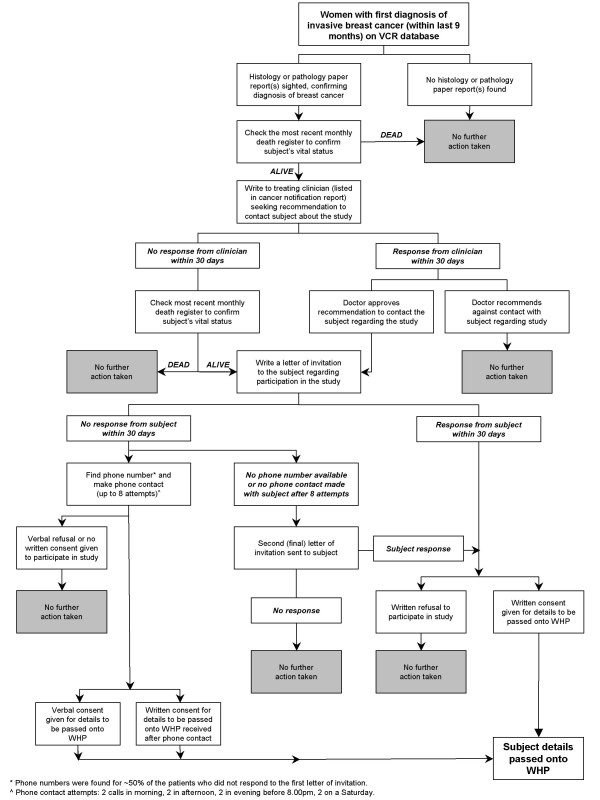
Women residing in the southern Australian state of Victoria newly diagnosed with invasive BC were recruited to this cohort study using two approaches: directly from the community using an advertising campaign and contemporaneously using an invitation to participate from the Victorian Cancer Registry (VCR).
Over the two and half year recruitment period, 2135 women were recruited and agreed to receive the enrollment questionnaire (EQ). Of these, 1684 women were eligible and completed an EQ, with the majority of participants having been recruited through the VCR (n = 1321). Only 16% of women contacted by the VCR actively refused participation following a letter of invitation and phone follow-up. The age distribution and tumour characteristics of participants are consistent with state-wide data and their residential postcodes include 400 of a possible 699. Recruitment through a direct community awareness program aimed at women with newly diagnosed invasive BC was difficult, labour-intensive and expensive. Barriers to the recruitment process were identified.
Most of the women in this study were recruited through a state-based cancer registry. Limitations to recruitment occurred because we required questionnaires to be completed within 12 months of diagnosis in a setting where there is several months delay in notification of new cases to the Registry. Characteristics of the cohort suggest that it is generally representative of women in the state of Victoria newly diagnosed with BC.
乳腺癌(BC)死亡率正在下降,因此社区中乳腺癌幸存者的数量在增加。乳腺癌幸存者报告称,在直接治疗期之后,她们的癌症及其治疗会带来一系列后遗症。以往记录这些后遗症的研究通常规模较小、基于诊所开展,或者在诊断数年之后才开始。我们从社区招募了一大群新诊断为浸润性乳腺癌的女性,她们将被随访五年,以便系统地记录乳腺癌及其治疗的身体、心理和社会经济后果。本文的目的是描述在招募这个基于社区的研究人群时遇到的问题。
居住在澳大利亚维多利亚州南部、新诊断为浸润性乳腺癌的女性通过两种方式被招募到这项队列研究中:一是通过广告活动直接从社区招募,二是同时利用维多利亚癌症登记处(VCR)的参与邀请。
在两年半的招募期内,招募了2135名女性并同意接受入组问卷(EQ)。其中,1684名女性符合条件并完成了EQ,大多数参与者是通过VCR招募的(n = 1321)。在收到邀请信和电话随访后,VCR联系的女性中只有16%主动拒绝参与。参与者的年龄分布和肿瘤特征与全州数据一致,她们的居住邮政编码涵盖了可能的699个中的400个。通过针对新诊断为浸润性乳腺癌女性的直接社区宣传项目进行招募困难、劳动强度大且成本高。确定了招募过程中的障碍。
本研究中的大多数女性是通过州癌症登记处招募的。招募存在局限性,因为我们要求问卷在诊断后12个月内完成,而在此环境下,新病例通知登记处会有几个月的延迟。该队列的特征表明,它总体上代表了维多利亚州新诊断为乳腺癌的女性。