Rolny Charlotte, Capparuccia Lorena, Casazza Andrea, Mazzone Massimiliano, Vallario Antonella, Cignetti Alessandro, Medico Enzo, Carmeliet Peter, Comoglio Paolo M, Tamagnone Luca
Institute for Cancer Research and Treatment (IRCC), University of Turin, School of Medicine, 10060 Candiolo, Italy.
J Exp Med. 2008 May 12;205(5):1155-71. doi: 10.1084/jem.20072509. Epub 2008 May 5.
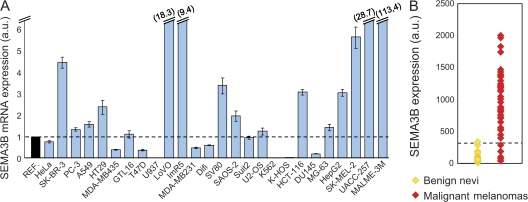
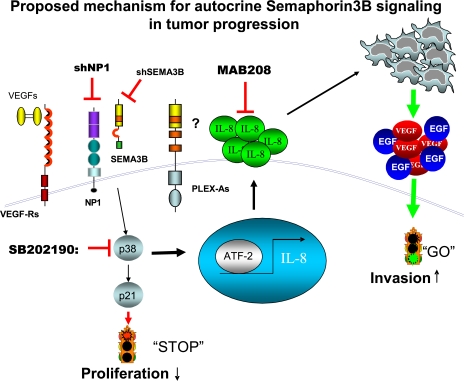
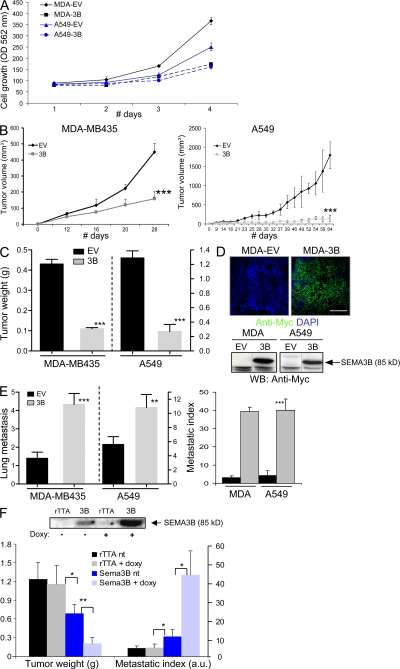
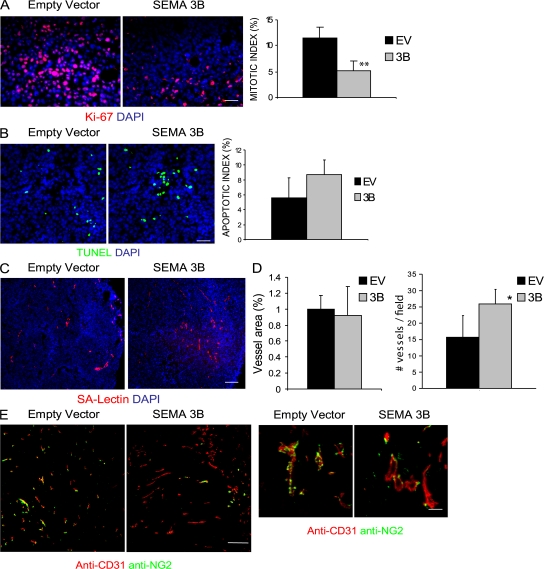
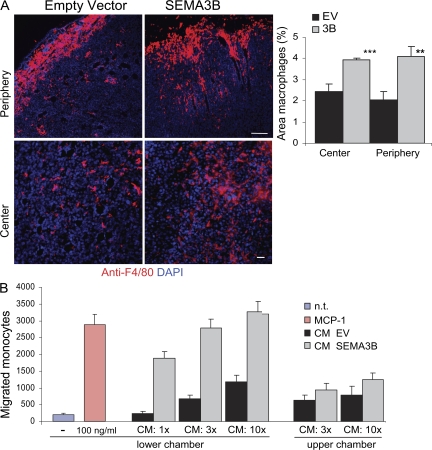
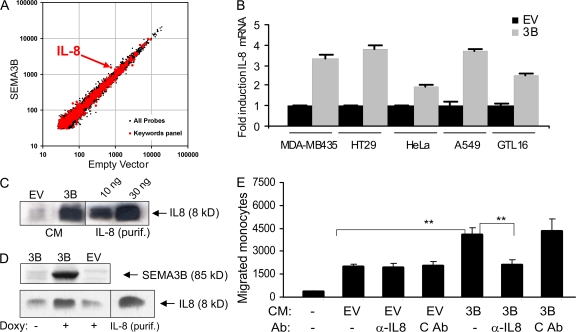
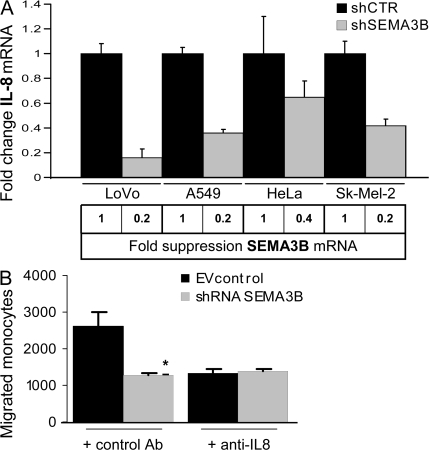
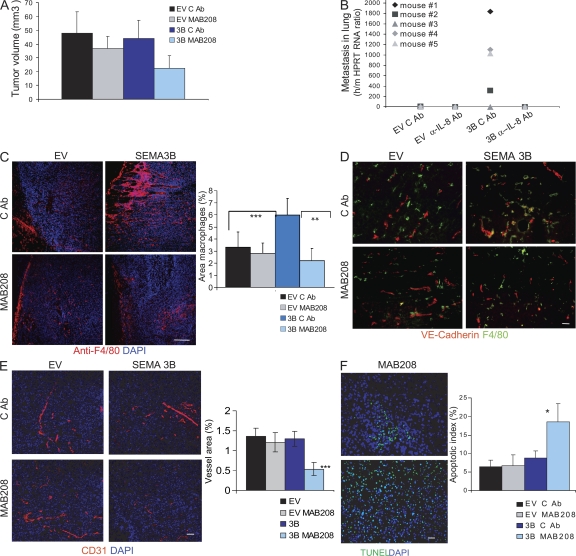
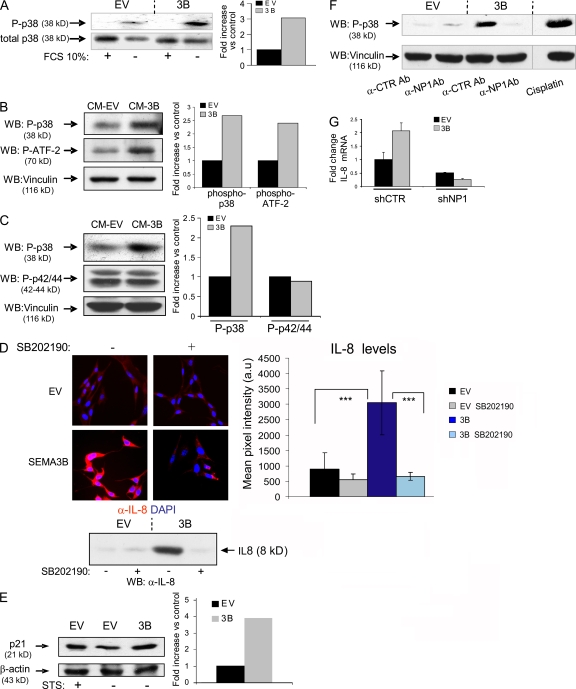
Semaphorins are a large family of evolutionarily conserved morphogenetic molecules originally identified for their repelling role in axonal guidance. Intriguingly, semaphorins have recently been implicated in cancer progression (Neufeld, G., T. Lange, A. Varshavsky, and O. Kessler. 2007. Adv. Exp. Med. Biol. 600:118-131). In particular, semaphorin 3B (SEMA3B) is considered a putative tumor suppressor, and yet we found that it is expressed at high levels in many invasive and metastatic human cancers. By investigating experimental tumor models, we confirmed that SEMA3B expression inhibited tumor growth, whereas metastatic dissemination was surprisingly increased. We found that SEMA3B induced the production of interleukin (IL) 8 by tumor cells by activating the p38-mitogen-activated protein kinase pathway in a neuropilin 1-dependent manner. Silencing the expression of endogenous SEMA3B in tumor cells impaired IL-8 transcription. The release of IL-8, in turn, induced the recruitment of tumor-associated macrophages and metastatic dissemination to the lung, which could be rescued by blocking IL-8 with neutralizing antibodies. In conclusion, we report that SEMA3B exerts unexpected functions in cancer progression by fostering a prometastatic environment through elevated IL-8 secretion and recruitment of macrophages coupled to the suppression of tumor growth.
信号素是一大类在进化上保守的形态发生分子,最初因其在轴突导向中的排斥作用而被发现。有趣的是,信号素最近被认为与癌症进展有关(Neufeld, G., T. Lange, A. Varshavsky, and O. Kessler. 2007. Adv. Exp. Med. Biol. 600:118-131)。特别是,信号素3B(SEMA3B)被认为是一种假定的肿瘤抑制因子,但我们发现它在许多侵袭性和转移性人类癌症中高表达。通过研究实验性肿瘤模型,我们证实SEMA3B的表达抑制肿瘤生长,而转移扩散却出人意料地增加。我们发现SEMA3B通过以一种依赖于神经纤毛蛋白1的方式激活p38丝裂原活化蛋白激酶途径,诱导肿瘤细胞产生白细胞介素(IL)8。沉默肿瘤细胞中内源性SEMA3B的表达会损害IL-8的转录。反过来,IL-8的释放诱导肿瘤相关巨噬细胞的募集以及向肺部的转移扩散,而用中和抗体阻断IL-8可以挽救这种情况。总之,我们报告SEMA3B通过升高IL-8分泌和募集巨噬细胞来促进转移前环境并抑制肿瘤生长,从而在癌症进展中发挥意想不到的作用。