Mehra Rohit, Tomlins Scott A, Yu Jianjun, Cao Xuhong, Wang Lei, Menon Anjana, Rubin Mark A, Pienta Kenneth J, Shah Rajal B, Chinnaiyan Arul M
Michigan Center for Translational Pathology, Department of Pathology, University of Michigan Medical School, Ann Arbor, Michigan, USA.
Cancer Res. 2008 May 15;68(10):3584-90. doi: 10.1158/0008-5472.CAN-07-6154.
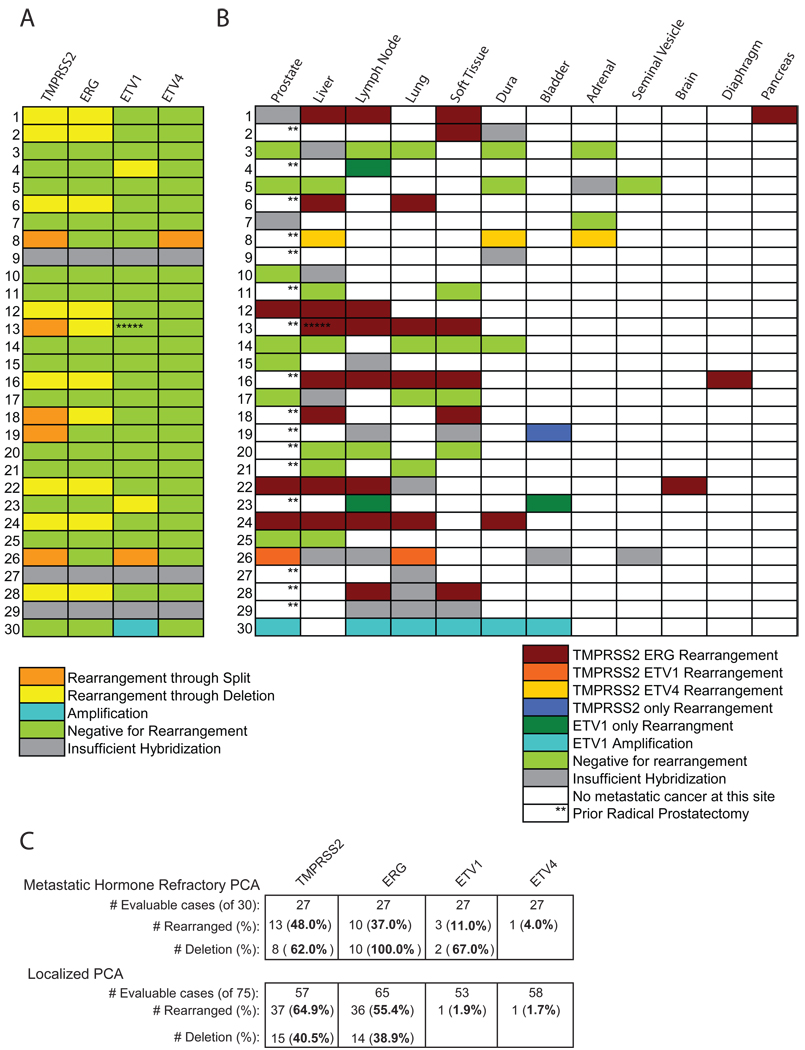
Recurrent gene fusions between the androgen-regulated gene TMPRSS2 and the ETS transcription factor family members ERG, ETV1, and ETV4 have been identified as a critical event in prostate cancer development. In this study, we characterized the prevalence and diversity of these rearrangements in hormone-refractory metastatic prostate cancer. We used a fluorescence in situ hybridization (FISH) split probe strategy to comprehensively evaluate TMPRSS2-ETS aberrations across 97 nonosseous metastatic sites of prostate cancer from 30 rapid autopsies of men who died of androgen-independent disease. Tissue microarrays were constructed representing multiple metastatic sites from each patient, and split signal FISH probes for TMPRSS2, ERG, ETV1, and ETV4 were used to assess for TMPRSS2-ETS rearrangements. In patients exhibiting these aberrations, multiple sites from an individual case harbored the same gene fusion molecular subtype suggesting clonal expansion of disease. The most common prostate cancer gene fusion, TMPRSS2-ERG, can be generated by the mechanism of interstitial deletion (Edel) about 39% to 60% of the time in clinically localized disease. Interestingly, we observed that all of the androgen-independent metastatic prostate cancer sites harboring TMPRSS2-ERG were associated with Edel. These findings suggest that TMPRSS2-ERG with Edel is an aggressive and, in this study, uniformly lethal molecular subtype of prostate cancer associated with androgen-independent disease.
雄激素调节基因TMPRSS2与ETS转录因子家族成员ERG、ETV1和ETV4之间的复发性基因融合已被确定为前列腺癌发展中的关键事件。在本研究中,我们对激素难治性转移性前列腺癌中这些重排的发生率和多样性进行了特征分析。我们采用荧光原位杂交(FISH)分裂探针策略,对30例死于雄激素非依赖性疾病的男性快速尸检中97个非骨性前列腺癌转移部位的TMPRSS2-ETS畸变进行了全面评估。构建了代表每位患者多个转移部位的组织微阵列,并使用针对TMPRSS2、ERG、ETV1和ETV4的分裂信号FISH探针评估TMPRSS2-ETS重排。在表现出这些畸变的患者中,单个病例的多个部位具有相同的基因融合分子亚型,提示疾病的克隆性扩增。最常见的前列腺癌基因融合TMPRSS2-ERG,在临床局限性疾病中约39%至60%的情况下可通过间质缺失(Edel)机制产生。有趣的是,我们观察到所有携带TMPRSS2-ERG的雄激素非依赖性转移性前列腺癌部位均与Edel相关。这些发现表明,伴有Edel的TMPRSS2-ERG是一种侵袭性的、在本研究中一致致命的前列腺癌分子亚型,与雄激素非依赖性疾病相关。