Botham Crystal M, Wandler Anica M, Guillemin Karen
Institute of Molecular Biology, University of Oregon, Eugene, Oregon, United States of America.
PLoS Pathog. 2008 May 16;4(5):e1000064. doi: 10.1371/journal.ppat.1000064.
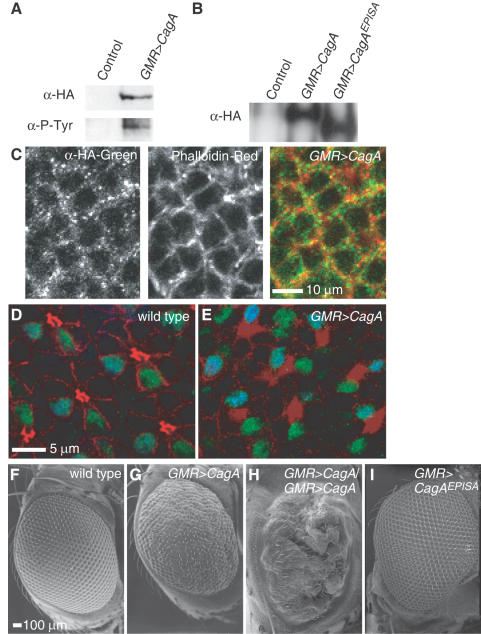
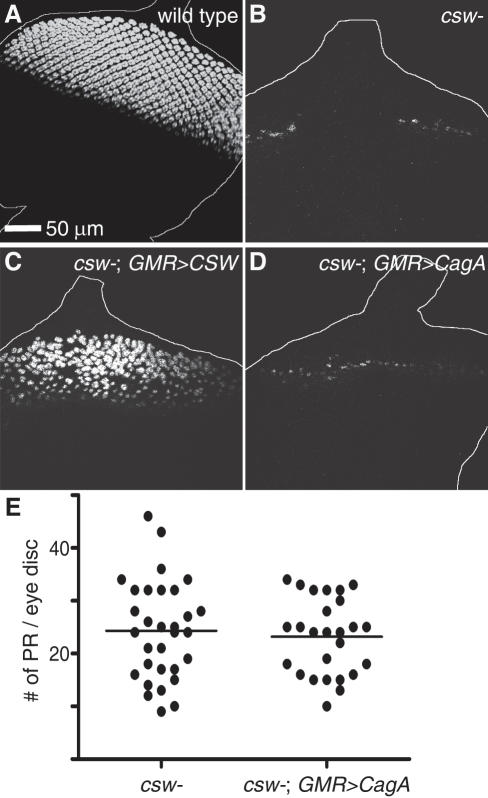
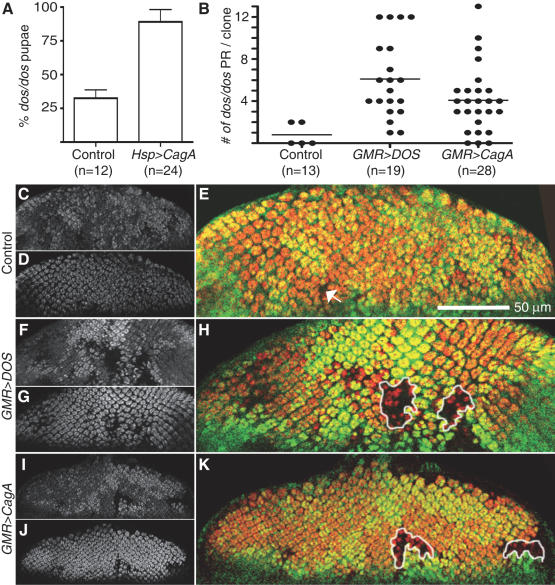
Infection with the human gastric pathogen Helicobacter pylori is associated with a spectrum of diseases including gastritis, peptic ulcers, gastric adenocarcinoma, and gastric mucosa-associated lymphoid tissue lymphoma. The cytotoxin-associated gene A (CagA) protein of H. pylori, which is translocated into host cells via a type IV secretion system, is a major risk factor for disease development. Experiments in gastric tissue culture cells have shown that once translocated, CagA activates the phosphatase SHP-2, which is a component of receptor tyrosine kinase (RTK) pathways whose over-activation is associated with cancer formation. Based on CagA's ability to activate SHP-2, it has been proposed that CagA functions as a prokaryotic mimic of the eukaryotic Grb2-associated binder (Gab) adaptor protein, which normally activates SHP-2. We have developed a transgenic Drosophila model to test this hypothesis by investigating whether CagA can function in a well-characterized Gab-dependent process: the specification of photoreceptors cells in the Drosophila eye. We demonstrate that CagA expression is sufficient to rescue photoreceptor development in the absence of the Drosophila Gab homologue, Daughter of Sevenless (DOS). Furthermore, CagA's ability to promote photoreceptor development requires the SHP-2 phosphatase Corkscrew (CSW). These results provide the first demonstration that CagA functions as a Gab protein within the tissue of an organism and provide insight into CagA's oncogenic potential. Since many translocated bacterial proteins target highly conserved eukaryotic cellular processes, such as the RTK signaling pathway, the transgenic Drosophila model should be of general use for testing the in vivo function of bacterial effector proteins and for identifying the host genes through which they function.
人类胃部病原体幽门螺杆菌感染与一系列疾病相关,包括胃炎、消化性溃疡、胃腺癌和胃黏膜相关淋巴组织淋巴瘤。幽门螺杆菌的细胞毒素相关基因A(CagA)蛋白通过IV型分泌系统转运到宿主细胞中,是疾病发展的主要危险因素。胃组织培养细胞实验表明,一旦转运,CagA就会激活磷酸酶SHP-2,SHP-2是受体酪氨酸激酶(RTK)途径的一个组成部分,其过度激活与癌症形成有关。基于CagA激活SHP-2的能力,有人提出CagA起到真核生物Grb2相关结合蛋白(Gab)衔接蛋白的原核模拟物的作用,Gab通常激活SHP-2。我们开发了一种转基因果蝇模型,通过研究CagA是否能在一个特征明确的Gab依赖过程中发挥作用来检验这一假设:果蝇眼睛中光感受器细胞的特化。我们证明,在没有果蝇Gab同源物Sevenless之女(DOS)的情况下,CagA的表达足以挽救光感受器的发育。此外,CagA促进光感受器发育的能力需要SHP-2磷酸酶Corkscrew(CSW)。这些结果首次证明CagA在生物体组织内起到Gab蛋白的作用,并深入了解了CagA的致癌潜力。由于许多转运的细菌蛋白靶向高度保守的真核细胞过程,如RTK信号通路,转基因果蝇模型应该普遍用于测试细菌效应蛋白的体内功能以及识别它们发挥作用所通过的宿主基因。