Institute of Molecular Biology, University of Oregon, Eugene OR, USA.
Front Cell Infect Microbiol. 2012 Mar 13;2:24. doi: 10.3389/fcimb.2012.00024. eCollection 2012.
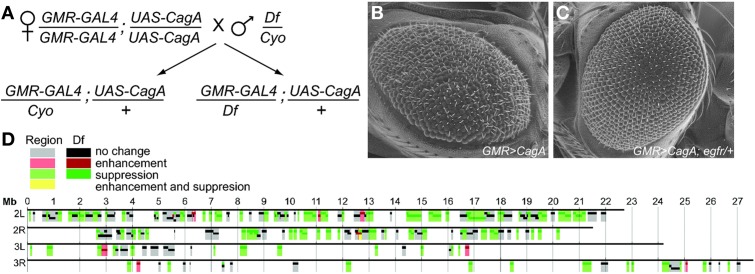
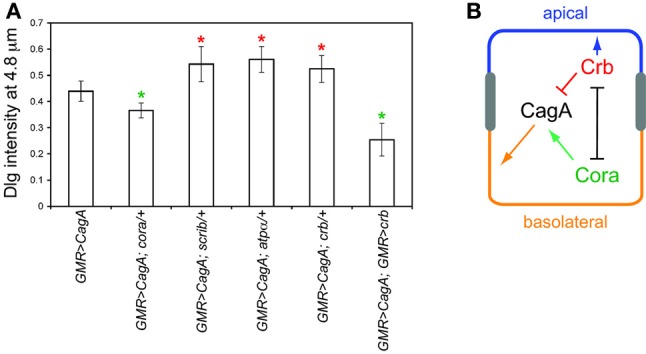
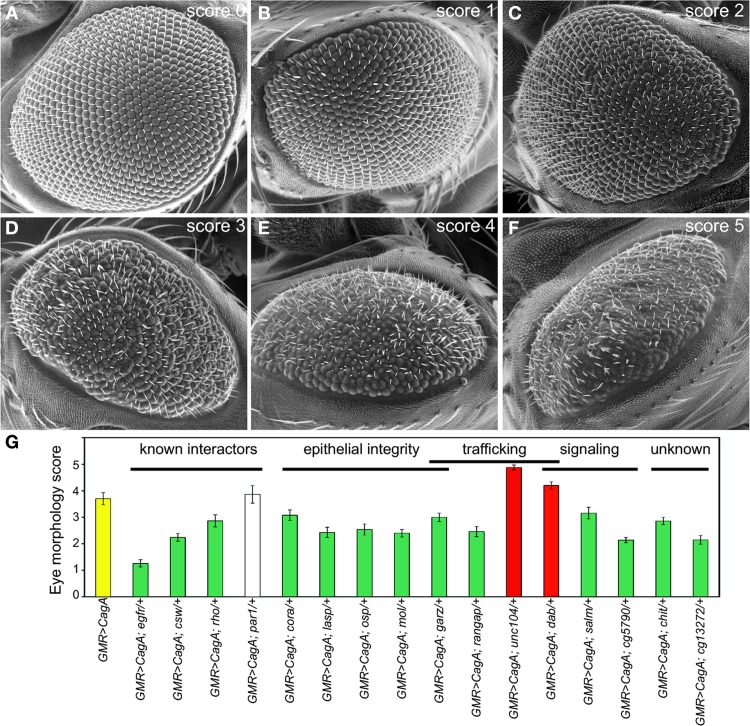
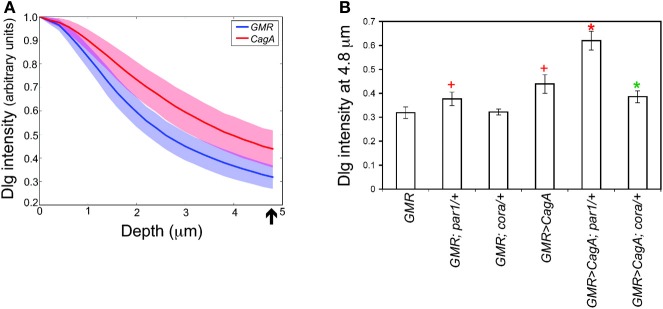
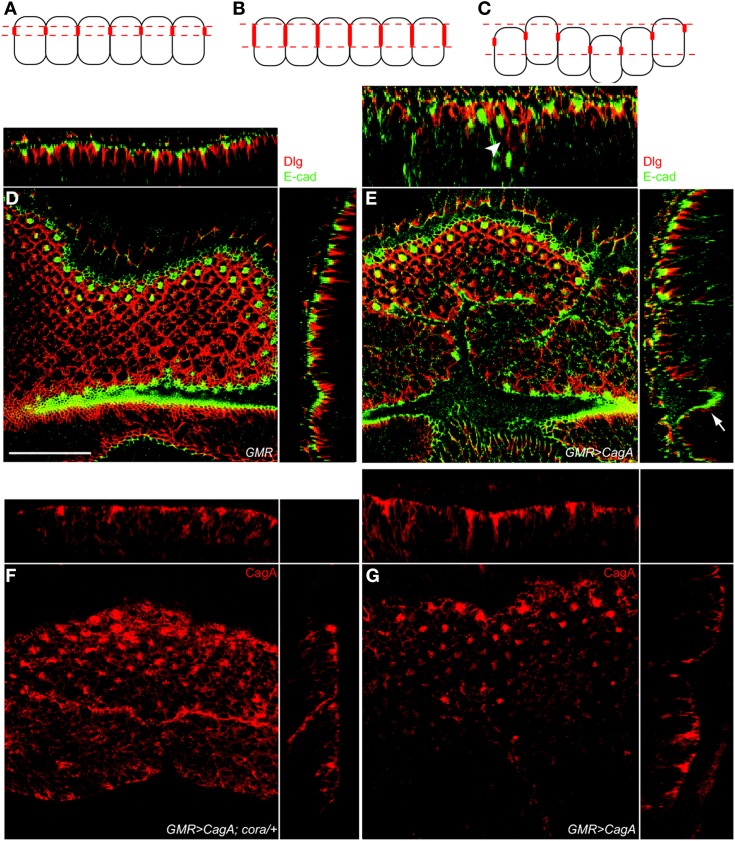
Helicobacter pylori strains containing the CagA protein are associated with high risk of gastric diseases including atrophic gastritis, peptic ulcers, and gastric cancer. CagA is injected into host cells via a Type IV secretion system where it activates growth factor-like signaling, disrupts cell-cell junctions, and perturbs host cell polarity. Using a transgenic Drosophila model, we have shown that CagA expression disrupts the morphogenesis of epithelial tissues such as the adult eye. Here we describe a genetic screen to identify modifiers of CagA-induced eye defects. We determined that reducing the copy number of genes encoding components of signaling pathways known to be targeted by CagA, such as the epidermal growth factor receptor (EGFR), modified the CagA-induced eye phenotypes. In our screen of just over half the Drosophila genome, we discovered 12 genes that either suppressed or enhanced CagA's disruption of the eye epithelium. Included in this list are genes involved in epithelial integrity, intracellular trafficking, and signal transduction. We investigated the mechanism of one suppressor, encoding the epithelial polarity determinant and junction protein Coracle, which is homologous to the mammalian Protein 4.1. We found that loss of a single copy of coracle improved the organization and integrity of larval retinal epithelia expressing CagA, but did not alter CagA's localization to cell junctions. Loss of a single copy of the coracle antagonist crumbs enhanced CagA-associated disruption of the larval retinal epithelium, whereas overexpression of crumbs suppressed this phenotype. Collectively, these results point to new cellular pathways whose disruption by CagA are likely to contribute to H. pylori-associated disease pathology.
含有 CagA 蛋白的幽门螺杆菌菌株与包括萎缩性胃炎、消化性溃疡和胃癌在内的高风险胃部疾病相关。CagA 通过 IV 型分泌系统注入宿主细胞,在那里它激活生长因子样信号,破坏细胞-细胞连接,并扰乱宿主细胞极性。使用转基因果蝇模型,我们已经表明 CagA 的表达会破坏上皮组织的形态发生,如成年眼睛。在这里,我们描述了一个遗传筛选,以鉴定 CagA 诱导的眼部缺陷的修饰因子。我们确定,降低编码 CagA 靶向的信号通路成分(如表皮生长因子受体 (EGFR))的基因的拷贝数,修饰了 CagA 诱导的眼部表型。在我们对半基因组的筛选中,我们发现了 12 个基因,它们要么抑制要么增强了 CagA 对眼上皮的破坏。其中包括涉及上皮完整性、细胞内运输和信号转导的基因。我们研究了一个抑制因子的机制,该基因编码上皮极性决定因子和连接蛋白 Coracle,它与哺乳动物的 Protein 4.1 同源。我们发现,单个拷贝的 coracle 的缺失改善了表达 CagA 的幼虫视网膜上皮的组织和完整性,但不改变 CagA 与细胞连接的定位。单个拷贝的 coracle 拮抗剂crumbs 的缺失增强了 CagA 相关的幼虫视网膜上皮破坏,而 crumbs 的过表达抑制了这种表型。总之,这些结果指向新的细胞途径,其被 CagA 破坏可能有助于幽门螺杆菌相关疾病的发病机制。