Trenell Michael I, Hollingsworth Kieren G, Lim Ee Lin, Taylor Roy
Diabetes Research Group, Institute of Cellular Medicine, Newcastle University, Newcastle upon Tyne, UK.
Diabetes Care. 2008 Aug;31(8):1644-9. doi: 10.2337/dc08-0303. Epub 2008 May 16.
To determine whether increased daily physical activity improves mitochondrial function and/or lipid oxidation in type 2 diabetes.
Volunteers with (n = 10) and without (n = 10) type 2 diabetes were matched for habitual physical activity, age, sex, and weight. Basal and maximal mitochondrial activity, physical activity, and resting substrate oxidation were measured at baseline and after 2 and 8 weeks of increased physical activity.
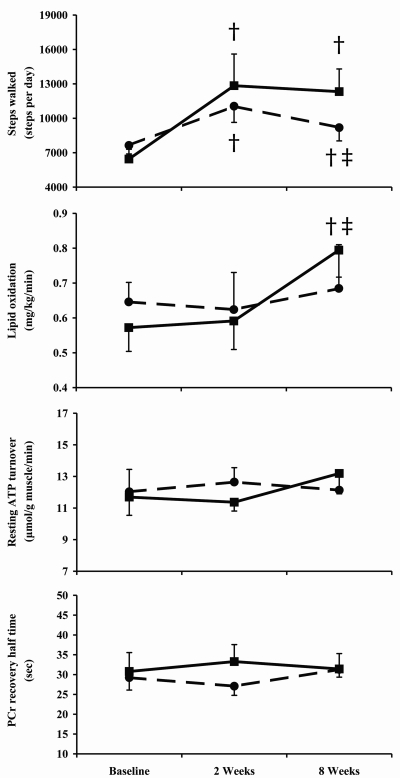
Baseline physical activity (6,450 +/- 851 vs. 7,638 +/- 741 steps/day), basal ATP use (12 +/- 1 vs. 12 +/- 1 micromol x ml(-1) x min(-1)), phosphocreatine recovery from exercise (31 +/- 5 vs. 29 +/- 3 s), and basal lipid oxidation (0.57 +/- 0.07 vs. 0.65 +/- 0.06 mg x kg body wt(-1) x min(-1)) were similar in people with and without type 2 diabetes. There was a significant increase in physical activity after 8 weeks (12,322 +/- 1,979 vs. 9,187 +/- 1,159 steps/day, respectively). Following increased physical activity, there were no changes in basal ATP use or phosphocreatine recovery after exercise in either group. Basal lipid oxidation increased after 8 weeks of increased physical activity in people with type 2 diabetes (0.79 +/- 0.08 mg x kg(-1) x min(-1)) but not people without (0.68 +/- 0.13 mg x kg body wt(-1) x min(-1)).
Resting and maximal ATP turnover are not impaired in people with well-controlled type 2 diabetes compared with control subjects matched for physical activity as well as age and weight. Increased unsupervised daily physical activity is sustainable and improves lipid oxidation independent of change in mitochondrial activity in people with type 2 diabetes.
确定增加日常身体活动是否能改善2型糖尿病患者的线粒体功能和/或脂质氧化。
将患有2型糖尿病(n = 10)和未患2型糖尿病(n = 10)的志愿者按照日常身体活动、年龄、性别和体重进行匹配。在基线以及身体活动增加2周和8周后,测量基础和最大线粒体活性、身体活动以及静息底物氧化情况。
2型糖尿病患者与非2型糖尿病患者的基线身体活动量(分别为6450±851步/天和7638±741步/天)、基础ATP使用量(分别为12±1与12±1微摩尔·毫升⁻¹·分钟⁻¹)、运动后磷酸肌酸恢复情况(分别为31±5秒与29±3秒)以及基础脂质氧化(分别为0.57±0.07与0.65±0.06毫克·千克体重⁻¹·分钟⁻¹)相似。8周后身体活动量显著增加(分别为12322±1979步/天和9187±1159步/天)。身体活动增加后,两组运动后的基础ATP使用量或磷酸肌酸恢复情况均无变化。2型糖尿病患者在身体活动增加8周后基础脂质氧化增加(0.79±0.08毫克·千克⁻¹·分钟⁻¹),而非2型糖尿病患者未增加(0.68±0.13毫克·千克体重⁻¹·分钟⁻¹)。
与在身体活动、年龄和体重方面相匹配的对照受试者相比,血糖控制良好的2型糖尿病患者的静息和最大ATP周转率未受损。增加无监督的日常身体活动是可持续的,并且能改善2型糖尿病患者的脂质氧化,而与线粒体活性的变化无关。