Fourlanos Spiros, Varney Michael D, Tait Brian D, Morahan Grant, Honeyman Margo C, Colman Peter G, Harrison Leonard C
Autoimmunity and Transplantation Division, The Walter and Eliza Hall Institute of Medical Research, Parkville, Victoria, Australia.
Diabetes Care. 2008 Aug;31(8):1546-9. doi: 10.2337/dc08-0239. Epub 2008 May 16.
The rising incidence of type 1 diabetes has been attributed to environment, implying a lesser role for genetic susceptibility. However, the rise could be accounted for by either more cases with classic high-risk genes or by cases with other risk genes. Separately, for any degree of genetic susceptibility, age at presentation may decrease in a permissive environment. To examine these possibilities, human leukocyte antigen (HLA) class II DRB1 genes known to confer risk for type 1 diabetes were analyzed in relation to year of birth and age at diagnosis over the last five decades.
Caucasoid subjects (n = 462) diagnosed with type 1 diabetes before age 18 between 1950 and 2005 were DRB1 genotyped.
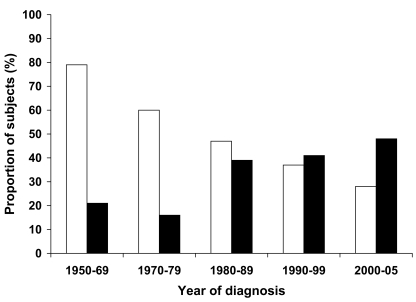
Mean +/- SD age at diagnosis, 8.5 +/- 4.5 years, did not differ across decades. Recent diagnosis was associated with a lower proportion but unchanged incidence of the highest-risk DRB1 genotype DR3,4 (2000-2005, 28% vs. 1950-1969, 79%; P < 0.0001) and a higher proportion of lower-risk genotypes DR4,X and DR3,X (2000-2005, 48% vs. 1950-1969, 20%; P = 0.0002). The frequency of the DRX,X genotype was low (<or=3%) across decades. Recent birth was associated with a lower age at diagnosis for lower risk DR3,3 and DR4,4 (P < 0.0001) and DR4,X (P < 0.0001) and DR3,X (P = 0.015) genotypes but not for DR3,4.
The rising incidence and decreasing age at diagnosis of type 1 diabetes is accounted for by the impact of environment on children with lower-risk HLA class II genes, who previously would not have developed type 1 diabetes in childhood.
1型糖尿病发病率的上升被归因于环境因素,这意味着遗传易感性的作用较小。然而,发病率的上升可能是由于携带经典高风险基因的病例增多,或者是携带其他风险基因的病例增多所致。另外,对于任何程度的遗传易感性,在宽松的环境中发病年龄可能会降低。为了研究这些可能性,我们分析了已知会导致1型糖尿病风险的人类白细胞抗原(HLA)II类DRB1基因与过去五十年来的出生年份和诊断年龄之间的关系。
对1950年至2005年间18岁之前被诊断为1型糖尿病的白种人受试者(n = 462)进行DRB1基因分型。
诊断时的平均年龄±标准差为8.5±4.5岁,在几十年间没有差异。近期诊断与最高风险的DRB1基因型DR3,4的比例较低但发病率不变相关(2000 - 2005年为28%,1950 - 1969年为79%;P < 0.0001),以及较低风险的基因型DR4,X和DR3,X的比例较高相关(2000 - 2005年为48%,1950 - 1969年为20%;P = 0.0002)。DRX,X基因型的频率在几十年间较低(≤3%)。近期出生与较低风险的DR3,3、DR4,4(P < 0.0001)、DR4,X(P < 0.0001)和DR3,X(P = 0.015)基因型的诊断年龄较低相关,但与DR3,4无关。
1型糖尿病发病率的上升和诊断年龄的降低是由于环境对携带较低风险HLA II类基因的儿童的影响,这些儿童以前在童年时期不会患1型糖尿病。