Li Pilong, Martins Ilídio R S, Amarasinghe Gaya K, Rosen Michael K
Howard Hughes Medical Institute and Department of Biochemistry, University of Texas Southwestern Medical Center, 5323 Harry Hines Boulevard, Dallas, Texas 75390-8816, USA.
Nat Struct Mol Biol. 2008 Jun;15(6):613-8. doi: 10.1038/nsmb.1428. Epub 2008 May 18.
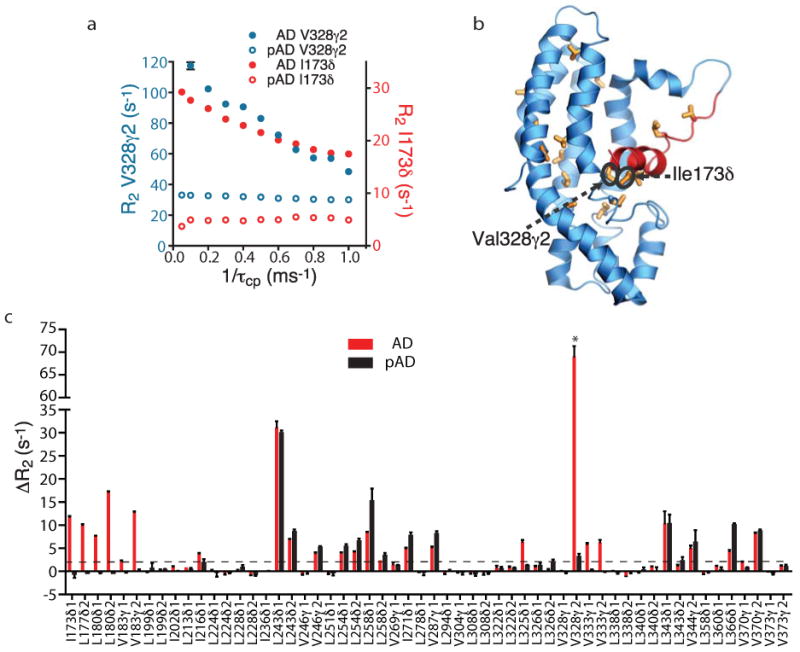
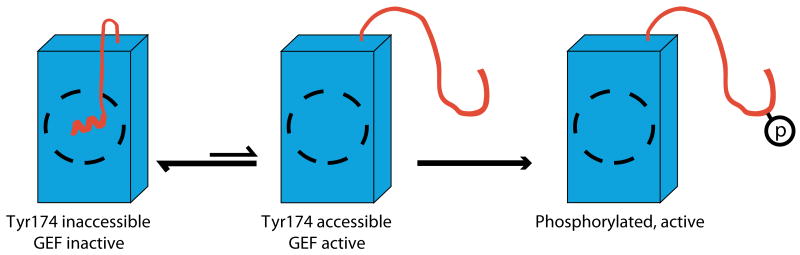
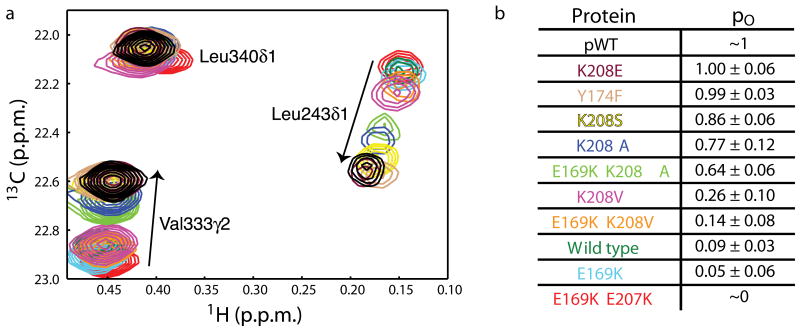
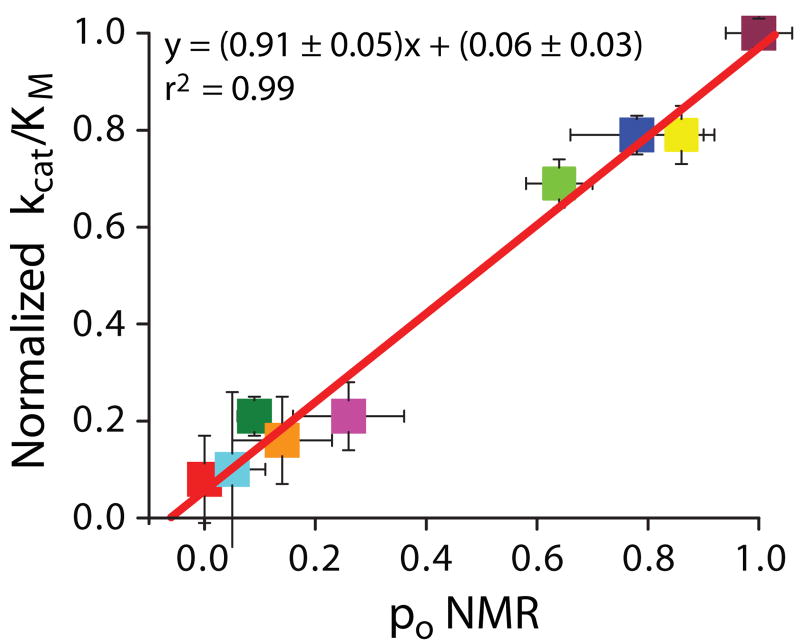
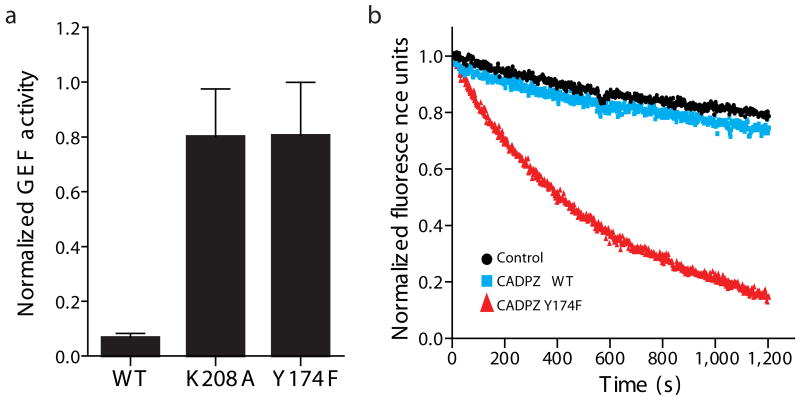
Protein motions are important to activity, but quantitative relationships between internal dynamics and function are not well understood. The Dbl homology (DH) domain of the proto-oncoprotein and guanine nucleotide exchange factor Vav1 is autoinhibited through interactions between its catalytic surface and a helix from an N-terminal acidic region. Phosphorylation of the helix relieves autoinhibition. Here we show by NMR spectroscopy that the autoinhibited DH domain exists in equilibrium between a ground state, where the active site is blocked by the inhibitory helix, and an excited state, where the helix is dissociated. Across a series of mutants that differentially sample these states, catalytic activity of the autoinhibited protein and its rate of phosphorylation are linearly dependent on the population of the excited state. Thus, internal dynamics are required for and control both basal activity and the rate of full activation of the autoinhibited DH domain.
蛋白质运动对活性很重要,但内部动力学与功能之间的定量关系尚未得到很好的理解。原癌蛋白和鸟嘌呤核苷酸交换因子Vav1的Dbl同源(DH)结构域通过其催化表面与来自N端酸性区域的螺旋之间的相互作用而被自身抑制。该螺旋的磷酸化可解除自身抑制。在这里,我们通过核磁共振光谱表明,自身抑制的DH结构域存在于基态(活性位点被抑制性螺旋阻断)和激发态(螺旋解离)之间的平衡中。在一系列不同程度采样这些状态的突变体中,自身抑制蛋白的催化活性及其磷酸化速率与激发态的丰度呈线性相关。因此,内部动力学对于自身抑制的DH结构域的基础活性和完全激活速率都是必需的,并且对其具有控制作用。