Ovanesov Mikhail V, Moldovan Krisztina, Smith Kimberly, Vogel Michael W, Pletnikov Mikhail V
Department of Psychiatry and Behavioral Sciences, Johns Hopkins University School of Medicine, Baltimore, MD, USA.
J Neuroinflammation. 2008 May 19;5:16. doi: 10.1186/1742-2094-5-16.
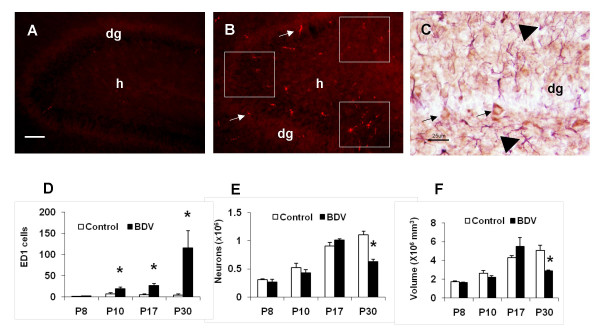
Neonatal Borna Disease Virus (BDV) infection in rats leads to a neuronal loss in the cortex, hippocampus and cerebellum. Since BDV is a non-lytic infection in vitro, it has been suggested that activated microglia could contribute to neuronal damage. It is also conceivable that BDV-induced cell death triggers activation of microglia to remove cell debris. Although an overall temporal association between neuronal loss and microgliosis has been demonstrated in BDV-infected rats, it remains unclear if microgliosis precedes or results from neuronal damage. We investigated the timing of microglia activation and neuronal elimination in the dentate gyrus (DG) of the hippocampus. We found a significant increase in the number of ED1+ microglia cells as early as 10 days post infection (dpi) while a detectable loss of granule cells of the DG was not seen until 30 dpi. The data demonstrate for the first time that a non-lytic persistent virus infection of neurons activates microglia long before any measurable neuronal loss.
新生大鼠感染博尔纳病病毒(BDV)会导致皮质、海马体和小脑中的神经元丢失。由于BDV在体外是非溶细胞性感染,有人提出活化的小胶质细胞可能导致神经元损伤。也可以想象,BDV诱导的细胞死亡会触发小胶质细胞的活化以清除细胞碎片。尽管在感染BDV的大鼠中已证明神经元丢失与小胶质细胞增生之间存在总体时间关联,但尚不清楚小胶质细胞增生是先于神经元损伤还是由神经元损伤导致。我们研究了海马齿状回(DG)中小胶质细胞活化和神经元清除的时间。我们发现,早在感染后10天(dpi),ED1+小胶质细胞的数量就显著增加,而直到30 dpi才观察到DG颗粒细胞有可检测到的丢失。数据首次证明,神经元的非溶细胞性持续性病毒感染早在任何可测量的神经元丢失之前就激活了小胶质细胞。