Department of Neurobiology, Weizmann Institute of Science Rehovot, Israel.
Front Cell Neurosci. 2013 Apr 8;7:34. doi: 10.3389/fncel.2013.00034. eCollection 2013.
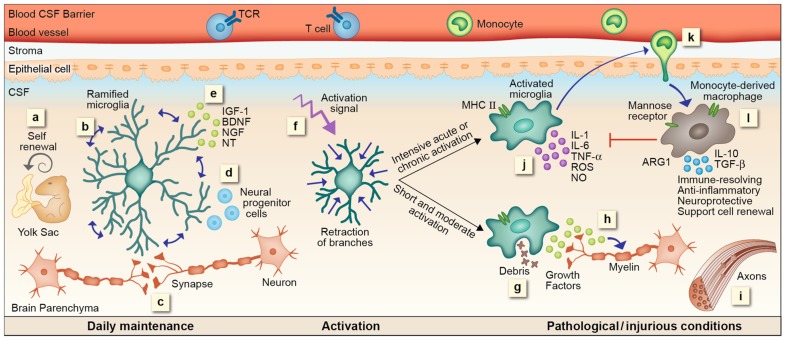
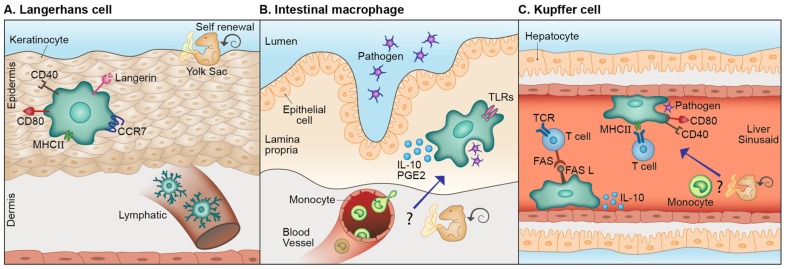
Functional macrophage heterogeneity is recognized outside the central nervous system (CNS), where alternatively activated macrophages can perform immune-resolving functions. Such functional heterogeneity was largely ignored in the CNS, with respect to the resident microglia and the myeloid-derived cells recruited from the blood following injury or disease, previously defined as blood-derived microglia; both were indistinguishably perceived detrimental. Our studies have led us to view the myeloid-derived infiltrating cells as functionally distinct from the resident microglia, and accordingly, to name them monocyte-derived macrophages (mo-MΦ). Although microglia perform various maintenance and protective roles, under certain conditions when they can no longer provide protection, mo-MΦ are recruited to the damaged CNS; there, they act not as microglial replacements but rather assistant cells, providing activities that cannot be timely performed by the resident cells. Here, we focus on the functional heterogeneity of microglia/mo-MΦ, emphasizing that, as opposed to the mo-MΦ, microglia often fail to timely acquire the phenotype essential for CNS repair.
功能性巨噬细胞异质性在中枢神经系统(CNS)之外得到认可,在那里,替代激活的巨噬细胞可以发挥免疫调节功能。与驻留的小胶质细胞和损伤或疾病后从血液募集的髓系来源细胞(以前定义为血源性小胶质细胞)相比,这种功能异质性在 CNS 中基本被忽视,两者都被认为是有害的。我们的研究使我们认为髓系来源的浸润细胞在功能上与驻留的小胶质细胞不同,并相应地将其命名为单核细胞衍生的巨噬细胞(mo-MΦ)。尽管小胶质细胞具有各种维持和保护作用,但在某些情况下,当它们无法再提供保护时,mo-MΦ 会被招募到受损的 CNS;在那里,它们不是作为小胶质细胞的替代品,而是辅助细胞,提供驻留细胞无法及时完成的活动。在这里,我们专注于小胶质细胞/mo-MΦ 的功能异质性,强调与 mo-MΦ 相反,小胶质细胞往往不能及时获得对 CNS 修复至关重要的表型。