Waldhoer Thomas, Wald Martin, Heinzl Harald
Center of Public Health, Department of Epidemiology, Medical University of Vienna, Borschkegasse 8a, 1090 Vienna, Austria.
Int J Health Geogr. 2008 May 21;7:21. doi: 10.1186/1476-072X-7-21.
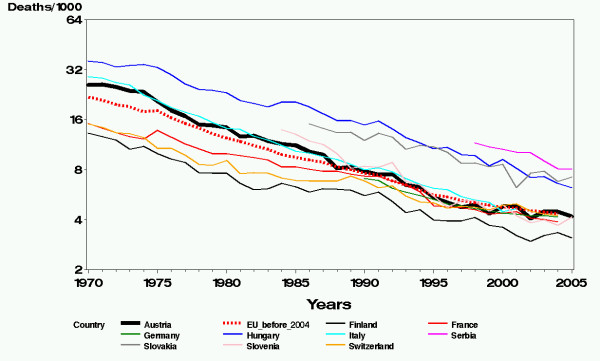
In Austria, over the last 20 years infant mortality declined from 11.2 per 1,000 life births (1985) to 4.7 per 1,000 in1997 but remained rather constant since then. In addition to this time trend we already reported a non-random spatial distribution of infant mortality rates in a recent study covering the time period 1984 to 2002. This present study includes four additional years and now covers about 1.9 million individual birth certificates. It aimes to elucidate the observed non-random spatial distribution in more detail. We split up infant mortality into six groups according to the underlying cause of death. The underlying spatial distribution of standardized mortality ratios (SMR) is estimated by univariate models as well as by two models incorporating all six groups simultaneously.
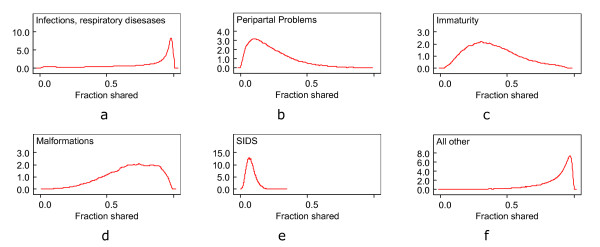
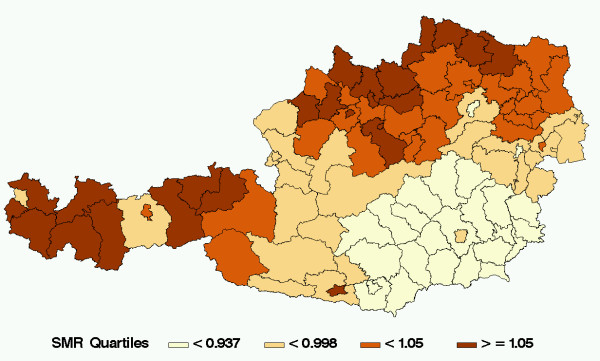
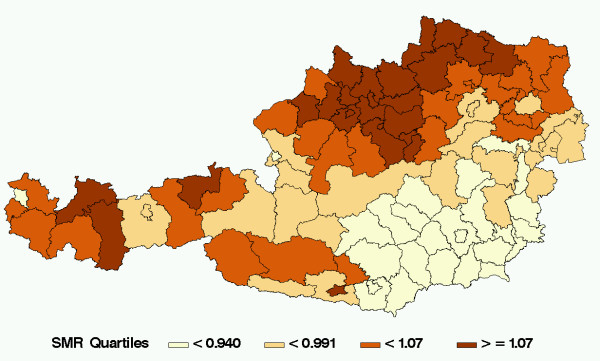
We observe strong correlations between the individual spatial patterns of SMR's except for "Sudden Infant Death Syndrome" and to some extent for "Peripartal Problems". The spatial distribution of SMR's is non-random with an area of decreased risk in the South-East of Austria. The group "Sudden Infant Death Syndrome" clearly and the group "Peripartal Problems" slightly show deviations from the common pattern. When comparing univariate and multivariate SMR estimates we observe that the resulting spatial distributions are very similar.
We observe different non-random spatial distributions of infant mortality rates when grouped by cause of death. The models applied were based on individual data thereby avoiding ecological regression bias. The estimated spatial distributions do not substantially depend on the employed estimation method. The observed non-random spatial patterns of Austrian infant mortality remain to appear ambiguous.
在奥地利,过去20年中婴儿死亡率从每1000例活产11.2例(1985年)降至1997年的每1000例4.7例,但此后一直保持相当稳定。除了这种时间趋势外,我们在最近一项涵盖1984年至2002年时间段的研究中已经报告了婴儿死亡率的非随机空间分布。本研究增加了四年的数据,现在涵盖了约190万份个人出生证明。其目的是更详细地阐明观察到的非随机空间分布。我们根据潜在死因将婴儿死亡率分为六组。标准化死亡率(SMR)的潜在空间分布通过单变量模型以及同时纳入所有六组的两个模型进行估计。
我们观察到除“婴儿猝死综合征”外,SMR的个体空间模式之间存在很强的相关性,在某种程度上“围产期问题”也是如此。SMR的空间分布是非随机的,在奥地利东南部存在一个风险降低的区域。“婴儿猝死综合征”组明显,“围产期问题”组略有偏离共同模式。比较单变量和多变量SMR估计时,我们观察到所得的空间分布非常相似。
按死因分组时,我们观察到婴儿死亡率存在不同的非随机空间分布。所应用的模型基于个体数据,从而避免了生态回归偏差。估计的空间分布在很大程度上不依赖于所采用的估计方法。奥地利婴儿死亡率观察到的非随机空间模式仍然显得模糊不清。