Waldhoer Thomas, Heinzl Harald
Department of Epidemiology, Center for Public Health, Medical University of Vienna, Vienna, Austria.
Center for Medical Statistics, Informatics, and Intelligent Systems, Medical University of Vienna, Vienna, Austria.
PLoS One. 2017 Sep 6;12(9):e0184312. doi: 10.1371/journal.pone.0184312. eCollection 2017.
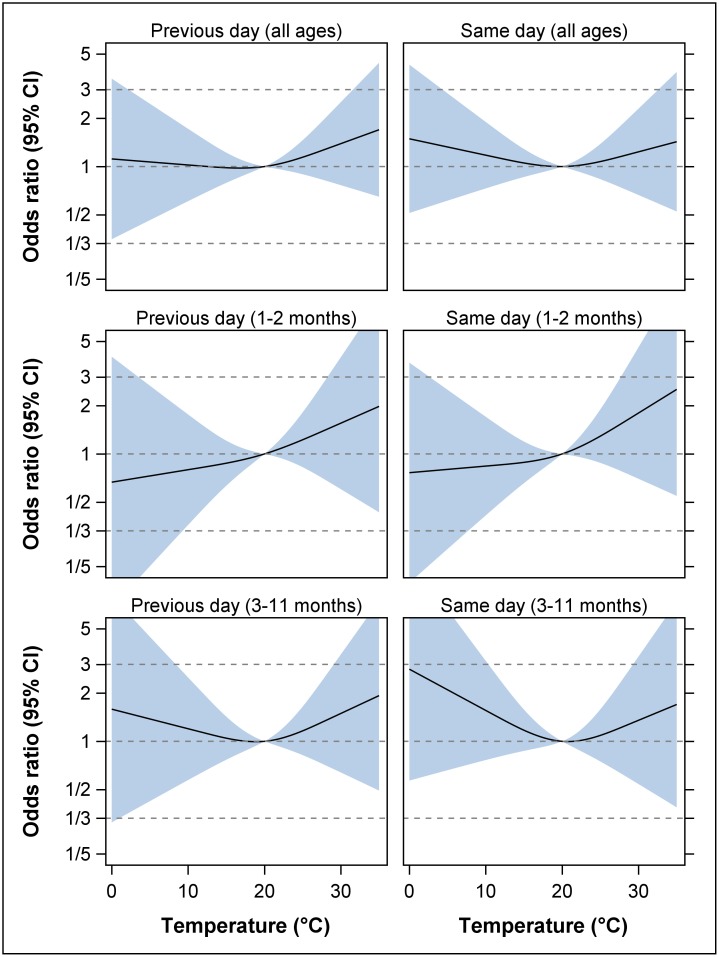
A non-linear relationship between maximum ambient temperature and number of sudden infant death syndrome (SIDS) cases had been reported for Montreal, Canada, for the warm season. In particular, high maximum ambient temperatures were found to be extra-hazardous for infants. The study was replicated with data from Vienna, Austria, applying the same statistical approach. Vienna is roughly comparable to Montreal with regard to temperatures in the warm season, size of population, and number of SIDS cases. Although the Viennese study was powerful enough to detect even smaller effects, the Montrealean results could not be confirmed. The Viennese results do not support the hypothesis of a strong effect of maximum ambient temperature on the risk of SIDS during the warm season.
据报道,在加拿大蒙特利尔的温暖季节,最高环境温度与婴儿猝死综合症(SIDS)病例数之间存在非线性关系。特别是,发现最高环境温度对婴儿具有额外的危险性。该研究采用相同的统计方法,用奥地利维也纳的数据进行了重复。在温暖季节的温度、人口规模和SIDS病例数方面,维也纳与蒙特利尔大致相当。尽管维也纳的研究有足够的能力检测到甚至更小的影响,但蒙特利尔的结果未能得到证实。维也纳的结果不支持最高环境温度对温暖季节SIDS风险有强烈影响这一假设。