Hustad Katherine C
University of Wisconsin-Madison, Madison, WI, USA.
J Speech Lang Hear Res. 2008 Jun;51(3):562-73. doi: 10.1044/1092-4388(2008/040).
This study examined the relationship between listener comprehension and intelligibility scores for speakers with mild, moderate, severe, and profound dysarthria. Relationships were examined across all speakers and their listeners when severity effects were statistically controlled, within severity groups, and within individual speakers with dysarthria.
Speech samples were collected from 12 speakers with dysarthria secondary to cerebral palsy. For each speaker, 12 different listeners completed 2 tasks (for a total of 144 listeners): One task involved making orthographic transcriptions, and 1 task involved answering comprehension questions. Transcriptions were scored for the number of words transcribed correctly. Responses to comprehension questions were scored on a 3-point scale according to their accuracy.
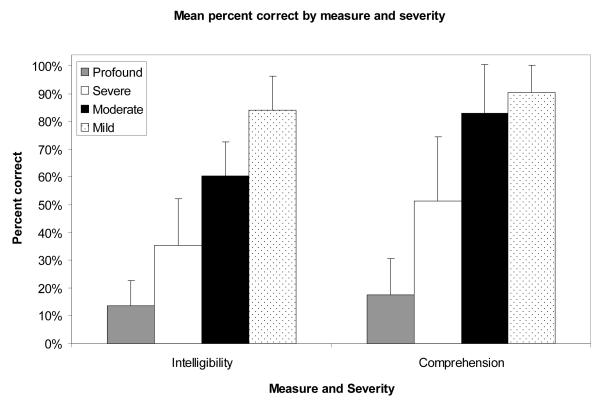
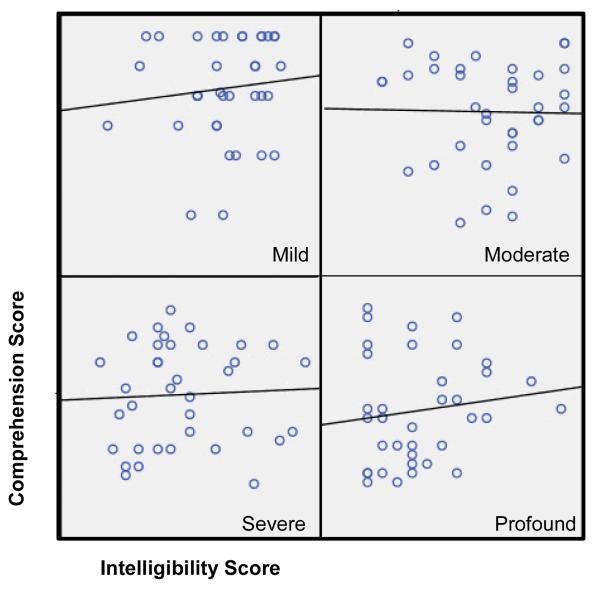
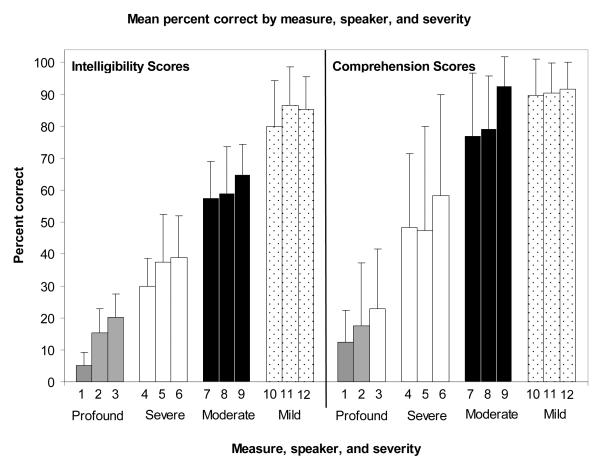
Across all speakers, the Pearson product-moment correlation between comprehension and intelligibility scores was nonsignificant when the effects of severity were factored out and residual scores were examined. Within severity groups, the same relationship was significant only for the mild group. Within individual speaker groups, the relationship was nonsignificant for all but 2 speakers with dysarthria. Percentage of correct scores for listener comprehension was descriptively higher than percentage of correct intelligibility scores for all groups.
Findings suggest that transcription intelligibility scores do not accurately reflect listener comprehension scores. Measures of both intelligibility and listener comprehension may provide a more complete description of the information-bearing capability of dysarthric speech than either measure alone.
本研究考察了轻度、中度、重度和极重度构音障碍患者的言语可懂度得分与听众理解度之间的关系。当对严重程度效应进行统计学控制时,在所有患者及其听众之间、严重程度组内以及患有构音障碍的个体患者内,对这种关系进行了考察。
从12名继发于脑瘫的构音障碍患者中收集言语样本。对于每名患者,12名不同的听众完成2项任务(共计144名听众):一项任务是进行正字法转录,另一项任务是回答理解问题。根据正确转录的单词数量对转录进行评分。根据回答理解问题的准确性,按3分制对回答进行评分。
在所有患者中,当排除严重程度效应并检查残差得分时,理解度得分与可懂度得分之间的Pearson积差相关不显著。在严重程度组内,同样的关系仅在轻度组中显著。在个体患者组内,除2名构音障碍患者外,所有患者的这种关系均不显著。在所有组中,听众理解的正确得分百分比在描述上均高于可懂度正确得分百分比。
研究结果表明,转录可懂度得分不能准确反映听众理解得分。与单独使用任何一种测量方法相比,可懂度测量和听众理解测量可能能更全面地描述构音障碍言语的信息承载能力。