Liu Zhuoqi, Shen Jing, Zhang Lian, Shen Lin, Li Qiang, Zhang Baozhen, Zhou Jing, Gu Liankun, Feng Guoshuang, Ma Junling, You Wei-Cheng, Deng Dajun
Peking University School of Oncology and Beijing Institute for Cancer Research and Beijing Cancer Hospital, Hai-Dian District, Beijing, 100036, PR China.
BMC Microbiol. 2008 May 28;8:81. doi: 10.1186/1471-2180-8-81.
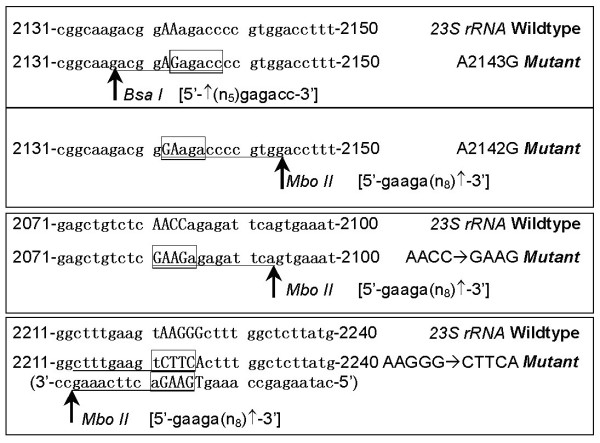
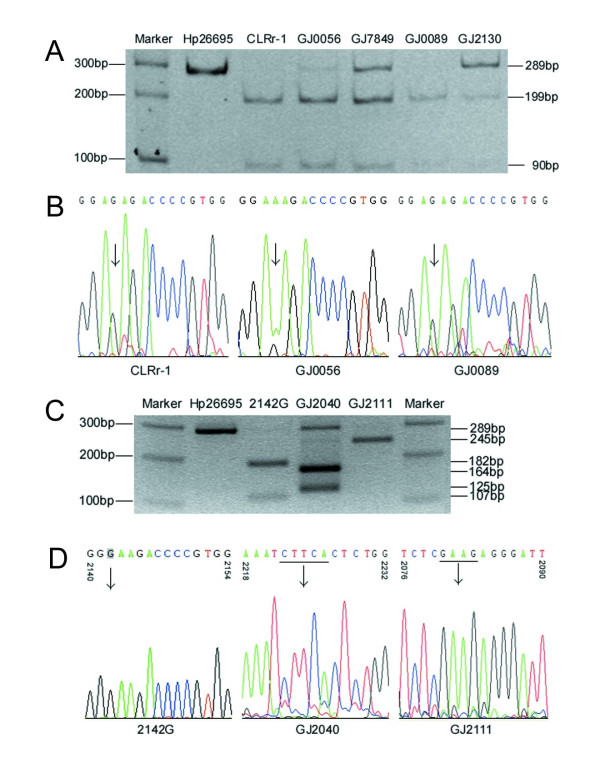
A2143G mutation of 23S rRNA gene of H. pylori results in clarithromycin (CLR) resistance. To investigate the prevalence of the CLR resistance-related A2143G mutation of the H. pylori-specific 23S rRNA gene in Chinese subjects with and without CLR use history, 307 subjects received the treatment with amoxicillin and omeprazole (OA) and 310 subjects received a placebo in 1995, and 153 subjects received a triple therapy with OA and CLR (OAC) in 2000. DNA was extracted from fasting gastric juice at the end of the intervention trial in 2003. H. pylori infection was determined by H. pylori-specific 23S rRNA PCR, ELISA, and13C-urea breath test assays. Mutations of the 23S rRNA gene were detected by RFLP assays.
The presence of 23S rRNA due to H. pylori infection in the OA group remained lower than that in the placebo group 7.3 yrs after OA-therapy [51.1% (157/307) vs. 83.9% (260/310), p = 0.0000]. In the OAC group, the 23S rRNA detection rate was 26.8% (41/153) three yrs after OAC-treatment. The A2143G mutation rate among the 23S rRNA-positive subjects in the OAC group [31.7% (13/41)] was significantly higher than that in the OA group [10.2% (16/157)] and the placebo group [13.8% (36/260)]. The frequency of the AAGGG --> CTTCA (2222-2226) and AACC --> GAAG (2081-2084) sequence alterations in the OAC group was also significantly higher than those in the OA group and the placebo group.
Primary prevalence of the A2143G mutation was 10~14% among Chinese population without history of CLR therapy. Administration of CLR to eliminate H. pylori infection increased the prevalence of the A2143G mutation in Chinese subjects (32%) significantly.
幽门螺杆菌23S rRNA基因的A2143G突变导致对克拉霉素(CLR)耐药。为调查在中国有或无CLR使用史的受试者中,幽门螺杆菌特异性23S rRNA基因与CLR耐药相关的A2143G突变的流行情况,1995年307名受试者接受阿莫西林和奥美拉唑(OA)治疗,310名受试者接受安慰剂治疗,2000年153名受试者接受OA和CLR的三联疗法(OAC)。2003年干预试验结束时,从空腹胃液中提取DNA。通过幽门螺杆菌特异性23S rRNA PCR、ELISA和13C-尿素呼气试验检测幽门螺杆菌感染。通过限制性片段长度多态性分析检测23S rRNA基因的突变。
OA治疗7.3年后,OA组因幽门螺杆菌感染导致的23S rRNA存在率仍低于安慰剂组[51.1%(157/307)对83.9%(260/310),p = 0.0000]。在OAC组,OAC治疗3年后23S rRNA检测率为26.8%(41/153)。OAC组23S rRNA阳性受试者中的A2143G突变率[31.7%(13/41)]显著高于OA组[10.2%(16/157)]和安慰剂组[13.8%(36/260)]。OAC组中AAGGG --> CTTCA(2222 - 2226)和AACC --> GAAG(2081 - 2084)序列改变的频率也显著高于OA组和安慰剂组。
在中国无CLR治疗史的人群中,A2143G突变的原发性流行率为10% - 14%。使用CLR消除幽门螺杆菌感染显著增加了中国受试者中A2143G突变的流行率(32%)。