He Ping-an, Nie Zuoming, Chen Jianqing, Chen Jian, Lv Zhengbing, Sheng Qing, Zhou Songping, Gao Xiaolian, Kong Lingyin, Wu Xiangfu, Jin Yongfeng, Zhang Yaozhou
Institute of Biochemistry, Zhejiang Sci-Tech University, Hangzhou 310018, PR China.
BMC Genomics. 2008 May 28;9:248. doi: 10.1186/1471-2164-9-248.
MicroRNAs (miRNAs) are small RNA molecules that regulate gene expression by targeting messenger RNAs (mRNAs) and causing mRNA cleavage or translation blockage. Of the 355 Arthropod miRNAs that have been identified, only 21 are B. mori miRNAs that were predicted computationally; of these, only let-7 has been confirmed by Northern blotting.
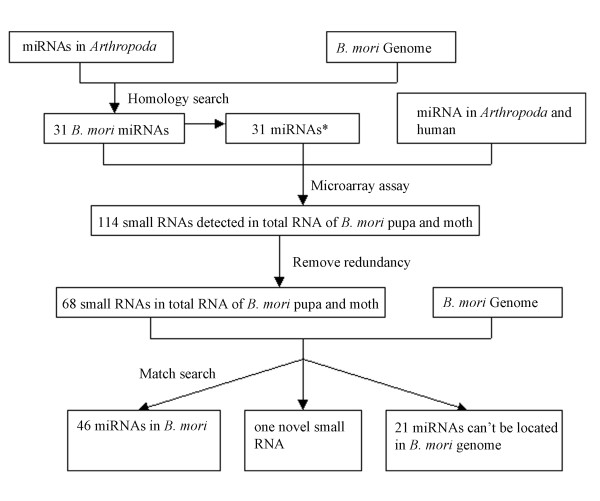
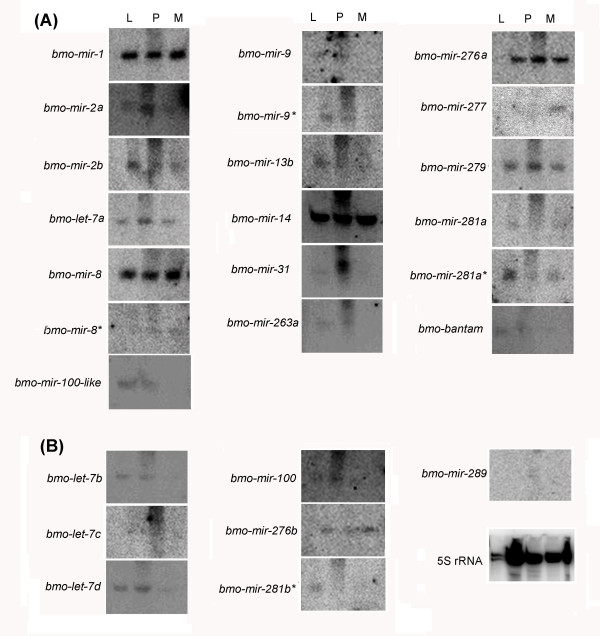
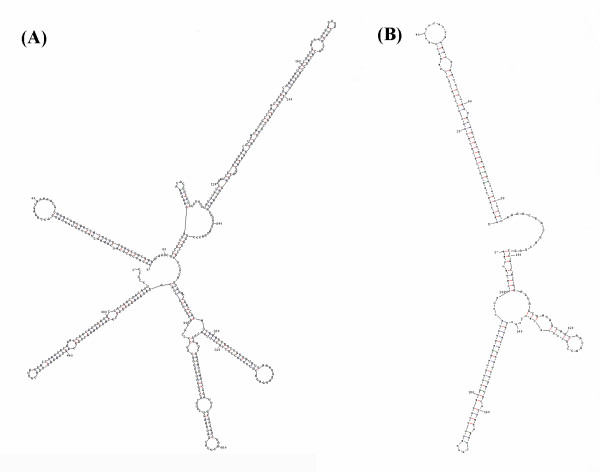
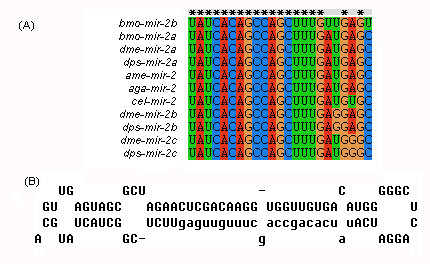
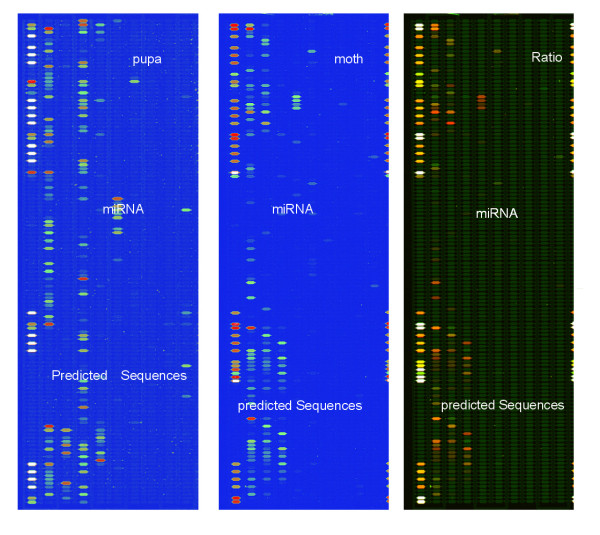
Combining a computational method based on sequence homology searches with experimental identification based on microarray assays and Northern blotting, we identified 46 miRNAs, an additional 21 plausible miRNAs, and a novel small RNA in B. mori. The latter, bmo-miR-100-like, was identified using the known miRNA aga-miR-100 as a probe; bmo-miR-100-like was detected by microarray assay and Northern blotting, but its precursor sequences did not fold into a hairpin structure. Among these identified miRNAs, we found 12 pairs of miRNAs and miRNAs. Northern blotting revealed that some B. mori miRNA genes were expressed only during specific stages, indicating that B. mori miRNA genes (e.g., bmo-miR-277) have developmentally regulated patterns of expression. We identified two miRNA gene clusters in the B. mori genome. bmo-miR-2b, which is found in the gene cluster bmo-miR-2a-1/bmo-miR-2a-1/bmo-miR-2a-2/bmo-miR-2b/bmo-miR-13a*/bmo-miR-13b, encodes a newly identified member of the mir-2 family. Moreover, we found that methylation can increase the sensitivity of a DNA probe used to detect a miRNA by Northern blotting. Functional analysis revealed that 11 miRNAs may regulate 13 B. mori orthologs of the 25 known Drosophila miRNA-targeted genes according to the functional conservation. We predicted the binding sites on the 1671 3'UTR of B. mori genes; 547 targeted genes, including 986 target sites, were predicted. Of these target sites, 338 had perfect base pairing to the seed region of 43 miRNAs. From the predicted genes, 61 genes, each of them with multiple predicted target sites, should be considered excellent candidates for future functional studies. Biological classification of predicted miRNA targets showed that "binding", "catalytic activity" and "physiological process" were over-represented for the predicted genes.
Combining computational predictions with microarray assays, we identified 46 B. mori miRNAs, 13 of which were miRNA*s. We identified a novel small RNA and 21 plausible B. mori miRNAs that could not be located in the available B. mori genome, but which could be detected by microarray. Thirteen and 547 target genes were predicted according to the functional conservation and binding sites, respectively. Identification of miRNAs in B. mori, particularly those that are developmentally regulated, provides a foundation for subsequent functional studies.
微小RNA(miRNA)是一类小RNA分子,通过靶向信使RNA(mRNA)并导致mRNA切割或翻译阻滞来调控基因表达。在已鉴定出的355种节肢动物miRNA中,只有21种是通过计算预测得到的家蚕miRNA;其中,只有let-7已通过Northern印迹法得到证实。
我们将基于序列同源性搜索的计算方法与基于微阵列分析和Northern印迹法的实验鉴定相结合,在家蚕中鉴定出46种miRNA、另外21种可能的miRNA以及一种新型小RNA。后者bmo-miR-100-like是使用已知的miRNA aga-miR-100作为探针鉴定出来的;bmo-miR-100-like通过微阵列分析和Northern印迹法检测到,但其前体序列未折叠成发夹结构。在这些鉴定出的miRNA中,我们发现了12对miRNA和miRNA*。Northern印迹法显示,一些家蚕miRNA基因仅在特定阶段表达,这表明家蚕miRNA基因(如bmo-miR-277)具有发育调控的表达模式。我们在家蚕基因组中鉴定出两个miRNA基因簇。在基因簇bmo-miR-2a-1/bmo-miR-2a-1*/bmo-miR-2a-2/bmo-miR-2b/bmo-miR-13a*/bmo-miR-13b中发现的bmo-miR-2b编码了mir-2家族的一个新鉴定成员。此外,我们发现甲基化可以提高用于Northern印迹法检测miRNA的DNA探针的灵敏度。功能分析表明,根据功能保守性,11种miRNA可能调控25个已知果蝇miRNA靶向基因中的13个家蚕直系同源基因;我们预测了家蚕基因1671个3'UTR上的结合位点;预测出547个靶向基因,包括986个靶位点。在这些靶位点中,338个与43种miRNA的种子区域具有完美碱基配对。从预测基因中,61个基因各自具有多个预测靶位点,应被视为未来功能研究的优秀候选基因。预测的miRNA靶标的生物学分类表明,预测基因在“结合”、“催化活性”和“生理过程”方面过度富集。
将计算预测与微阵列分析相结合,我们鉴定出46种家蚕miRNA,其中13种是miRNA*。我们鉴定出一种新型小RNA和21种可能存在但在现有的家蚕基因组中未定位到的家蚕miRNA,不过它们可通过微阵列检测到。分别根据功能保守性和结合位点预测出13个和547个靶基因。家蚕miRNA的鉴定,特别是那些受发育调控的miRNA,为后续功能研究奠定了基础。