Casajuana Josep, Iglesias Begoña, Fàbregas Mireia, Fina Francesc, Vallès Joan-Antoni, Aragonès Rosa, Benítez Mència, Zabaleta Edurne
EAP Gòtic, Institut Català de la Salut, Passatge de la Pau 1, 08001 Barcelona, Spain.
BMC Blood Disord. 2008 May 29;8:1. doi: 10.1186/1471-2326-8-1.
Influenza vaccines are recommended for administration by the intramuscular route. However, many physicians use the subcutaneous route for patients receiving an oral anticoagulant because this route is thought to induce fewer hemorrhagic side effects. Our aim is to assess the safety of intramuscular administration of influenza vaccine in patients on oral anticoagulation therapy.
Randomised, controlled, single blinded, multi-centre clinical trial.
4 primary care practices in Barcelona, Spain.
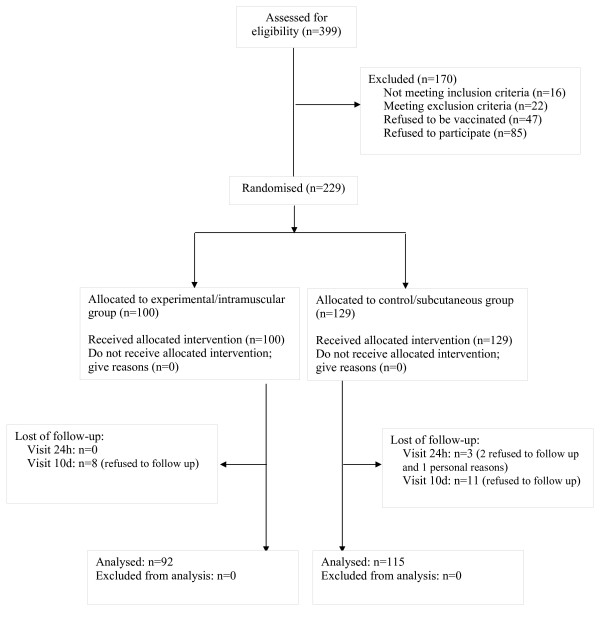
229 patients on oral anticoagulation therapy eligible for influenza vaccine during the 2003-2004 season.
intramuscular administration of influenza vaccine in the experimental group (129 patients) compared to subcutaneous administration in the control group (100 patients).
change in the circumference of the arm at the site of injection at 24 hours.
appearance of local reactions and pain at 24 hours and at 10 days; change in INR (International Normalized Ratio) at 24 hours and at 10 days. Analysis was by intention to treat using the 95% confidence intervals of the proportions or mean differences.
Baseline variables in the two groups were similar. No major side effects or major haemorrhage during the follow-up period were reported. No significant differences were observed in the primary outcome between the two groups. The appearance of local adverse reactions was more frequent in the subcutaneous administration group (37,4% vs. 17,4%, 95% confidence interval of the difference 8,2% to 31,8%).
This study shows that the intramuscular administration route of influenza vaccine in patients on anticoagulant therapy does not have more side effects than the subcutaneous administration route.
NCT00137579 at clinicaltrials.gov.
流感疫苗推荐通过肌肉注射途径给药。然而,许多医生对接受口服抗凝剂治疗的患者采用皮下注射途径,因为认为该途径引起的出血副作用较少。我们的目的是评估口服抗凝治疗患者肌肉注射流感疫苗的安全性。
随机、对照、单盲、多中心临床试验。
西班牙巴塞罗那的4家初级保健机构。
229名在2003 - 2004季节有资格接种流感疫苗的口服抗凝治疗患者。
试验组(129名患者)肌肉注射流感疫苗,对照组(100名患者)皮下注射流感疫苗。
注射后24小时注射部位手臂周长的变化。
24小时和10天时局部反应和疼痛的出现情况;24小时和10天时国际标准化比值(INR)的变化。采用意向性分析,使用比例或均值差异的95%置信区间。
两组的基线变量相似。随访期间未报告重大副作用或大出血情况。两组在主要结局方面未观察到显著差异。皮下注射组局部不良反应的出现更为频繁(37.4%对17.4%,差异的95%置信区间为8.2%至31.8%)。
本研究表明,抗凝治疗患者肌肉注射流感疫苗的途径与皮下注射途径相比,副作用并不更多。
clinicaltrials.gov上的NCT00137579 。